elders

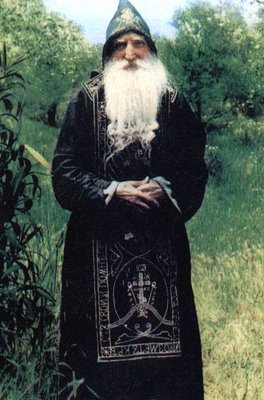
A starets … is an elder of an Eastern Orthodox or Eastern Catholic monastery or convent who functions as venerated adviser and teacher. Elders or spiritual fathers are charismatic spiritual leaders whose wisdom stems from God as obtained from ascetic experience. … Elders are not appointed by any authority; they are simply recognized by the faithful as being people “of the Spirit”. An elder, when not in prayer or in voluntary seclusion, receives visitors (some who travel very far) and spends time conversing with them, offering a blessing (if the elder is an ordained cleric) and confession, and praying. People often petition the elder for intercessionary prayers, believing that the prayer of an elder is particularly effective.

Starets

To this there is a simple answer. The spiritual father or starets is essentially a ‘charismatic’ and prophetic figure, accredited for his task by the direct action of the Holy Spirit. He is ordained, not by the hand of man, but by the hand of God. He is an expression of the Church as “event” or “happening”, rather than of the Church as institution.

The Spiritual Father in Orthodox Christianity

Certainty

What is the biggest challenge you will face in the next six months?

The biggest challenge is “where to from here?”. I have hit a sweet spot when it comes to my daily life – good rhythm, right interaction. I think I have found a paradigm for me in history and there is peace.

But there is never certainty. The very fact that I look for control is part of the current struggle. The desire for external consultation is the struggle.

To put it a different way: what does it mean for me that my relationship with Jesus is absolute?

Even so, come Lord Jesus.

absolute relationship

Humanity has lost meaning because the accepted criterion of reality and truth is ambiguous and subjective thought—that which cannot be proven with logic, historical research, or scientific analysis. Humans cannot think out choices in life, we must live them; and even those choices that we often think about become different once life itself enters into the picture. For Kierkegaard, the type of objectivity that a scientist or historian might use misses the point—humans are not motivated and do not find meaning in life through pure objectivity. Instead, they find it through passion, desire, and moral and religious commitment. These phenomena are not objectively provable—nor do they come about through any form of analysis of the external world; they come about through a direct relationship between one and the external world. Here Kierkegaard’s emphasis is on relationship rather than analysis. This relationship is a way of looking at one’s life that evades objective scrutiny.

Philosophy of SK

mortify the flesh

Therefore, brethren, we are debtors, not to the flesh, to live after the flesh For if ye live after the flesh, ye shall die: but if ye through the Spirit do mortify the deeds of the body, ye shall live. For as many as are led by the Spirit of God, they are the sons of God. For ye have not received the spirit of bondage again to fear; but ye have received the Spirit of adoption, whereby we cry, Abba, Father.

Romans 8:12-14

outsider

… the reason for Weil’s refusal of baptism that most stands out to me is perhaps the simplest: She didn’t love the church. “I love God, Christ, and the Catholic faith,” Weil writes. “I love the saints through their writings. . . . I love the six or seven Catholics of genuine spirituality whom chance has led me to meet in the course of my life. I love the Catholic liturgy, hymns, architecture, rites, and ceremonies. But I have not the slightest love for the Church in the strict sense of the word, apart from its relation to all these things that I do love.

Simone Weil, a kindred spirit for church outsiders

waiting

In a world of action, what does the call of Jesus to “follow me” mean? In the world of instant, what does it mean that everything belongs to God?

I like Weil – a rebel. She did not join the Church but confessed Jesus as Lord. Do moderns need to learn, from her, that waiting in hope is something to be desired?

institutions

But Christendom has abolished Christ; yet, on the other hand, it wants—to inherit him, his great name, to make use of the enormous consequences of his life. Indeed, Christendom is not far from wanting to appropriate them as its own merits and to delude us into thinking that Christendom is Christ.

Soren Kierkegaard

No institution can substitute for a living relationship with Jesus – as much as they may try, Sometimes you just have to stand alone before God!!!

Even so, come Lord Jesus.

freedom and Kafka

Kafka’s parable, “Before the Law,” serves as a profound commentary on the nature of authority and individual freedom. In the story, the protagonist can only access the law through a guardian who symbolizes the oppressive power of authority. The narrative suggests that the barrier to freedom is not merely external, but also internal, as individuals often succumb to fear and doubt, preventing them from asserting their autonomy. The parable emphasizes the necessity of transcending authoritative barriers to achieve true spiritual and personal liberation, prompting a reflection on the individual’s journey toward self-actualization.

Franz Kafka: A Religion of Freedom Against Legal Authority