If humans had taglines, what would yours be?
I have a tagline on this blog so that might be it for the moment:
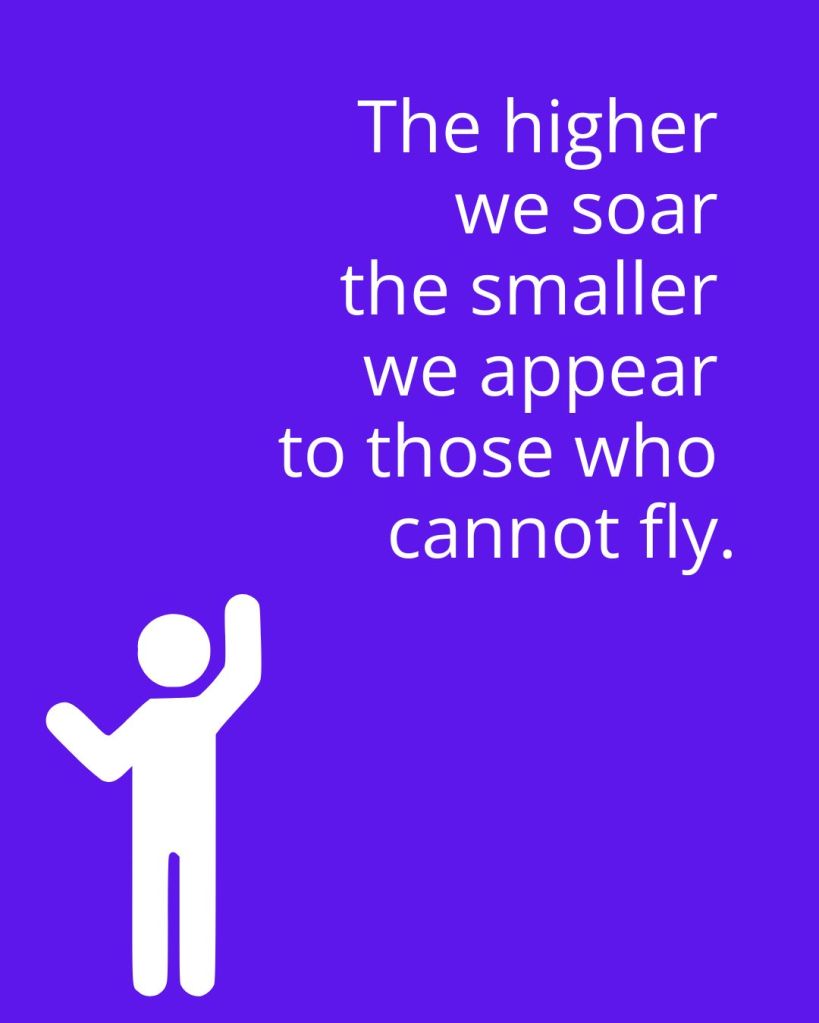
The higher we soar the smaller we appear to those who cannot fly.
If humans had taglines, what would yours be?
I have a tagline on this blog so that might be it for the moment:
The higher we soar the smaller we appear to those who cannot fly.
Abba Theodore of Pherme once complained: “When I was in Scetis, the work of the soul was our real job (ergon), and our handiwork we thought of as a sideline (parergon). But now the work of the soul has become the sideline and the handiwork has become the real job.”
… the most dangerous of errors hitherto has been a dogmatist error–namely, Plato’s invention of Pure Spirit and the Good in Itself. … But the struggle against Plato, or–to speak plainer, and for the “people”–the struggle against the ecclesiastical oppression of millenniums of Christianity (FOR CHRISTIANITY IS PLATONISM FOR THE “PEOPLE”)
Nietschze
What if, just what if, there is truth in the above? Has the Christian tradition baptised Plato’s world view? Where is the encounter with Jesus? Where is contemporaneity/presence?
In the carliest, least structured stage of monasticism the lines of “control between the church and the desert monks of Egypt seen to have been highly tenuous, after which their gradual imposition can be traced. Initially, retirement from the world entailed also retirement from the body of the church, since the earliest mont were solitaries. There is evidence too of a strong charismatic tendency among these ascetics which on occasion to served by-pass an important aspect of the authority nexus in the primitive church which was located in the dispensing of sacraments. So of the Egyptian hermits claimed to have received a miraculous distribution of the eucharistic sacraments, and this was representative of a more general devaluing of the church’s sacrame control which was the logical corollary of, if not the general practice of, the desert solitaries.
The Religious Order, 22
In those days came John the Baptist, preaching in the wilderness of Judaea, and saying, Repent ye: for the kingdom of heaven is at hand.
Matthew 3:1-2
By what authority does John the Baptist preach?
Man that is born of a woman hath but a short time to live, and is full of misery. He cometh up, and is cut down, like a flower; he fleeth as it were a shadow, and never continueth in one stay.
Book of Common Prayer
In the midst of life we are in death: of whom may we seek for succour, but of thee, O Lord, who for our sins art justly displeased?
Yet, O Lord God most holy, O Lord most mighty, O holy and most merciful Saviour, deliver us not into the bitter pains of eternal death.
Thou knowest, Lord, the secrets of our hearts; shut not thy merciful ears to our prayer; but spare us, Lord most holy, O God most mighty, O holy and merciful Saviour, thou most worthy Judge eternal, suffer us not, at our last hour, for any pains of death, to fall from thee.
Who can precisely say that my neighbour suffers more than I do, or that Jesus suffered more than all of us? … Each person remains with his own suffering, which he thinks absolute and limitless… Each subjective existence is absolute to itself. For this reason each man lives as if he were the centre of the universe or of history.
On the Heights of Despair
But Christendom has abolished Christ; yet, on the other hand, it wants—to inherit him, his great name, to make use of the enormous consequences of his life. Indeed, Christendom is not far from wanting to appropriate them as its own merits and to delude us into thinking that Christendom is Christ.
SK (Institutions)
Is “christianity” an abstraction that, when used against the individual, is dehumanizing? When Nietzsche writes again Christianity, maybe he is right?
So, do I believe in Christianity or in Jesus?
Although I feel that my tragedy is the greatest in history, greater than the fall of empires, I am aware of my total insignificance. I am totally convinced that I count for nothing in this universe, yet I feel that mine is the only real existence. If forced to choose between the world and myself, I would reject the world, its light and laws, unafraid to glide alone in absolute nothingness. Although my life is a torture, I cannot renounce it because I do not believe in any absolute values for which I could sacrifice myself’
On the Heights of Despair,, Cioran
 this solitary life