Solitude is to be sought not because of the relief from those who are not there but for His sake who is
John Henry Newman
Category: Anglican
public & individual
The performance of the liturgy, which the Orthodox Church sees as the fundamental reason for its existence, is a public event in which the words and gestures of the priest, familiar to all, are repeated before the eyes of the faithful; any variation or deviation can be recognised. The deep spiritual truths of the Faith, on the other hand, were communicated to individuals by spiritual fathers who had prepared themselves through long periods of solitude and prayer.
France, Peter. Hermits: The Insights of Solitude
pilgrimage of grace
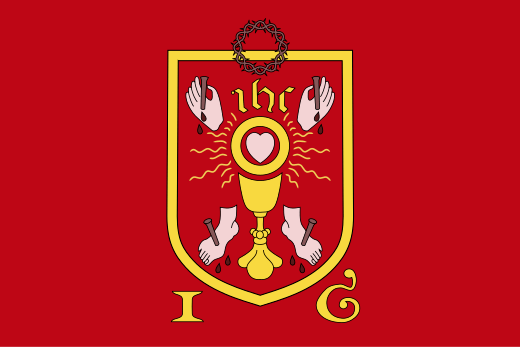
Why is the Pilgrimage of Grace not remembered liturgically? (Why is there no feast?)
One of the outcomes is:
Four of the seven sacraments that were omitted from the Ten Articles were restored in the Bishop’s Book of 1537, which marked the end of the drift of official doctrine towards Protestantism. The Bishop’s Book was followed by the Six Articles of 1539.
Also: the flag is the Five Wounds!!!!!
growth?
… he that prophesieth speaketh unto men to edification, and exhortation, and comfort. … the church may receive edifying.
1 Cor 14:3, 5
Take heed that the persons, whom ye present unto us, be apt and meet, for their learning and godly conversation, to exercise their ministry duly, to the honour of God, and the edifying of his Church.
BCP: The Ordering of Priests
The Church and the priesthood are for growth in relationship with Jesus. It is not an institution concerned with itself. It is concerned with individuals. What happens when this individual “growth” is no longer the aim?
is contemplative life possible in the Anglican Communion?

I was thinking about William of Glasshamption (aka Fr William Sirr SDC), especially a piece he wrote about the contemplative life in the Anglican Communion.
When I read the letter, I was struck by the need for contemplative life within the Anglican Communion. In a world full of action and busyness, contemplative life is a secular necessity. There is no return to the old days. Contemplative life in a social media age!
But, I wonder, is the contemplative life possible within the Anglican Communion? Is there room in the Anglican Communion for individuals who separate for “prayer and mortification”? Does it fall inside of “mission action plans”?
So, read! Reflect! Share!
Spring, 1933.
“Now there stood by the Cross of Jesus His Mother”
To our FRIENDs
THE COMPANIONS OF
BLESSED MARY AT THE CROSS.GREETINGS TO YOU ALL.
Not least among many marvellous recoveries the Anglican Communion has restoration of the made in the last hundred years is the vigorous Religious Life which had been so rudely suppressed at the Reformation. We realise not only what has already been done in this direction, but also how much more must yet be achieved ere we reach the goal set before us. But whether we consider the immediate past or the unknown future, we thank-fully take courage and press on again.
Now as we look around at this stage of the revival we find contemplative communities of women happily established in our midst. This is the highest peak we have attained in the recovery of the Religious Life. It gives promise that the men will soon follow.
We cannot, however, forget the great shock it gave Newman, those many years ago, when he first realised there were no monks and nuns in the Church of England, and we wonder whether we are sufficiently concerned to-day to find we are still left without one established community of men set apart wholly for this supreme work of prayer and mortification. Are we fully alive to the serious loss it must be for the Church to remain bereft of monks of this description?
There can be no doubt of the increasing need there is of men who will make daring adventure in the field of prayer. We mean men after the pattern of what Jacob once proved himself to be. He determined he would by prayer win a blessing from God. For this purpose he carefully sought and diligently planned to be alone, and alone he wrestled in prayer through the long watches of the night until the breaking of the day. “I will not let thee go unless thou bless me.” He declared he had seen God face to face, and as a prince, he won power with God and with men. It is true he ever afterwards bore the marks of the struggle he had gone through-but he prevailed.
It is men like that the Church needs so desperately today-men who will deliberately go apart to be with God alone, and stay. They must be men wholly surrendered, and determined with dauntless courage to follow God through every tedious and painful vicissitude, and to endure in prayer right on to the very end, whatever the cost may be. That is the way prescribed by God, and it is in that direction such men of God have always “I give myself unto prayer.”
“The help that is done upon earth, God doeth it himself.” But He deigns to ask for our co-operation as fellow-workers together with Him. God will not consent to act in loneliness.
Think—a divided Christendom has to be reunited, a distracted world has to be mended, all nations have to be brought to do Him service. These are blessings we all yearn for. And these are blessings we know God wills to give. Indeed, He is even now holding them out and waiting to bestow them upon us. without our utmost co-operation. Wherein, then, do we fail?
It is not in activities that we are in danger of falling short. In some respects our activities are excessive. It is in prayer and mortification we sorely need strengthening. And it is to monks we must look to help us to fill up this deficiency.
In our recovery of the Religious Life we have reversed the true order in which the Religious Life originally came into being. In the early days of the Church the solitaries came first, and then the monks and nuns. Men were the pioneers, and the women Then out of this monastic life of prayer and mortification sprang the various orders of active religious, raised up one after the other to meet the pressing needs of the time.
We, on the other hand, started in the revival by first recovering the active life-Sisters of Charity devoted to the poor and sick. Then came other active Sisters for the purposes of educational, preventive and rescue work. After that the men followed-mission priests and lay Brothers, communities of men for training ordinands, for the care of aged and infirm sailors, and for the ” downs and outs ” And most of these communities of men and women have spread out into the mission field.
Now we discover that, quietly and without observation, enclosed nuns have come to life, like the seed hidden and growing secretly in the earth. We find them here just as we suddenly find the flowers in full blossom in the garden, without seeing them unfold. There is yet awaited, last of all, the coming of enclosed monks as of men born out of due time. Then we shall have completely recovered.
Until the enclosed monks are born to us the power of the Church is seriously weakened. We suffer because of the absence of their lives of prayer and mortification-the two most essential implements needed in the terrific warfare for God against the world, the flesh and the devil. The Church is waiting for such lives-waiting for you, young men, because you are strong, and the Word of God abideth in you, and you have overcome the wicked one, you who can ensure that there are men as well as women always standing by night and day to praise the Lord.
Without such monks we are in grave danger of losing sight of the fact that there are some things God has set the Church to do for Him that can only be accomplished by prayer and mortification. Is it not precisely to this purpose of prayer and mortification our Lord was referring when He said to His disappointed disciples, “this kind goeth not out except by prayer and fasting”?
God’s arm is not shortened. Somewhere among us are those to whom God is waiting to impart this rare vocation. And we ask for your prayers during this centenary year, that He will graciously impart it now; and that they to whom this call shall come will fully and courageously respond to it; and that, please God, once again the desert will shoot out her blossoms and restore to the Church these specialists in prayer and mortification, monks as well as nuns, monks who will, like Moses on the mountain-top, stretch forth their hands in strong and never-failing supplications while those on the plains beneath continue their heroic activities.
Who can doubt that we, too, shall then prevail? It will be the breaking of a new day. With the help of our God, we shall leap over the wall.
God bless you.
who?
.
He ate distasteful food; wore a hair shirt next his skin; used the discipline on his body; accepted humiliations with the eagerness of a saint; said Mass every day at four; ignored malaise and headaches; made acts of humiliation when servants touched their caps to him; and had a rule of life “always to lie down in bed, confessing that I am unworthy to lie down except in Hell, but, so praying, to lie down in the Everlasting Arms.” To look into his face was to see the light of Heaven. Thus his sermons were listened to by breathless congregations, in spite of their inordinate length and his monotonous delivery.
Anyone want to guess the saint?
living sacrifice
Father, we offer ourselves to you
APBA, Prayer after Communion
as a living sacrifice
through Jesus Christ our Lord.
Send us out in the power of your Spirit
to live and work for your praise and glory.
The New Life in Christ
Romans 12:1-2
I appeal to you therefore, brothers and sisters, by the mercies of God, to present your bodies as a living sacrifice, holy and acceptable to God, which is your spiritual worship. Do not be conformed to this world, but be transformed by the renewing of your minds, so that you may discern what is the will of God—what is good and acceptable and perfect.
Sacrifice is surrendering a good for a greater good. It is the flip side of sin, choosing a lesser good over a greater good. For me, sacrifice is a part of my daily life: to always choose Jesus!
ad orientem
In an ongoing attempt to be more transparent and less censored ….

I am pro-‘ad orientem’. It is not a hill I am prepared to die on, but I think it is an option that is not discussed.
the decision
In baptism, God calls us out of darkness into his marvellous light.
Common Worship – Baptism
To follow Christ means dying to sin and rising to new life with him.
Therefore I ask:
Do you reject the devil and all rebellion against God?
I reject them.
Do you renounce the deceit and corruption of evil?
I renounce them.
Do you repent of the sins that separate us from God and neighbour?
I repent of them.
Do you turn to Christ as Saviour?
I turn to Christ.
Do you submit to Christ as Lord?
I submit to Christ.
Do you come to Christ, the way, the truth and the life?
I come to Christ.
towards a patrimony
… solitaries, recluses, or anchorites, [are] men and women who … live a spirituality of contemplative isolation. … embracing a spirituality of on-going conversion, spiritual combat, penance, and solitude. … Anchorites … [or] urban hermits … [embrace] stability and enclosure as a means of protecting contemplative prayer.
The above is a modified version – that is, present tense – of some introductory points from the book, Hermits and Consecrated Virgins, Ancient Vocations in the Contemporary Catholic Church: A Canonical-Pastoral Study of Canons 603 and 604 Individual Forms of Consecrated Life. I will use these as an ongoing guide to building a “spirituality of patrimony” of the enclosed solitary life in a modern Anglican context.
 this solitary life