And many of the Samaritans of that city believed on him for the saying of the woman, which testified, He told me all that ever I did. So when the Samaritans were come unto him, they besought him that he would tarry with them: and he abode there two days. And many more believed because of his own word; And said unto the woman, Now we believe, not because of thy saying: for we have heard him ourselves, and know that this is indeed the Christ, the Saviour of the world.
There came unto him a woman having an alabaster box of very precious ointment, and poured it on his head, as he sat at meat. But when his disciples saw it, they had indignation, saying, To what purpose is this waste? For this ointment might have been sold for much, and given to the poor. When Jesus understood it, he said unto them, Why trouble ye the woman? for she hath wrought a good work upon me. For ye have the poor always with you; but me ye have not always. For in that she hath poured this ointment on my body, she did it for my burial. Verily I say unto you, Wheresoever this gospel shall be preached in the whole world, there shall also this, that this woman hath done, be told for a memorial of her.
I beseech you therefore, brethren, by the mercies of God, that ye present your bodies a living sacrifice, holy, acceptable unto God, which is your reasonable service. And be not conformed to this world: but be ye transformed by the renewing of your mind, that ye may prove what is that good, and acceptable, and perfect, will of God.
Romans 12:1-2 (KJV)
The above is from Second Evensong for Candlemas. It reminded me of one of the post-communion prayers In the Second Order in APBA:
Father, we offer ourselves to you as a living sacrifice through Jesus Christ our Lord. Send us out in the power of your Spirit to live and work to your praise and glory.
What does “sacrifice” mean in these two texts? Not death. Perhaps we could define it as the surrender of a good (body in Romans) for a greater good (life in Jesus).
BTW: Augustine makes the opposite his definition of sin:
On account of all these, and such as these, is sin committed; while through an inordinate preference for these goods of a lower kind, the better and higher are neglected — even You, our Lord God, Your truth, and Your law.
Confessions 2:5:10
So, the choice between higher and lower goods is the root of sin and sacrifice.
Then the Gileadites took the fords of the Jordan against the Ephraimites. Whenever one of the fugitives of Ephraim said, “Let me go over,” the men of Gilead would say to him, “Are you an Ephraimite?” When he said, “No,” they said to him, “Then say Shibboleth,” and he said, “Sibboleth,” for he could not pronounce it right. Then they seized him and killed him at the fords of the Jordan. Forty-two thousand of the Ephraimites fell at that time.
But the Lord said to him, “What are you doing here, Elijah?”
10 Elijah replied, “I have zealously served the Lord God Almighty. But the people of Israel have broken their covenant with you, torn down your altars, and killed every one of your prophets. I am the only one left, and now they are trying to kill me, too.”
11 “Go out and stand before me on the mountain,” the Lord told him. And as Elijah stood there, the Lord passed by, and a mighty windstorm hit the mountain. It was such a terrible blast that the rocks were torn loose, but the Lord was not in the wind. After the wind there was an earthquake, but the Lord was not in the earthquake. 12 And after the earthquake there was a fire, but the Lord was not in the fire. And after the fire there was the sound of a gentle whisper.13 When Elijah heard it, he wrapped his face in his cloak and went out and stood at the entrance of the cave.
And a voice said, “What are you doing here, Elijah?”
Normally I do not comment on scripture readings – that is for the professionals to do. Yet, I was thinking about The Temptation of Jesus in the wilderness (Matthew 4:1-11) and how Jesus uses Scripture.
And my conclusion? Jesus uses Scripture to allow God to speak, and the devil uses Scripture to validate himself. The temptation is to use the holy for selfish means. The temptation is to not allow the holy to transform me.
Maybe a little simplistic (like me). Yet I find it a helpful way to think about how I use Scripture. Scripture does not exist in isolation from the hearer. Proof texting without context ignores the reader.
I have not posted in a while. I have been emotionally exhausted and had an event that caused me some anxiety. But things are now returning to some form of routine.
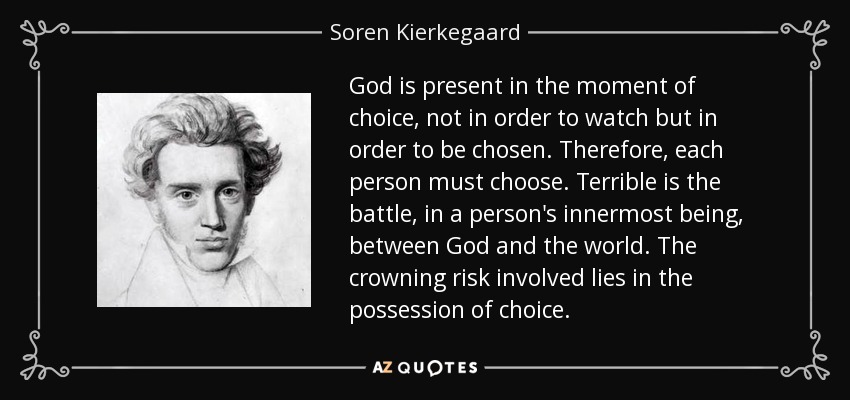
I have been working on the Bible Study for this week – Luke 12:49-59. It is an interesting passage. On first reading, it sounds harsh. But, as it unfolds, Jesus’ words are an encouragement to live absolutely for him today in the choices we make.
It reminds me of this quote from Kierkegaard:
Also, I should mention that I have had a delightful email from the Archivist at Walsingham. It is about the anchoresses who lived there.



 this solitary life