reading

I have had more time to read. I am a little of a shatter-brain reader – when something takes me I like to simply sit and think. (Or pretend to think!) So sometimes I read a huge amount and sometimes only a sentence.

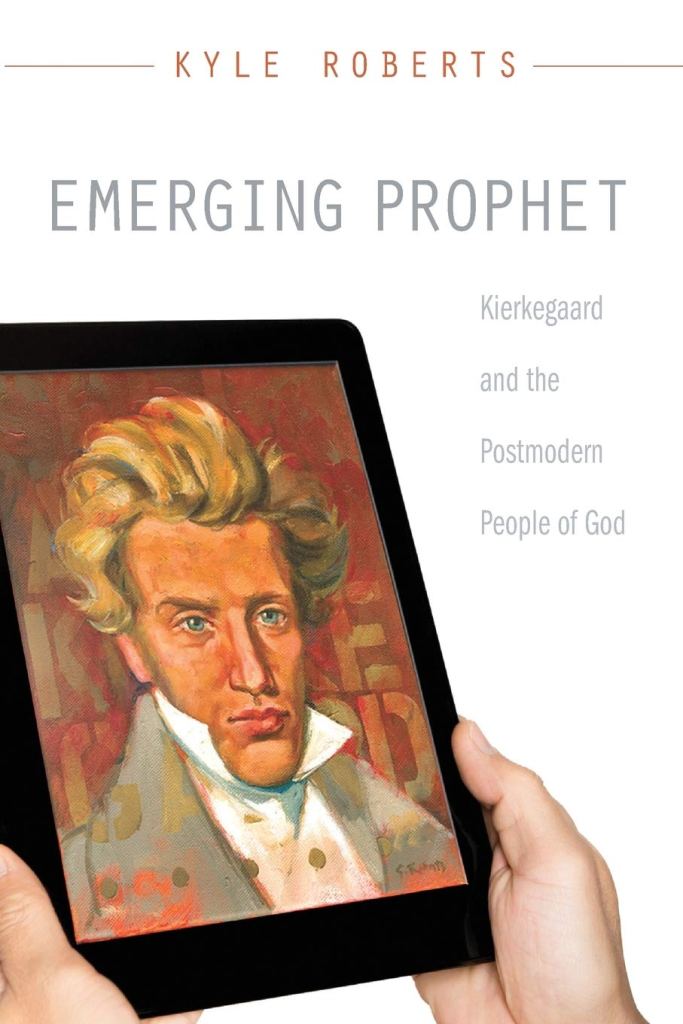
I have been reading Emerging Prophet: Kierkegaard and the Postmodern People of God. I have not read much about the emerging church movement so the book has been a nice introduction. I am more of a new monasticism type person.

I am struck, again, how Kierkegaard is way ahead of his day. He is one of a kind, a single individual, far apart from the crowd. Maybe he is the original new monastic religious? I would like to read more about the emerging church movement! And I want to read more about and by Kierkegaard.

As an aside (completely off-topic): I wonder what Kierkegaard would make of me? (How egotistic!) Would he sit with me in a cafe and drink coffee (and smoke cigars)? Or would he walk past me in the street?

So what are you reading?

tears and rings

I have been reading a book about Margery Kempe. And, I admit, I am somewhat taken with her. The context of her life – medieval England – is interesting. And the changes in spirituality and theology that her life reflect are extremely interesting.

Kempe was known as a person whose spiritual emotions often overflowed. Again and again, she is removed from places due to her weeping. While I see that this may be contextual, I also envy that depth of devotion. My natural disposition is to intellectualize everything. But I have learned that if I keep ignoring my emotions they have a habit of finding their way out.

The book, Margery Kempe: A Mixed Life by Anthony Bale, looks at some of the devotional items that were important to Kempe. Among these is a ring with the inscription, “Jhesus est amor meus” (Jesus is my love). It is very-Kempe to have such a devotional item and, as with others, to ascribe magical powers to it. Yet I really like the plainness of the sentiment which I often find missing in modern spirituality. Yes, I am in love with Jesus – that simple and that complex. Again, how intellectualised my faith often is and how without emotion when, in reality, it should be full of emotion.

I have added the book to the Reading List.

reading?

Aelred of Rievaulx, in his Rule of Life for a Recluse, laments that some anchorites like gossiping:

… their purpose no longer to being to arouse desire but to gratify it.

I think that is also true for a lot of reading in a modern context. People read all the time – online, on their phones, emails, etc. In a sense, anchorite solitude is all about space to read. But read well! Reading to “arouse desire” for Jesus. Not reading to pass the time or “gratify” a base desire. Reading to move closer to Jesus.

I think people of faith should make more time for reading to arouse desire. Not just the Scriptures or the Prayer Book – both of which should be a very important part of every day. Lectio Divina should become a part of every Christians’ day.

Also good Christian books. Our tradition is overflowing with good reading material for which a whole lifetime would not be enough to read. Guided reading – with a spiritual guide – would be a magnificent place for people to feed their spiritual life.

Sorry if that is a little preachy.

naked intent

You only need a naked intent for God. When you long for him, that’s enough.

I have been reading The Cloud of Unknowing which I have not really read previously. I think there are books that I am aware exist and have some idea about their content but that I have never really read.

So two things: there is such a thing as really reading something. Slowly and with intent. Allowing the words to penetrate and feed your inward person. I know that is true with the Scriptures but it is also true with other literature. And the difference, between reading for information and reading to be fed, is in the intent. A relationship is much more than information and hits the very centre of what it means to be “me”. It is this centre that reads with intent.

Second: “a naked intent”! A longing for God in every aspect of my life. Putting time aside is very much part of it. But every moment of my day (and night) is a continual longing for God. My intent today is for Jesus.

I think I like The Cloud of Unknowing. It is simple in its language but deep in its ideas.

manage people

… because everyone is drawn almost irresistibly back towards this urge to manage.

Rowan Williams. Silence and Honey Cakes, 26.

I have been reading Silence and Honey Cakes – a book by Archbishop of Canterbury Rowan Williams on desert spirituality. It was recommended to me by a lecture in history at a Catholic theological institute.

The above – “this urge to manage” – is a very strong image for me in the first chapter. The withdrawal into the desert is not a withdrawal from a sinful world but an opening of my own sinfulness. And at the core of this is my need to manage people. To set limits on other people’s access to God and to always place myself between God and people. To make myself the spiritual guru, the person with the answers, the person who has it all worked out. To place myself above the other is not an act of love but hubris.

But that is nothing but my sinfulness. And in silence, I hear that most clearly. The desert is not a place but part of my heart that I need to listen to intently. Only when I know what it means to be broken can I really appreciate what it means to be whole – or holy!

questioning

Spiritual guidance affirms the basic quest for meaning. It calls for the creation of space in which the validity of the questions does not depend on the availability of answers but on the questions’ capacity to open us to new perspectives and horizons. We must allow all the daily experiences of life—joy, loneliness, fear, anxiety, insecurity, doubt, ignorance, the need for affection, support, understanding, and the long cry for love—to be recognized as an essential part of the spiritual quest.

Nouwen, Spiritual Direction

I have been listening to Henry Nouwen’s book on spiritual direction. I have not read much by him so I am super impressed with this book. Especially as an audiobook that I can listen to while doing other things.

So I thought I would share the above. Questioning is important and very much part of the journey into Jesus.

witnesses to Jesus

I have been continuing to read The Freedom to Become a Christian: A Kierkegaardian Account of Human Transformation in Relationship with God. (I had a very pleasant hour on the beach yesterday reading and watching the waves.)

I just wanted to share two quotes that really struck me:

When Christian conceptions or propositions become the object of the Christian faith (for example, in the form of Christian doctrine), ‘Christianity’ becomes a plaything for intellectual pursuits, cultural sensibilities and political agendas. This is not, of course, to deny that Christian concepts and propositions serve a purpose. Their primary purpose, however, is to serve as a witness to God: to provide us with teaching that helps us to talk about, understand and know both who God is and who we are before God. But, for Kierkegaard, they are not to take centre stage.

The Freedom to Become a Christian, 4.

I was struck by the idea that doctrine etc are witnesses. And that these provide a framework for us to speak about God.

The conclusion that this work seeks to draw is that, for Kierkegaard, Christian belief and understanding are subordinate to a person’s relationship with God. They do not constitute the relationship itself. They are nothing more than a witness to and expression of the fact that God actively relates to us in history.

This is the main aim of the book. And I think this is a really important point to remember: it is all about a relationship. As the author further explains it is about a choice for the Christian life, it is not about conclusions but rather a resolution. (The last part is me!)

be transformed

… it is conceived as a transformative journey that is grounded in an active relationship with the God who is present with us and encounters us in and through the person of Jesus Christ. Furthermore, it involves a growing in relationship with God that does not simply result from God’s encountering us from the eternal beyond but takes place concretely within the history of this world. Accordingly, becoming a Christian requires responding to God’s historical engagement with us within the limitations of time.

The Freedom to Become a Christian, 2.

I have been reading The Freedom to Become a Christian with much interest. I think it discusses some issues that need to be discussed more – a theology of conversion. Further I think this theology of conversion should stand in the middle of our theology of mission. So I might share one or two quotes from the book as I progress through it. I am also hoping to write a full review and discussion of the book when I am done.