Alone and lonely?

In the book I am enjoying the anchoress (sic) is asked by a visitor, “Are you lonely?”. Of course she answers is a resounding “no”. I have been thinking about that answer.

I think it is natural to feel lonely at times. That is only human. Yes, I feel lonely sometimes. I admit very rarely in the last year or so. But the point of the anchorite or solitary life is that “loneliness” is given new meaning in Jesus. And that is the point – Jesus does not change the way I feel but he changes what it means to me.

Today is a public holiday. It changes very little in my day. So I am just trying to be me in the presence of Jesus.

music

I have not shared any music lately. To be honest, I have struggled to get through the day and music has been background noise at best. I have not been connecting to anything or anyone in the last couple of weeks.

I especially this:

The more I’m leaning
The more I’m flying
Feels less like dying
More like living for Heaven on Earth

be still

Today we had our first Lenten Prayer Group. We have had an ongoing online Prayer Group for some time but this was the first at church.

I decided I was going to try to “be still”. It is really hard. The exterior silence is one thing but the interior a completely different thing. I found a comfortable sitting position, finally worked out what to do with my hands, and just sat there. I think it is the first time I have sat still for nearly an hour.

The exterior is a skill but so is the interior. Allowing God to speak. Being attentive to Jesus in the silence. Letting my mind drift but then pulling it back to the centre. I think this is a skill I would like to work on.

More and more I have enjoyed alone time. So much so that I am enjoying time with people more. No pressure to preform, to know all the answers, to see the way ahead. And, for the first time in my life, I do not mind “me” – ok person, a little hard to get along with, but not too bad.

Lent and me

I have been thinking about Lent – what to do this year? In my lifetime I think I have done all the traditional things: caffeine, alcohol, TV, music, soft drink, etc. And I do not want to give something up just for the “show of it” and then return to normal after Easter.

I have also been thinking about why I have been unable to maintain relationships in my life. I have many fallen friends with whom I am no longer in contact. My life is a field of broken relationships.

I think for Lent this year, I am going to self-censor. I am going to speak only when spoken to and then will speak only upbuilding things. Especially online – ok, I see the irony. Also, I am going to try to listen more (and read more which is my primary form of listening).

Anyway, happy Lent to you all!

transparency and Lent

The formula that describes the state of the self when despair is completely rooted out is this: in relating itself to itself and in willing to be itself, the self rests transparently in the power that established it.

Sickness unto Death

So Lent starts tomorrow. I have been thinking about it a lot in the last couple of days. Not because I have huge plans but rather I have been wondering what it means to me. Why bother with Lent?

I think the issues I have raised before – living in the past or anticipation of the future – are real issues in my spiritual life. So I am not surprised that they would come to mind when I think about Lent. But Lent cannot be about my past sins or my future reward! It must be about my relationship with Jesus now. So should I give up on Lenten disciplines? No! But I am going to look at them from a different angle.

Living for Jesus now! Sometimes I overbalance one way, sometimes another. Lent is a season for balance: to see what things draw me away from my centre. Or, to put it in a slightly Kierkegaardian fashion, what is stopping me from becoming a self – to become transparent before God.

So this Lent is about balance. It is also about prayer and silence. And it is about reading and sharing.

self?

The self is a relation that relates itself to itself or is the relation’s relating itself to itself in the relation; the self is not the relation but is the relation’s relating itself to itself. A human being is a synthesis of the infinite and the finite, of the temporal and the eternal, of freedom and necessity, in short, a synthesis. A synthesis is a relation between two. Considered in this way, a human being is still not a self

Sickness unto Death, Hong 13

I think that is one of the first Kierkegaard quotes I ever read. Looking back now at how confused I was – still am – about what he means makes me wonder if I have progressed at all.

I have been thinking about Lent, the “religious life”, and being a self. They are all about “balance”. Finding a balance between the various forces that pull and push. Finding balance with those things that I have control over. Asceticism, in the traditional sense, is about finding balance in the physical world to focus exclusively on Jesus.

Anyway, not to find a definition of “religious life” that suits me!

solitary?

The terms Hermit and Solitary are often used interchangeably but for the purposes of the Handbook, the term ‘hermit’ refers to a member of a Religious Community and the term ‘solitary’ refers to one who is not a Religious.

A Handbook of the Religious Life, The Advisory Council for Religious Communities

So … the above is from the Church of Englabnd document, and there is an Australian version that is not as clear, indicating that people living a “vow of celibacy” can do so under a religious rule (hermit) or under a personal rule (solitary).

I think the term religious can be confusing. In a sense (but who am I to say this) the solitary is the modern form of an anchorite – a celibate/single layperson living alone under a rule. And that is how I use the term anchorite – a single layperson living under a personal rule inspired by the lived example of anchorites.

I have been thinking about the above a lot recently. Am I called to such a life? Especially with a few things that are going on in my life, am I called by God to embody a religious incognito type of spirituality within the context of a modern parish?

love the truth?

So here is a completely random idea: what if we were to stop talking about knowing the truth and start talking about loving the truth? Or, to put it in Christian terms, what if we were to stop talking about knowing Jesus and start talking about loving Jesus?

While I kinda understand the idea of knowing something, I think it has been drawn into a direction that is not helpful for our relationship with Jesus. It makes the relationship all about our head and then our heart. Let’s turn that around and make it about the heart exclusively. Let’s make it a human relationship rather than an intellectual.

I want to write about this more but I think this is a start!

normal?

After my recent changes I had hoped that I would return to feeling normal. I was hoping for some sense of balance.

This morning I had an insight: what is normal for me? Do I actually have any idea what a balanced life looks like for me? This is the first time in my life – all 50 plus years of it – that I have had the space to find answers to the above.

In the past, and this is one insight that has become clear to me, I defined normal by other people. I thought I could trust people. I thought I could rely on love and mercy working through people for my good, for my normal.

So while I feel somewhat stuck, I know why.

vows as sacrifice

I appeal to you therefore, brothers and sisters, by the mercies of God, to present your bodies as a living sacrifice, holy and acceptable to God, which is your spiritual worship. Do not be conformed to this world, but be transformed by the renewing of your minds, so that you may discern what is the will of God—what is good and acceptable and perfect.

Romans 12:1-2

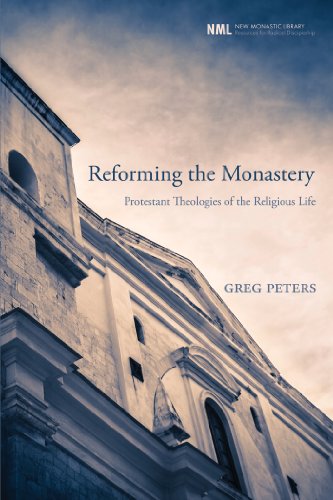
I have been reading a book on the theology of monasticism within post-reformation groups, Reforming the Monastery: Protestant Theologies of the Religious Life. Interesting! The Anglican chapter is especially interesting as it shows how different the English reformation was from its continental counterparts.

The first chapter looks at Luther and Calvin. Both have the same problem with monasticism: vows as works. The context is faith and works versus works in our relationship with God. So, one could say, Luther and Calvin are not anti-monasticism but rather against the taking of vows that are not directly related to our relationship with God.

But I think (and who am I to say anything?) that the above becomes less of a problem when vows are seen in terms of Romans 12: vows as sacrifice. I need to go much deeper than a superficial reading of the above – and I hope I can do that in the near future. I also realise that the very term sacrifice is a disputed idea. Above all, I am glad I am an Anglican (alas, a very poor one) because it allows the freedom to move beyond the above Reformers.

So allow me to put forward a working definition of sacrifice (that does not include death): a sacrifice is a free surrender of a good for a greater good. And the greater good in the above context is always Jesus. So vows as sacrifice would look a little like this: the free intention of the individual to surrender a good (created by God) for the greater good of living for Jesus alone. The intention is never to work towards salvation or away from my sin but rather an act of love for Jesus. And, by extension, an act of love for my neighbour whom I am free to serve in various ways.

Anyway!