

What is alienation, and what is an alienated person, and what are the results of alienation? Alienation is the psychological condition of somebody who is never allowed to be fully himself. For example, in the social order a slave is an alienated person because he does not belong to himself. His work is not his own. There is no real personal meaning to his life, because everything he does belongs to somebody else. Anything can be taken away at any moment.
Transfer that obvious example to a person who is never able to be himself because he is always dominated by somebody else’s ideas or somebody else’s tastes or somebody else’s saying that this is the way to act and this is the way to see things. We live in a society in which many people are alienated in that sense without realizing it. Their choices are made for them, they don’t really have ideas and desires of their own; they simply repeat what has been told them. And yet they think that they are making free choices, and to some extent maybe they are.
What happens to a person in this condition is that, without realizing it, he does not have any real respect for himself. He thinks that he has ideas and he thinks he is doing what he freely wants to do, but actually he is being pushed around, and this results in a sort of resentment, which in turn leads to hatred and violence under a cover of respectability. This is the problem of our world, psychologists tell us. People feel inner tensions and violence and hatred, and they are ready to explode at any moment because they don’t really belong to themselves.
Thomas Merton in Alaska: The Alaskan Conferences, Journals, and Letters, (New York: New Directions Publishing, 1989), p. 74.
Category: Merton quote
Day 33 – seriously?
Normal day! I think I am really going to struggle next week when it is back to the “world”.
I have been moved by two Thomas Merton quotes:
À contemplative is not one who takes his prayer seriously, but one who takes God seriously, who is famished for truth, who seeks to live in generous simplicity, in the spirit.
Yes! It is not about solitude, silence, prayer, or meditation. It is about Jesus! Taking him seriously is the point. And all is gift!
I should add, not only for those who live a monastic/religious/vowed life – for all!
Hence monastic prayer, especially meditation and contemplative prayer, is not so much a way to find God as a way of resting in him whom we have found, who loves us, who is near to us, who comes to us to draw us to himself.
Rest versus action – that is the tension of the anchorite life. Simply resting in God, being present for him, and riding the wave.
freedom?
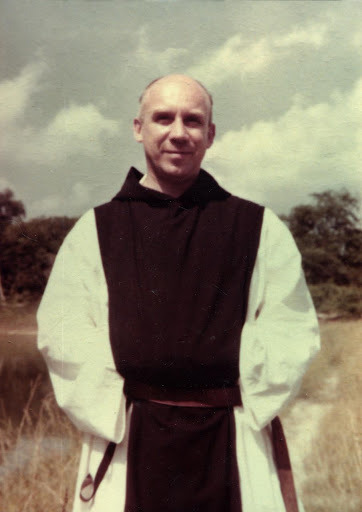
A major theme in anchorite spirituality is freedom. Unlike more traditional monasticism, where the major theme is obedience, anchorites have the freedom to build their own spirituality alone. I think, in a way, this is how in a modern context, the ancient tradition can be lived. Built around prayer, meditation, and reading, the anchorite builds their life in freedom completely focused on Jesus.
So I found this quote from Merton that says it much better:
This means I must use my freedom in order to love, with full responsibility and authenticity, not merely receiving a form imposed on me by external forces, or forming my own life according to an approved social pattern, but directing my love to the personal reality of my brother, and embracing God’s will in its naked, often unpenetrable mystery. I cannot discover my “meaning” if I try to evade the dread which comes from first experiencing my meaninglessness!
Contemplative Prayer
silence
I have two Merton quotes about silence I have been thinking about. Silence has been my solas for two weeks. While I have felt much more balanced and in control, I wonder if it is due to the periods of silence I have enjoyed.
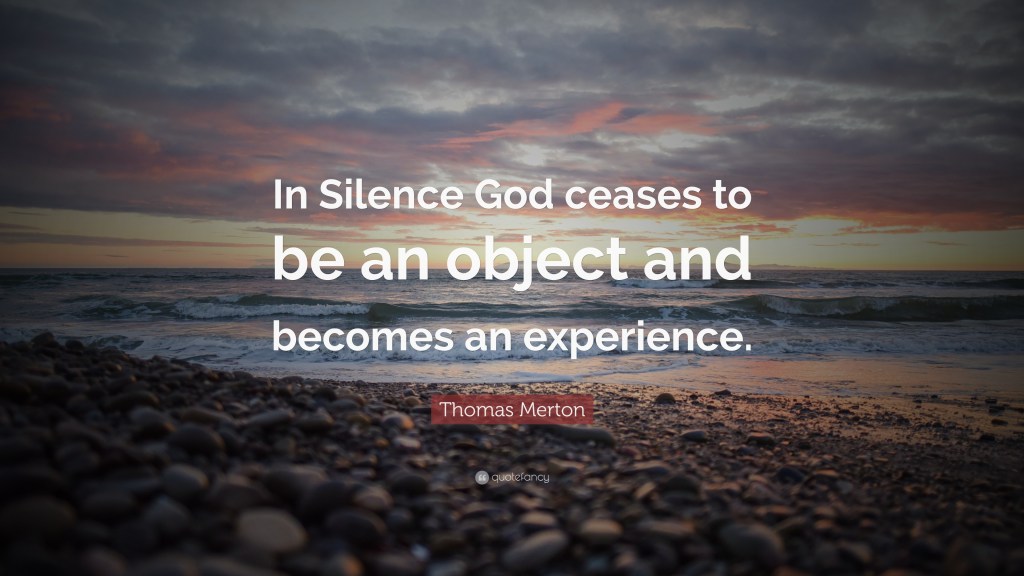
In so many ways, I think, Jesus is an experience rather (God forbid) a doctrine, teaching, or idea. I think the same can be said of our meeting with other people – in the silence of presence they become an experience and not an object to be used or manipulated.

I think I like this one more for the insight – silence is necessary to understanding. We are often (yes, I!) more willing to make noise than stand in the silence.
Merton poem
I just wanted to share this poem by Thomas Merton. I have always enjoyed his poetry.
being me
Many poets are not poets for the same reason that many religious men are not saints: they never succeed in being themselves.
Thomas Merton, New Seeds of Contemplation
I like the theme that runs through Merton of “being me”. So the above is part of that!
no masks
I was thinking about a Merton quote this morning before saying Morning Prayer:
I need solitude for the true fulfillment which I seek – that of being ordinary.
A Search for Solitude, 27
In those moments of solitude and silence I have during the day, I wear no masks. When I am alone with God, I am truly me. All the pretence is gone. All my pain and suffering is laid open before the Heart of Jesus.
Yet that solitude and silence requires effort on my part. I need to slow down, take a breath, and be intentional about my focus. It is much easier to have my mind filled with the everyday – the worries, the hurts, and the constant need to be in control or at least seem to be in control. That moment of silence requires effort!
Rest in Jesus
Prayer was the very heart of the desert life, and consisted of psalmody (vocal prayer – recitation of the Psalms and other parts of the Scriptures which everyone had to know by heart) and contemplation. What we would call today contemplative prayer is referred to as quies or “rest.” This illuminating term has persisted in Greek monastic tradition as hesychia, “sweet repose.” Quies is a silent absorption aided by the soft repetition of a lone phrase of the Scriptures – the most popular being the prayer of the Publican: “Lord Jesus Christ, Son of God, have mercy on me a sinner!” In a shortened form this prayer became “Lord have mercy” (Kyrie eleison) – repeated interiorly hundreds of times a day until it became as spontaneous and instinctive as breathing.
Thomas Merton, The Wisdom of the Desert, 20
The repeating of a single phrase while breathing is a great way to pray. I find, especially at night, it is super relaxing but it also focuses me on Jesus. But what I really like about the above quote is that “sweet repose” and liturgical prayer live alongside each other. As it should be!
Experiencing Jesus
To be grateful is to recognize the Love of God in everything He has given us—and He has given us everything. Every breath we draw is a gift of His love, every moment of existence is a grace, for it brings with it immense graces from Him. Gratitude therefore takes nothing for granted, is never unresponsive, is constantly awakening to new wonder and to praise of the goodness of God. For the grateful [person] knows that God is good, not by hearsay but by experience. And that is what makes all the difference.
Thomas Merton, Thoughts in Solitude (20 in my edition)
“Not by hearsay but by experience”. Yes, that does make all the difference. I feel that is something I would like to be able to say. To experience Jesus is the aim of it all. To really know Him above all.
All of that reminds me of a Kierkegaard quote which I think I have already used:
I do not dare to call myself a Christian; but I want honesty, and to that end I will venture.
“What do I want?”, The Moment
To be honest, like Kierkegaard, I dare not call myself a Christian – my life does not reflect Him nor does my thinking. My life does not conform to the Pattern – my life does not follow Jesus. I try! I try by doing Christian things and choosing Him when I have the choice. I try by allowing myself to be swept along by His Love. I try by living with hope that in God all things are possible.
being ordinary
I have been looking for this quote for a couple of days. I knew it was in one of the seven volumes of journals. So today I looked at my physical copy and found it:
Like climbing down from a mountain or a pillar and starting all over again to behave as a human being – I need solitude for the true fulfillment which I seek – that of being ordinary.
A Search for Solitude, 27
I have always liked that Merton joins two things that are important to me: solitude and being ordinary. And I completely identify with Merton on this point. I need some space to be me, nothing special or extraordinary just simply me. In a world full of noise where everyone is trying to outdo everyone else, in which everyone is trying to be extraordinary, it is nice to just be plain simple me. And for that I need solitude – space and time without noise. Not the absence of sound but rather the detachment from this world. To transcend myself by being the person I was made to be. Nothing more, nothing less.
 this solitary life