being ordinary

I have been looking for this quote for a couple of days. I knew it was in one of the seven volumes of journals. So today I looked at my physical copy and found it:

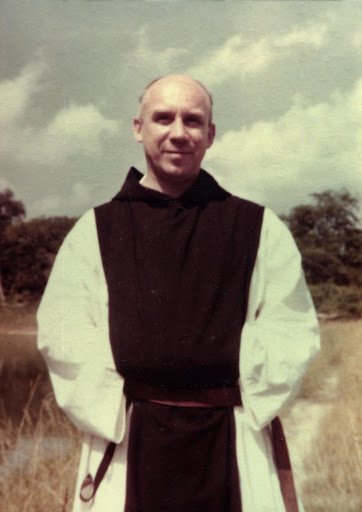
Like climbing down from a mountain or a pillar and starting all over again to behave as a human being – I need solitude for the true fulfillment which I seek – that of being ordinary.

A Search for Solitude, 27

I have always liked that Merton joins two things that are important to me: solitude and being ordinary. And I completely identify with Merton on this point. I need some space to be me, nothing special or extraordinary just simply me. In a world full of noise where everyone is trying to outdo everyone else, in which everyone is trying to be extraordinary, it is nice to just be plain simple me. And for that I need solitude – space and time without noise. Not the absence of sound but rather the detachment from this world. To transcend myself by being the person I was made to be. Nothing more, nothing less.

solitude of heart

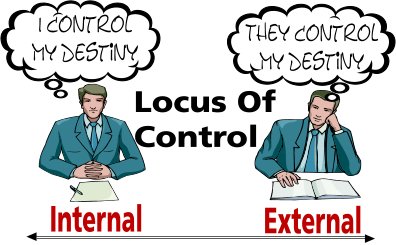
I have been reading about the idea of the locus of control. In brief, it is “the degree to which people believe that they, as opposed to external forces (beyond their influence), have control over the outcome of events in their lives“. I find that a challenging idea as it appears to not include any room for the Divine – that there is a Person outside of me that is in control of everything.

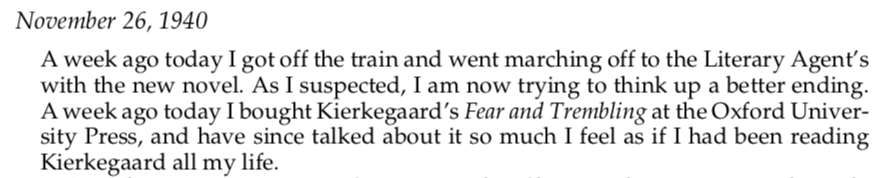
I think in his Journals Kierkegaard says that an all-powerful being is not all-powerful if that being cannot choose to not use all of their powers. And we Christians call that choice “love”. For me to love God, to choose Him, I must be free and God allows that freedom so that I can love Him. I know people theologically disagree – and I was raised in a tradition that does not agree with that idea of freedom. But I find that a comforting and challenging idea – I am free to love people and to love God without limit.

So back to the locus of control. Rather than not allowing for the Divine, it calls on me to “own” my choices. As I have worked with my counselor I have been encouraged to move beyond a “victim mentality”. And that movement has really helped me face my depression and my anxiety. These are not choices but how I react to them and how I live with them are my choices. In the past, I have made the wrong choices and those choices have hurt people.

So this morning I stumbled across this quote from Thomas Merton:

Today I seemed to be very much assured that solitude is in­ deed His will for me and that it is truly God Who is calling me into the desert. But this desert is not necessarily a geographical one. It is a solitude of heart in which created joys are consumed and reborn in God.

Sign of Jonas, 52

I think as Christians we can find our locus of control outside of ourselves. Christians have swallowed the scientific world view and elevated the “objective” to the role of the Divine. Simply to surrender to an idea, to a community, to a tradition, and to simply conform. Faith becomes an intellectual movement of non-questioning and just “doing”. Faith becomes an impersonal act. Of course, it is human nature to create that outside according to my experience and expectations. And, maybe even worse, it is human nature to expect that my “conforming” pleases God.

Maybe the Christian way of speaking about the locus of control is to speak about the “solitude of heart”? There is a place inside of me into which I can withdraw that I truly meet Jesus. And in this place, I surrender to Jesus. In this solitude, I listen to Jesus and have intimacy with Him. This place is not external to me but is the very nature of my being. My relationship is not only intellectual but personal and instinctive. Faith is personal and subjective. I experience Jesus in my “solitude of heart”.
christian heroism?

It is Christian heroism – a rarity, to be sure – to venture wholly to become oneself, an individual human being, this specific individual human being, alone before God, alone in this prodigious strenuousness and this prodigious responsibility; but it is not Christian heroism to be taken in by the idea of man in the abstract or to play the wonder game with world history.

Sickness unto Death, Hong 5

From The Moment

It is a tradesman. His principle is: Everyone is a thief in his trade. “It is impossible,” he says, “to be able to get through this world if one is not just like the other tradesmen, all of whom hold to the principle: Everyone is a thief in his trade.”

As far as religion is concerned-well, his religion is actually this: Everyone is a thief in his trade. He also has a religion in other respects, and in his opinion every tradesman ought to have one. “A tradesman,” says he, “should, even if he has no religion, never allow it to be noticed, because this can easily become harmful by possibly throwing suspicion on his honesty; and a tradesman should preferably have the prevailing religion in the land.” As for the latter, he accounts for that by the fact that the Jews always have a reputation for cheating more than the Christians, which he claims is by no means the case. He claims that the Christians cheat just as much as the Jews, but what harms the Jews is that they do not have the religion that prevails in the land. As for the former, the advantage that having a religion provides with regard to favoring one in cheating, he refers to what one learns from the clergy. He claims that what helps the clergy to be able to cheat more than any other social class is simply that they are so close to religion; if such a thing could be done, he would gladly pay a handsome sum to obtain ordination, because it would pay for itself splendidly.

Two or four times a year this man dresses up in his best clothes and goes to Communion. There a pastor makes his appearance, a pastor who (like those figures that jump out of a snuflbox when the spring is touched) jumps as soon as he sees “a blue banknote.” And then the holy ceremony is celebrated, from which the tradesman, or rather both of the tradesmen (both the pastor and the citizen) return home to their ordinary way of life, except that one of them (the pastor) cannot be said to return home to his ordinary way of life – after all, he had not left it, has been much more engaged as a tradesman!

And one dares to offer this to God in the name of the Sacrament of the Altar, the Communion of Christ’s body and blood! The Sacrament of the Altar! It was at the Communion table that Christ, himself consecrated from eternity to be the sacrifice, for the last time before his death was together with his disciples and consecrated them also to death, or to the possibility of death if they truly followed him. Therefore, in all its solemnity, what is said about his body and blood is so dreadfully true, this blood-covenant that has united the sacrifice with his few faithful blood- witnesses, which they surely would become.

And now the solemnity is this: to live before and after in a completely worldly way – and then a ceremony. Yet to instruct people about what the New Testament understands by the Lord’s Supper and its commitment – for good reasons the pastors guard against that. That others have been sacrificed, to live on this is the basis of their whole livelihood; their Christianity is to receive the sacrifice. To suggest to them that they themselves be sacrificed would be regarded by them as eine sonderbare und hochst unchristliche Zumuthung [a strange and highly unchristian presumption], totally in conflict with the New Testament’s sound doctrine, which they presumably would demonstrate with such colossal learning that no individual’s lifetime would suffice to study this thoroughly.

The Moment No 7, Hong 231

barnyard geese

A certain flock of geese lived together in a barnyard with high walls around it. Because the corn was good and the barnyard was secure, these geese would never take a risk. One day a philosopher goose came among them. He was a very good philosopher and every week they listened quietly and attentively to his learned discourses. ‘My fellow travellers on the way of life,’ he would say, ‘can you seriously imagine that this barnyard, with great high walls around it, is all there is to existence?

I tell you, there is another and a greater world outside, a world of which we are only dimly aware. Our forefathers knew of this outside world. For did they not stretch their wings and fly across the trackless wastes of desert and ocean, of green valley and wooded hill? But alas, here we remain in this barnyard, our wings folded and tucked into our sides, as we are content to puddle in the mud, never lifting our eyes to the heavens which should be our home.

The geese thought this was very fine lecturing. ‘How poetical,’ they thought. ‘How profoundly existential. What a flawless summary of the mystery of existence.’ Often the philosopher spoke of the advantages of flight, calling on the geese to be what they were. After all, they had wings, he pointed out. What were wings for, but to fly with? Often he reflected on the beauty and the wonder of life outside the barnyard, and the freedom of the skies.

And every week the geese were uplifted, inspired, moved by the philosopher’s message. They hung on his every word. They devoted hours, weeks, months to a thoroughgoing analysis and critical evaluation of his doctrines. They produced learned treatises on the ethical and spiritual implications of flight. All this they did. But one thing they never did. They did not fly! For the corn was good, and the barnyard was secure!

Kierkegaard as quoted by Athol Gill, The Fringes Of Freedom: Following Jesus, Living Together, Working For Justice.

Living it

Therefore the meditations in this book are intended to be at the same time traditional, and modern, and my own. I do not intend to divorce myself at any point from Catholic tradition. But neither do I intend to accept points of that tradition blindly, and without understanding, and without making them really my own. For it seems to me that the first responsibility of a man of faith is to make his faith really part of his own life, not by rationalizing it but by living it.

Thomas Merton, No Man is An Island.

I am often amazed by Merton’s insights. I like him as a writer but I think somewhere underneath it all there is the Spirit of God speaking to a modern age. He has many points that I think Kierkegaard would agree and many points that he would disagree. Most of all by withdrawing from the world – first into the monastery and then into the hermitage – Merton entered the world more fully. Silence made him more human and closer to his fellow travellers.

I like the above quote from the Preface to No Man is An Island. Merton lays bare the facts: he is formed by a tradition but he has made that tradition his own life, and it is from this life that he writes. Not defending a theoretical theological position but expressing the living presence of God in his life.

I like theology. I read about Christology and biblical hermeneutics. But I do not write about them. I write about my life. When these are part of the living presence of Jesus, I reflect on them and what they mean for me. But I have no desire to define what it means to be a “person” without living that reality. Faith always draws me into the everyday – into the ordinary.

So, if I may be so bold, I place myself into that tradition, not defining it or defending it, but living it.

existential individual

We are born biological beings but we must become existential individuals by accepting responsibility for our actions. This is an application of Nietzsche’s advice to ‘become what you are’. Many people never do acknowledge such responsibility but rather flee their existential individuality into the comfort of the faceless crowd.

Thomas Flynn, Existentialism: A Very Short Introduction.

I remember first reading the above quote and being caught off-guard. The philosophy I had read before that had been western Aristotelian – Thomas Aquinas and the more conservative Roman Catholic philosophers. I read Augustine’s Confessions one Lent and became more interested in Plato and Christian Platonism. Somehow (by God’s grace) I read a few books about existentialism and ended with Kierkegaard. I’ll admit that just being able to spell “Kierkegaard” was a point of pride. I was attracted by Kierkegaard’s view of the self but the Absolute Paradox keeps me reading. But that is for another post!

The above is a thought I have often returned to because it puts it so simply and elegantly. Kierkegaard, of course, would speak of becoming a “single individual” before God. Often in Christian circles I have heard people speak of the evil of modern individualism. I think that is how some people would read the above quote. But the issue with modern individualism (what is that?) is the idea of freedom – someone being free does not mean that their actions are right. Again, for another post!

“Actions and consequences before God” is how I read the quote. (And how I understand Kierkegaard’s “single individual”.) I am responsible for my actions and for my relationship with Jesus. There is no magic formula or secret handshake that creates and keeps me in that relationship. No doctrinal position or liturgical rite will take away from me the responsibility I have before God for my relationship with Him. God makes the first move and reaches out to me. I am called to respond to Him in my particular and individual situation.

Maybe I should write a little about “faith” in the future? But the above is just as true for me in my daily life with depression. The moment I took responsibility for my mental health things changed. I remember crying for the first time during counselling – not hiding the pain behind a mask given to me by the crowd, not allowing the crowd to define me and box me into a role. Finding out what that “me” is has been painful and very hard. And it is a daily struggle not to run back into the crowd and just surrender “me” to a function I have been assigned.

So, anyway, I just wanted to share that quote.

#ThomasMerton May 1, 1961

I have been reading “Turning towards the World”, volume 4 of Thomas Merton’s journals. I always get much out of reading Merton, especially his journals. There is something very human about it all – the minor concerns and the major discussions all in a private context.

I read the above, from the entry for 1 May 1961, yesterday and was struck by the last sentence. I am exhausted from talking. And, yes, I have build an image of myself as someone who has something to say. But mostly I am exhausted because I want to talk to people about real things and not the weather or the latest specials at the supermarket. There is so much noise in the world that likes to parade as conversation but is really just space-fillers. So rather than talk for the sake of talking, I am silent. Maybe I am just rude?!