SK for Grownups
This is one of the first articles that I read about SK from a former Lutheran who died a Catholic priest. Anyway, here is a quote:
There are Christians who call themselves Kierkegaardians, much as others call themselves Augustinians or Thomists or Barthians. But Kierkegaard provides no school of thought, and most emphatically no “system,” that can be a secure resting place for one’s Christian identity. Kierkegaard offers only a mode of being, of thinking, of living that has no end other than the end of being “contemporaneous” with Jesus Christ, true man and true God, who has no end. The certifying mark that one has accepted what he offers—or, more precisely, what Christ offers—is martyrdom, and Kierkegaard yearned to be a martyr. The word martyr, one recalls, means witness. If Kierkegaard was not to be given the privilege of literally shedding his blood, he would bear witness in other ways. He welcomed the derision of those surrounding him, recognizing in them the same crowd that surrounded the cross of his contemporary, Jesus Christ.
the mystic?
INFJs have vivid imaginations exercised both as memory and intuition, and this can amount to genius, resulting at times in an INFJ’s being seen as mystical.
Moviegoer
I am reading Walker Percy’s Moviegoer (as my novel as against more philosophical/theological books). So I found this article most interesting:
Living in the Ruins: Walker Percy, Kierkegaard and the Healing of the Modern Self
Sometimes …
… jokes come pretty close to the truth.
The man has somehow been able to self-sacrificially empathize with and show love and support to people who are nearly identical to him in race, politics, socioeconomic background, and religion throughout his entire life, reports confirmed.
via Local Christian Proud Of Himself For Loving People Who Are Exactly Like Him
preaching?
Most preaching I have heard falls into one of a number of categories:
- self-validating (“We are much better than [insert group disliked]”)
- intellectual gymnastics (“The Trinity is like …”). [As an aside, a sermon on the current state of a theological discussion on an issue is the dullest of all!]
- service agreement (“Because Jesus died for you, you ought to …”)
- just follow the rules (“DO what the Bible/[Authority] says!”)
- carrot and stick (“DO this or go to hell”)
- hyper-grace or fatalistic (“nothing we do does any good so don’t try”)
I have fallen for each of the above when I have preached, especially #3 as a form of emotionally manipulating people into agreeing with me.
I can count the profound sermons on one hand. And these have not been about a theological issue, a doctrinal insight, a new take on the liturgy, or seeing the hidden meaning in a scriptural text.
I find a lot of preaching has no clear purpose apart from that it should be done. And that is apart from the fact that rhetoric is a lost art – there is no development of the argument from point A to point B. And, of course, the preacher has so much to say that they cannot expand any point beyond simply stating a truth.
Or the sermon is seen as an intellectual activity like a lecture where a point of doctrine is the issue. So the sermon becomes an avalanche of information and distinctions, often leaving even the most educated overwhelmed. And the preacher is validated by feedback congratulating them for their brilliance – because, in the end, no one understood a word.
Jesus uses simple stories from everyday life to illustrate his mission and life. He does not invent a new terminology but he gives a new meaning to old language by his life and death. And he doesn’t answer questions no one is asking. His message is simple: love. Love God, love your neighbour, love your enemies.
Anyway, just an observation!
SK and Luther
O, Luther, you had ninety-five theses; in our present situation there is only one thesis: Christianity does not exist at all.
Source: Journals
photo of Merton’s first Mass
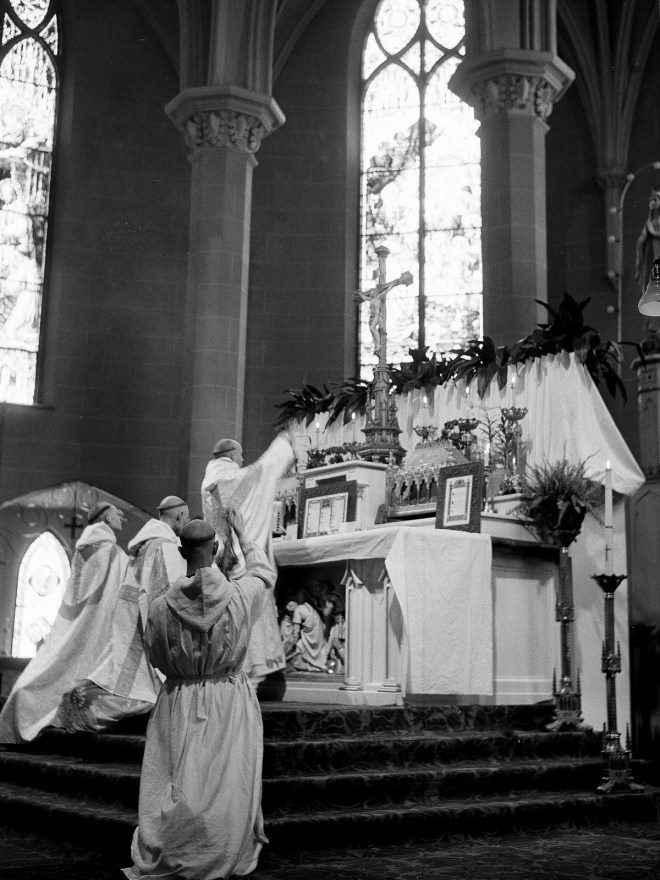
faith is a passion
From Fear and Trembling:
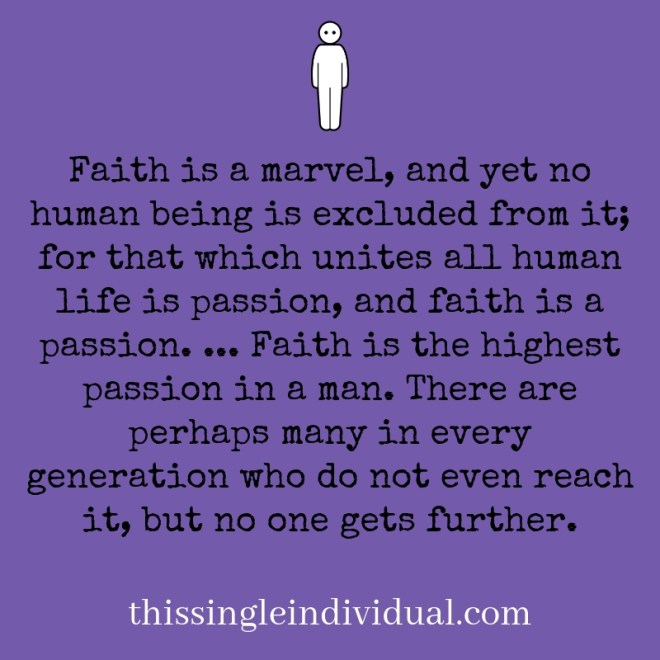
faith?
I have been thinking a little about “faith” – what is it? Too often we create two poles – faith and reason – and simply ask where a person stands. Is faith simply a choice to sidestep reason and accept something on authority? I wonder if it is not a little more fundamental – faith is the movement from being a human being to becoming a person, a single individual.
So I did a quick google and found this article from a psychologist, The Nature of Faith. The article has a nice start but I think the author misses something:
Finally, at least in the Judeo-Christian tradition, there is another important element to faith. Faith is not mere belief in the claim that God exists. Just believing a statement has little to do with one’s life, in many respects. The New Testament takes faith to include belief, but it goes beyond this as well. Faith also includes trust, in this case trust in God. So perhaps the best definition of faith is something like this: Faith is trusting in God, based on sound reasons.
Yes, faith in a statement about something is not faith in the Christian sense. Yet there is something more fundamental that the article misses: for the Christian tradition “faith” is not in a something but in a someone. Faith is primarily relational – it is mutual and reciprocal. It is a choice! But a choice to receive.
 a fool and his prayer book