
compassion

 For people are willing enough to practice compassion and self-denial, willing enough to seek after wisdom etc., but they want to determine the criterion themselves, that it shall be to a certain degree. They do not wish to do away with all these glorious virtues; on the contrary, they want – at a cheap price – to have as comfortably as possible the appearance of and the reputation for practicing them. Therefore as soon as the true divine compassion appears in the world it is unconditionally the sacrifice. It comes out of compassion for people, and it is people who trample it down.

Practice in Christianity, 60 (Hong)

Compassion on my terms? Is that compassion or self-validation? Compassion is love in action – love for neighbour actualised.

I am dreading the Easter sermon farmed in legal terms – Jesus took the punishment for my sin. An angry God that needs to be satisfied – a holy distant God that is offended at my sin and fallenness so He sacrifices His own Son. Not the Loving Father who cries with me and feels my pain – who has compassion on my weakness and wants a relationship with me in His Son. A relationship that is truely human!

Anyway!
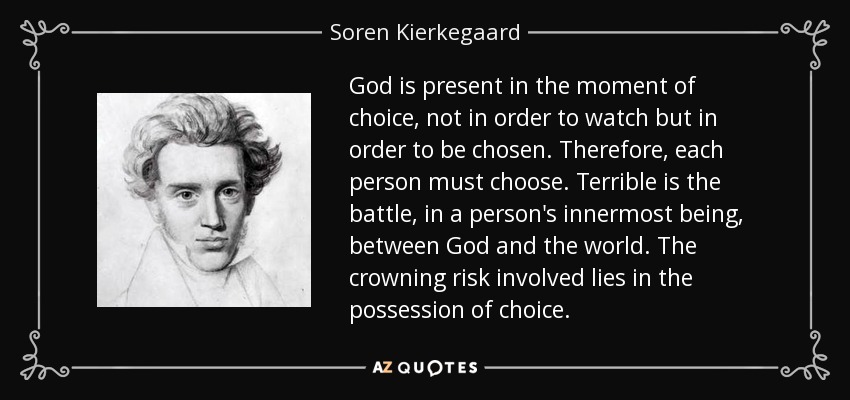
Kierkegaard and preaching

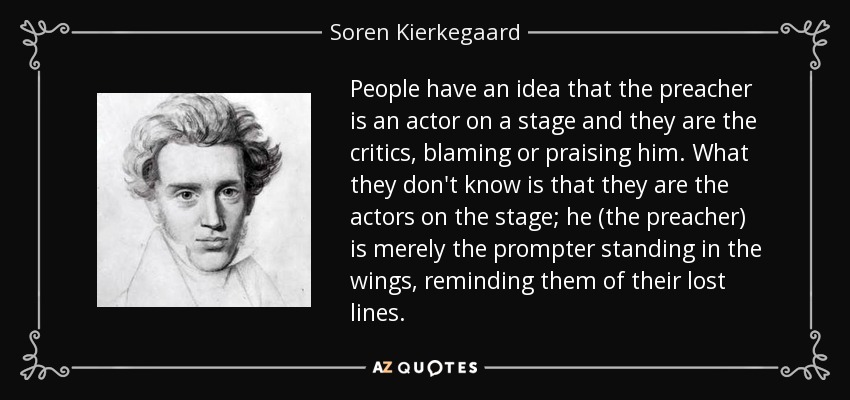
I would like to explore preaching in a modern context from a Kierkegaardian point of view, if I had the time. Most of the preaching I have heard is average at best, simple battle of authorities, or spoon feeding. The academic lecture explaining doctrine is my least favourite form of preaching! I once heard a preacher, in a parish setting, parse a greek verb during his sermon. And there is no need to explore every point of the text. I think Show, don’t tell is a good summary of the type of sermon I would like to hear.

Anyway, here is a Kierkegaard quote:

a TV show and two articles

I have just finished watching the Netflix original series The Keepers. It is a very powerful and very sad story. I would like to reflect more on it but I will need to let it sink in a little.

And I just wanted to share two articles I have read recently:

Kierkegaard’s ways to be human (by Ray Monk) which is a review of the soon to be released book by Clare Carlisle.

Appropriating the Paradox (by Karl Dusza) which is a review of SK’s Three Discourses on Imagined Occasions and Upbuilding Discourses in Various Spirits. I would like to explore SK’s discourses more!

Neuhaus on #Kierkegaard

Christendom is the enemy of Christianity—it is, Kierkegaard says repeatedly, the “blasphemy”—that stands in the way of encountering Christ as our contemporary. Christendom assumes that Christ is far in the past, having laid the foundation for the wonderful thing that has historically resulted, Christendom. Of course we are all good Christians because we are all good Danes. It is a package deal and Christ and Christianity are part of the package. If we are good Danes (or good Americans), if we work hard and abide by the rules, the church, which is an integral part of the social order, will guarantee the delivery to heaven of the package that is our lives. But Christ is not in the distant past, protests Kierkegaard. He confronts us now, and a decision must be made. “In relation to the absolute there is only one tense: the present. For him who is not contemporary with the absolute—for him it has no existence.”

This encounter with Christ the contemporary is not to be confused with today’s evangelical Protestant language about conversion as a decisive moment in which one “accepts Jesus Christ as one’s personal Lord and Savior.” Kierkegaard did not, of course, know about the nineteenth-century American revivalism from which today’s evangelicalism issues, but he had some acquaintance with the enthusiasms that were in his day associated with “pietism.” As he inveighed against Christendom, it seems likely he would also inveigh against Evangelicaldom today. As he would inveigh against Christianity of any sort—whether it calls itself liberal or conservative, orthodox or progressive—that neatly accommodates itself to its cultural context. To decide for Christ our contemporary is always a decision to be a cultural alien, to join Christ on his way of suffering and death as an outsider.

Kierkegaard for Grownups