doctrine over people

I was thinking about this passage from Fear and Trembling:

The paradox of faith, then, is this: that the single individual is higher than the universal, that the single individual…determines his relation to the universal by his relation to the absolute, not his relation to the absolute by his relation to the universal.

And then I stumbled upon this:

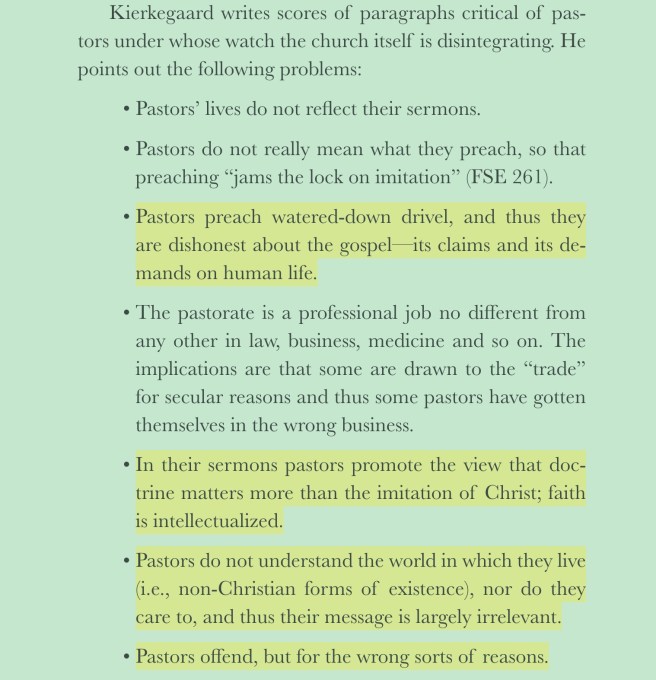
Identifying Religious Brainwashing: Doctrine Over Person (Part 7 of 8)

In our modern scientific post-Enlightenment age have we placed doctrine/ideas above people? Is there a general push just to conform, to defend the party, rather than embody the truth in my life?

life

There are many people who reach their conclusions about life like schoolboys; they cheat their master by copying the answer out of a book without having worked out the sum for themselves. (17 January 1837)

from the Journals

From the entry for August 1, 1835

Of what use would it be to me for truth to stand before me, cold and naked, not caring whether or not I acknowledged it, making me uneasy rather than trustingly receptive. I certainly do not deny that I still accept an imperative of knowledge and that through it men may be influenced, but then it must come alive in me, and this is what I now recognize as the most important of all.

Of what use would it be to me to discover a so-called objective truth, to work through the philosophical systems so that I could, if asked, make critical judgments about them, could point out the fallacies in each system; of what use would it be to me to be able to develop a theory of the state, getting details from various sources and combining them into a whole, and constructing a world I did not live in but merely held up for others to see; of what use would it be to me to be able to formulate the meaning of Christianity, to be able to explain many specific points — if it had no deeper meaning for me and for my life?

I shall now calmly attempt to look at myself and begin to initiate inner action; for only thus will I be able, like a child calling itself “I” in its first consciously undertaken act, be able to call myself “I” in a profounder sense.

via SAK Journals: I A
single individual

Reading last night, I found this in Kierkegaard’s Journals (1847):

The evolution of the whole world tends in the direction of the absolute significance of the category of the particular, which is precisely the principle of Christianity. But as yet, concretely, we haven’t come especially far, for it is only recognized in abstracto. That explains why it is still impresses people as presumptuously and overwhelmingly arrogant to speak of the single individual, instead of recognizing that absolute humanity means precisely that everyone is a single individual.