
more about fasting
A religious Fast requires total abstinence, not only from all food (unless bodily weakness do manifestly disable from holding out till the Fast be ended, in which case somewhat may be taken, yet very sparingly, to support nature when ready to faint), but also from all worldly labour, discourses, and thoughts, and from all bodily delights (although at other times lawful), rich apparel, ornaments, and suchlike, during the Fast ; and much more from whatever is in the nature or use scandalous and offensive, as gaudish attire, lascivious habits and gestures, and other vanities of either sex ; which we recommend to all Ministers, in their places, diligently and zealously to reprove, as at other times, so especially at a Fast, without respect of persons, as there shall be occasion.
Before the public meeting each family and person apart are privately to use all religious care to prepare their hearts to such a solemn work, and to be early at the Congregation. So large a portion of the day as conveniently may be is to be spent in Public Reading and Preaching of the Word, with Singing of Psalms fit to quicken affections suitable to such a duty: but especially in Prayer, to this or the like effect.
Book of Common Order
only 3?
List three books that have had an impact on you. Why?
- Book of Common Prayer: rhythm of prayer and the language
- Fear and Trembling: insightful on faith and duty.
- Metamorphosis: transformation is not always as expected
this one goes to 11
What’s a moment in your life that felt like it was straight out of a movie?
I have heard many sermons, seen many illustrations, and been at many meetings. And, I think, this video says it all – if you know, you know:
Let’s play it safe
Choose your religious denomination very carefully. If you want to play it safe, stick to Anglicanism. Clasp the 1662 Book of Common Prayer to your chest, tell everyone that you despise Catholics, Quakers and atheists, curse the pope, praise the king, and commemorate the anniversary of Charles I’s execution each year on 30 January as the death of a martyr.
Ian Mortimer, The Time Traveller’s Guide to Restoration Britain
puzzles
Describe one simple thing you do that brings joy to your life.
I normally would write about books. Or maybe reading, or information. But the one thing that brings me unconditional joy is jigsaw puzzles. I love the peace and enjoy the development of the picture. In fact, I think jigsaw puzzles are a metaphor for the way that I think – I describe pieces and you make the picture.
Trinity or heresy Sunday?
Today is Trinity Sunday. The BCP sets John 3 as the Gospel while the Western Roman Rite has Matthew 28:18–20. Interesting?! I am not much of a theologian (hubris much?!) so the following needs to be read with some salt.
I have heard many sermons trying to explain the Trinity. Some end in modalism – oh, so modern – others in a different heresy. The worst are “children’s sermons” that use physical examples. I sometimes wonder if Trinity Sunday should not be renamed to “Heresy Sunday”?!
So, simply, a reworked quasi-quote from Kierkegaard:
[The Trinity] is not a problem to be solved, but a reality to be experienced
Asher Lev
What’s the first book you ever finished and still remember to this day?
My Name Is Asher Lev by Chaim Potok. I read the whole book in a day, missing a lectures at Seminary. Maybe I should read it again?
St James Garlickhythe
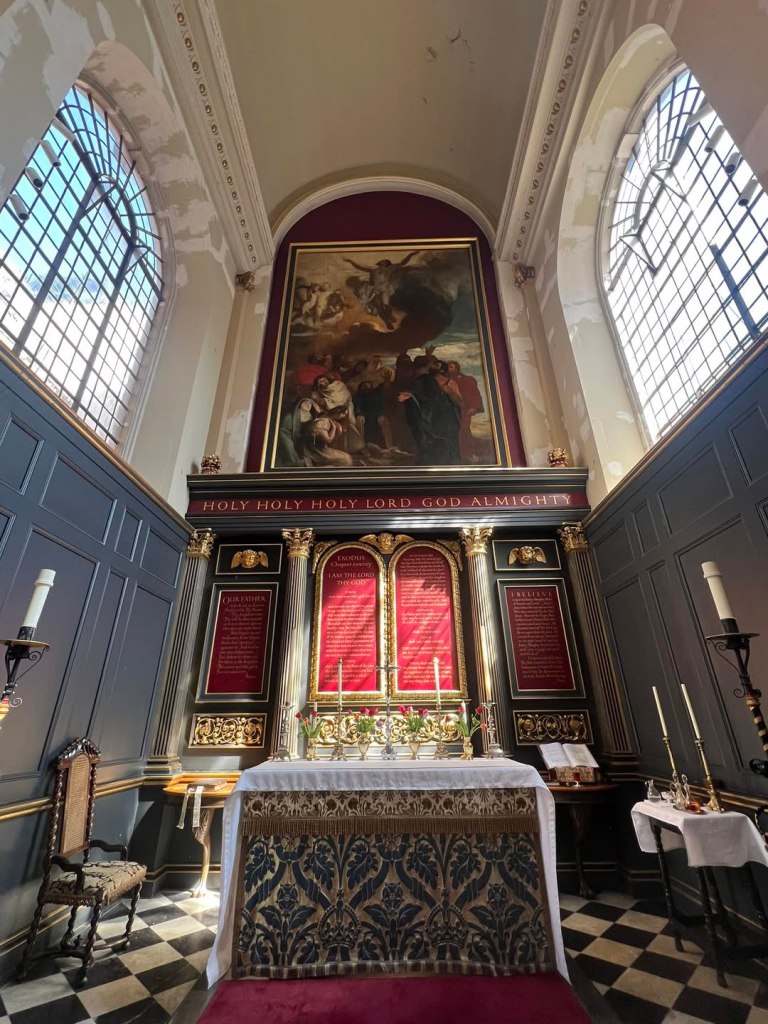
Wikipedia: St James Garlickhythe
Parish website: St James Garlickhythe
no “grand system”!
The philosopher creates and critiques continuous lines of argument. The aphorist, on the other hand, composes scattered lines of intuition. One moves in a chain of discursive logic; the other by arrhythmic leaps and bounds. Much of the history of Western philosophy can be narrated as a series of attempts at the construction of systems. My theory proposes that much of the history of aphorisms can be narrated as an animadversion, a turning away from grand systems through the construction of literary fragments.
A Theory of the Aphorism, 2
 a fool and his prayer book