A particular individual can take the lead in an insurrection, but no particular individual can take the lead in leveling, for then he would, after all, become the commander and escape the leveling. Particular individuals may contribute to leveling, each in his own little group, but leveling is an abstract power and is abstraction’s victory over individuals. In modern times leveling is reflection’s correlative to fate in antiquity. The dialectic of antiquity was oriented to the eminent (the great individual—and then the crowd; one free man, and then the slaves); at present the dialectic of Christianity is oriented to representation (the majority perceive themselves in the representative and are liberated by the awareness that he is representing them in a kind of self-consciousness). The dialectic of the present age is oriented to equality, and its most logical implementation, albeit abortive, is leveling, the negative unity of the negative mutual reciprocity of individuals.
Two Ages, 84
Category: Kierkegaard
beards etc
[W]earing a beard in Orthodoxy can and should be interpreted as an outward sign of an inward belief. The Bible makes a strong case that growing a beard is an honor for a man and glory to God. … What is it about a man’s face that would cause him to reflect on who and what he is and what is required of him? In short, if he wore a beard in compliance with the holiness code, he would immediately be reminded of his obedience to God and his ways. Modern times reflect something similar.
Ask An Eastern Orthodox Christian: On Beards
To shave or not to shave, that is the question. I have a beard because I am lazy and really dislike shaving.
Yet the above makes the point that the outward sign is a reminder for the individual. This is a great starting point for everything – clothing, religious symbols, etc. These are a reminder for me and not a religious “look at me”. Or, as Soren Kierkegaard says,
[The individual] is a stranger in the world of the finite, but does not define his difference from worldliness by an alien mode of dress (a contradiction, since it would define him as worldly); he is incognito, but his incognito consists precisely in looking just like everyone else.
Concluding Unscientific Postscript (Cambridge Texts in the History of Philosophy), 345
Ok, not incognito with a long white beard but nothing about me screams heretic!
certainty of now?
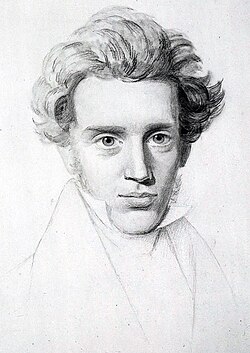
It is really true what philosophy tells us, that life must be understood backwards. But with this, one forgets the second proposition, that it must be lived forwards. A proposition which, the more it is subjected to careful thought, the more it ends up concluding precisely that life at any given moment cannot really ever be fully understood; exactly because there is no single moment where time stops completely in order for me to take position [to do this]: going backwards.
Kierkegaard, Journals 1843
Trinity or heresy Sunday?
Today is Trinity Sunday. The BCP sets John 3 as the Gospel while the Western Roman Rite has Matthew 28:18–20. Interesting?! I am not much of a theologian (hubris much?!) so the following needs to be read with some salt.
I have heard many sermons trying to explain the Trinity. Some end in modalism – oh, so modern – others in a different heresy. The worst are “children’s sermons” that use physical examples. I sometimes wonder if Trinity Sunday should not be renamed to “Heresy Sunday”?!
So, simply, a reworked quasi-quote from Kierkegaard:
[The Trinity] is not a problem to be solved, but a reality to be experienced
inner vs outer
Now if what has been advanced here is true, if there is nothing incommensurable in a human life except the incommensurability that is there only by accident, from which nothing follows insofar as existence is considered ideally, then Hegel is right. But he is not right in speaking about faith or in allowing Abraham to be regarded as its father, for by the latter he has passed sentence both on Abraham and on faith. In Hegelian philosophy the outer (the externalization) is higher than the inner. This is often illustrated by an example. The child is the inner, the man the outer; hence the child is determined precisely by the outer, and conversely the man as the outer by the inner. Faith, on the contrary, is this paradox, that inwardness is higher than outwardness, or to recall a previous expression, that the odd number is higher than the even.
Evans, C. Stephen; Walsh, Sylvia. Kierkegaard: Fear and Trembling (Cambridge Texts in the History of Philosophy), 60.
Jesus alone?
But Christendom has abolished Christianity – on the other hand, it would like to inherit Him and His great name, to gain advantage from the immense consequences of his life, coming pretty close to appropriating these consequences as its own meritorious achievement and making us believe that Christendom is Christ. Every generation has to begin all over again with Christ and thus to present His life as the paradigm; but instead of this, Christendom has taken the liberty of interpreting the whole relationship simply historically, beginning by letting Him be dead – and then it triumphs! Since that time Christendom has been increasing in numbers year by year – and what wonder; for people are only too eager to take part when there is nothing whatever to do but to triumph and to join the parade. And therefore to be a Christian in Christendom is as different from being a Christian in the situation of contemporaneousness as paganism is from Christianity.
Training in Christianity, 109
transparency
This, then, is the formula that describes the state of the self when despair is entirely eradicated: in relating to itself, and in willing to be itself, the self is grounded transparently in the power that established it.
Sickness unto Death, #132
heroism
It is Christian heroism—and indeed, it is perhaps seen quite rarely —to dare to be oneself entirely, an individual human being, this particular individual human being, alone before God, alone in that enormous effort and that enormous responsibility; but it is not Christian heroism to be fooled by the abstract notion of pure humanity in itself, or to play “Guess Who?” with world history.
Sickness unto Death, #117
nobody goes further
Faith is the highest passion in a human being. There are perhaps many in every generation who do not even come to it, but nobody goes further.
Evans, C. Stephen; Walsh, Sylvia. Kierkegaard: Fear and Trembling (Cambridge Texts in the History of Philosophy), 108.
further …
… to yesterday’s post, what if, here is a section from Kierkegaard:
But as in Christendom everything has been brought to confusion, so also this; and thereby the point has been reached where Christianity has become paganism. In Christendom they preach perpetually about what happened then after Christ’s death, how He triumphed, and how His disciples made a triumphal conquest of the whole world-in short, one hears only sermons which might properly end with Hurrah I rather than with Amen. No, Christ’s life here upon earth is the paradigm; it is in likeness to it that I along with every Christian must strive to construct my life; and this is the essential object of the sermon, this is the end it should serve, to keep me alert when I would become slack, and to strengthen me when I would become disheartened. In such a sense He is the paradigm in the situation of contemporaneousness; in that situation there was no stuff and nonsense about what happened afterwards. But Christendom has abolished Christianity – on the other hand, it would like to inherit Him and His great name, to gain advantage from the immense consequences of his life, coming pretty close to appropriating these consequences as its own meritorious achievement and making us believe that Christendom is Christ. Every generation has to begin all over again with Christ and thus to present His life as the paradigm; but instead of this, Christendom has taken the liberty of interpreting the whole relationship simply historically, beginning by letting Him be dead-and then it triumphs! Since that time Christendom has been increasing in numbers year by year-and what wonder; for people are only too eager to take part when there is nothing whatever to do but to triumph and to join the parade. And therefore to be a Christian in Christendom is as different from being a Christian in the situation of contemporaneousness as paganism is from Christianity.
Training in Christianity, 109
 a fool and his prayer book