So I have posted for 93 days straight. Without stopping or missing a day. But today I am out of ideas. I feel exhausted and emotionally drained and numb. So this is Day 94 – not very interesting!
Author: a fool
All alone with Jesus
the problem with authority
From the very beginning, I have stressed and repeated unchanged that I was ‘without authority.’ I regard myself rather as a reader of the books, not as the author. ‘Before God,’ religiously, I call my whole work as an author (when I speak with myself) my own upbringing and development, but not in the sense as if I were now complete or completely finished with respect to needing upbringing and development.
On My Work as an Author (1851)
The problem with authority is that you always are speaking on someone else’e behalf. I think SK understood that in the religious sense. I have come to appreciate that I am completely without authority.
the problem with sermons
Once in a while a pastor causes a little hubbub from the pulpit, about their being something wrong somewhere with all these numerous Christians – but all those to whom he is speaking are Christians, and those he speaks about are not present.
The Point Of View For My Work As An Author (1848)
Sermons are sometimes more about validating the audience than challenging their unbelief.
being utter nothingness
I have been reading Julian of Norwich: Revelations of Divine Love. Just a couple quotes:
BEING A NOBODY in a society obsessed with prestige and prosperity is a challenging position; and yet embracing a state of utter nothingness, renouncing the clutter of worldly possessions and the preoccupation with social status, can, in fact, be a totally liberating experience.
Yes, being utter nothingness is very countercultural. There is a sense that being nothing is about being a person – a “no thing”. But in a world of objects that can be measured and valued, being a person is often being nothing.
For if I look at myself, I am really nothing; but as one of mankind in general, I am in oneness of love with all my fellow Christians; for upon this oneness of love depends the life of all who shall be saved; for God is all that is good, and God has made all that is made, and God loves all that he has made.
Yes, being nothing is about oneness with everyone else who is nothing. And about oneness with God who is above all a “no thing”.
beards?!
I have been reading about beards on the Catholic Encyclopedia. There is some very interesting information from a western point of view. Just some quotes:
Thus an ordinance of the Council of Toulouse, in 1119, threatened with excommunication the clerics who “like a layman allowed hair and beard to grow”, and Pope Alexander III ordained that clerics who nourished their hair and beard were to be shorn by their archdeacon, by force if necessary.
So laypeople beards, clergy no beard. And if the clerics do not like it – shave by force! The last part really made me laugh.
… the clergy “should not seem to be aping the fashions of military folk” or wearing flowing beards like goats (hircorum et caprarum more), or allowing the hair on their upper lip to impede their drinking of the chalice.
Beards like goats? Interesting terminology. But at least this suggests a practical reason behind the common practice of clean-shaven.
… in Eastern lands a smooth face carries with it the suggestion of effeminacy.
Hence the Orthodox clergy and monks with long beards.
Anyway, I might keep my beard. Not for religious reasons but because I am too lazy to shave.
regrets
And if I bend and if I break
I'll trust the hands that hold me are greater than all my regrets
Macarius again
I found this video and thought I would share it. I feel a kinship with St Macarius. Enjoy!
header image
I thought I would update the header image to reflect more of where I am at. So here it is:
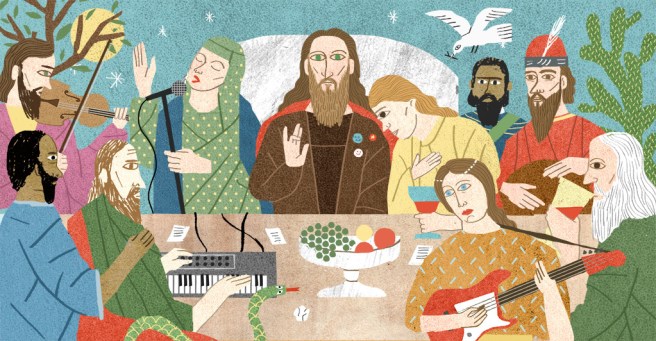
layperson?
Yesterday, during “leadership prayers” before church, I had this strange inside: I like being part of a community of Christians within the Anglican tradition. I had this very strong sense that this was a new beginning for us as a community and for me as an individual. I have been struggling with a couple of issues and, as always, it has affected my sense of balance.
I have been thinking about what it means to be a layperson. And, in my case, a layperson with a theological degree. So a person who has the same academic qualification as a priest but has no desire to become clergy. I will add, a very happy Anglican! Experience has taught me that I do not have the gifts to run a parish or to be involved in the larger denominational context. I am somewhat of a free spirit and like my own agenda.
I have no desire to lead a parish (what a disaster that would be) and I do not want to celebrate the divine mysteries. Other people do that much better than I could ever do. I am happy to use my gifts within the liturgy as a layperson – serving or being Master of Ceremonies, and sacristan. In my current context, it means helping with the technology on a Sunday and setting up the altar before our service.
For my own mental health, I need to be in “the moment”. That means being what I am right now and not looking forward to a possible self that depends on others. And right now I am a “happy layperson” who sometimes teaches and sometimes helps in the parish. I like the freedom of being “without authority” (like SK!). I like that I am answerable to my vicar for what I teach and what I do.
I like the freedom of being an Anglican – the unity within diversity that means I can be “somewhat Catholic” within an emerging parish. A context where doctrine is a witness but not as important as Jesus. I want to be part of a context where the sign of the cross is as familiar as hands raised in praise. Individuals gathering around Jesus!
So a somewhat weird start to the week!!!
as long as I know how to love
I heard this song on the way home from church. Yes, I have heard it before but the lyrics really struck me today. A witness to the truth and an echo of what has been going on inside me.
“As long as I know how to love I know I’ll stay alive”!!!!
 a fool and his prayer book