If the monastic ideal is to attain a creative spiritual freedom, if the monastic ideal realizes that freedom is attainable only in God the Father, God the Son, and God the Holy Spirit, and if the monastic ideal asserts that to become a slave to God is ontologically and existentially the path to becoming free, the path in which humanity fully becomes human precisely because the created existence of humanity is contingent upon God, is by itself bordered on both sides by non-existence, then is such an ideal Christian? Is such an ideal Biblical—New Testamental? (The Byzantine, Ascetic and Spiritual Fathers)
Sánchez-Escobar, Ángel F.. ON ASCESIS AND HESYCHASM, AND THE CHURCH FATHERS (Books on Christian Orthodoxy) (p. 47)
Asides
just in case …
… I have not mentioned it: I have started using Common Prayer: Daily Prayer as my office book. And I must admit I absolutely love it. It is physically a very nice book. And the offices are within the Anglican tradition and solidly traditional in their shape. It provides Morning Prayer, Prayer During the Day, Evening Prayer, and Prayer at the end of the day. I like the four-fold office as it is doable for me in my current context. And, to be honest, I do not want more at the moment!
I will admit that sometimes I feel some anxiety about not using the Australian prayer book that my parish uses. But that is for another day to consider!
a picture is worth a 1000 words

Me, right now!
Reading list?
I have decided to keep a list of some of the books and articles I have read in the last month or so. So go to Anchorite Reading List.
reading?
Aelred of Rievaulx, in his Rule of Life for a Recluse, laments that some anchorites like gossiping:
… their purpose no longer to being to arouse desire but to gratify it.
I think that is also true for a lot of reading in a modern context. People read all the time – online, on their phones, emails, etc. In a sense, anchorite solitude is all about space to read. But read well! Reading to “arouse desire” for Jesus. Not reading to pass the time or “gratify” a base desire. Reading to move closer to Jesus.
I think people of faith should make more time for reading to arouse desire. Not just the Scriptures or the Prayer Book – both of which should be a very important part of every day. Lectio Divina should become a part of every Christians’ day.
Also good Christian books. Our tradition is overflowing with good reading material for which a whole lifetime would not be enough to read. Guided reading – with a spiritual guide – would be a magnificent place for people to feed their spiritual life.
Sorry if that is a little preachy.
my cell
I have used this verse from the Song of Songs (2:5) as my tagline on this blog for a couple of months:
He brought me to the banqueting house,
    and his intention toward me was love.
Today, I was reflecting on the monastic cell – the place where a religious “lives”. It is the place where God leads the individual and the intent of God is only love. And the intent of the religious is on God alone – their naked intent is for Jesus.
I find that thought really comforting – there is a place where I am alone with God and where God is all about love. A place God himself has “brought me”. A place of rest! A place of no hiding from God or myself.
risking it all
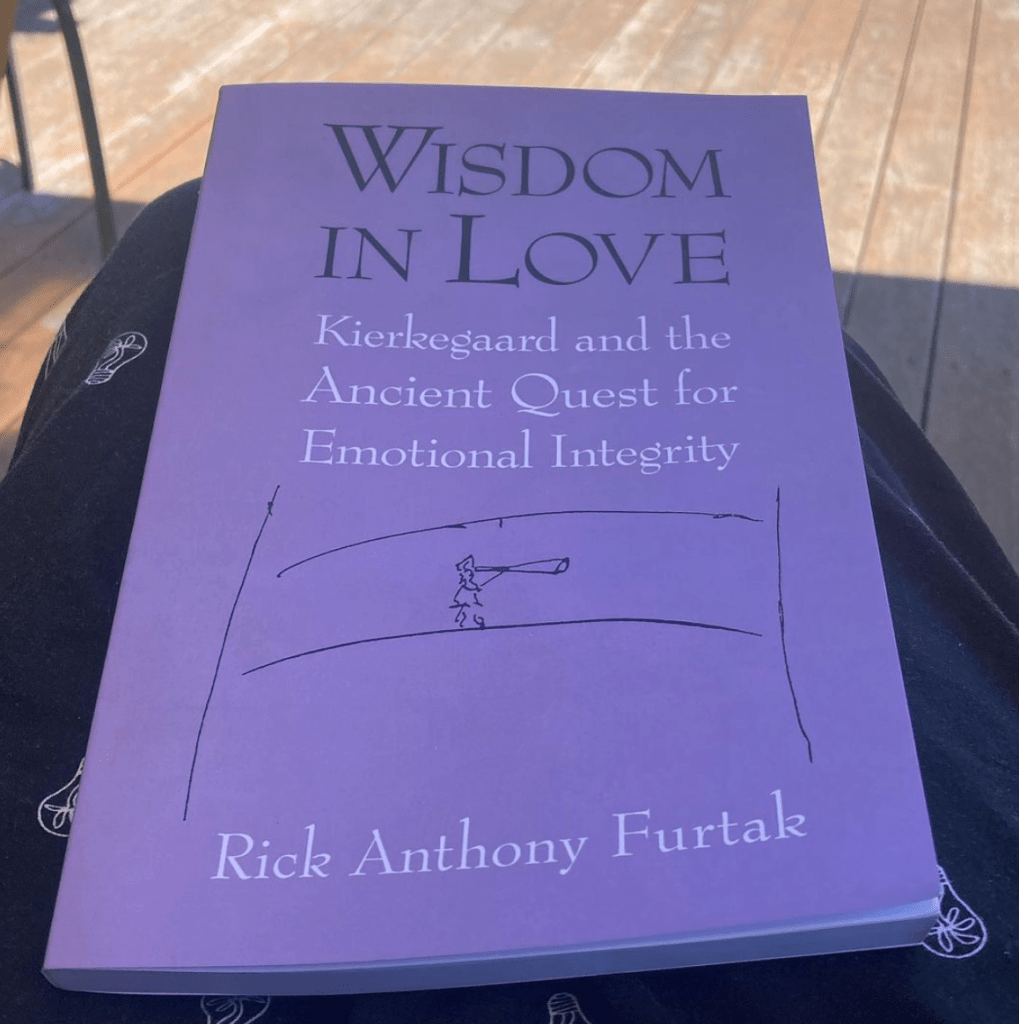
I have been reading Wisdom in Love: Kierkegaard and the Ancient Quest for Emotional Integrity by Rick Anthony Furtak. It has been on my list for a while and it was on special so I thought I might as well. I have been thinking about emotions a lot and this book really hits the spot on that topic.
So here is a quote from the Introduction:
One uncomfortable truth which emerges from this inquiry is that we cannot sustain the emotions that hold us together without accepting the risk of suffering the emotions that tear us apart.
All life involves risk! Maybe that is the fundamental problem with people today?! (Sorry, that is really judgemental and generalised.) Maybe that is the fundamental problem with me!? Life always involves risk because it always involves faith.
I did a quick google (as you do!) and found this article: Kierkegaard on the Psychology of a Risk Averse Society. It is worth a read.
So my point? I think we have become a society that likes to watch because we like to play it safe. It is much more fun watching someone else do the risky thing. More fun watching the “love story” or the “adventure movie” than loving or acting ourselves. But can we really grow (spiritually or emotionally) if we never risk? With the risk of being wrong can we ever really be right? Without the risk of hate can there ever really be love?
kindle my affections
Open, O Lord, my mouth to bless thy holy Name; cleanse also my heart from all vain, evil, and wandering thoughts; enlighten my understanding and kindle my affections; that I may worthily, attentively, and devoutly recite this office, and so be meet to be heard before the presence of thy divine Majesty. Through Christ our Lord. Amen.
I have used the traditional prayer before the Office for many years. (Yes, I still use the more traditional language above because my mind is old and I cannot learn anything new.)
I have been thinking about “kindle my affections”. For many years I have tried, at all costs, to keep emotion out of my relationship with Jesus. But is it really a “relationship” without emotions? Yes, ordered affections! But not “no affections”. Part of my struggle with depression has been an unwillingness to see my feelings as real – I have feelings. I still need to learn to express them in the right way in the right context. But these feelings are not pre-defined for me by my context.
I have learned that I am not a robot – I have feelings and desires. And my relationship with Jesus is not about stopping those but ordering them to Jesus – “Jesus, I desire you alone!”. Holy tears are part of that discovery.
Jesus wants a human response to Him and that response must include feelings.
religious life?
I have been returning to an older theme: religious life. And I have been thinking about two quotes in particular that, I think, say the same thing.
Life in Religion is the ultimate wager on the existence of God. The Church should always be engaged in doing things that make no sense if God does not exist. This is the reason why I hold the Religious life in the highest esteem … the monastic life models for all Christians what it means to live fully and abundantly, with and for Christ.
The Most Rev’d Justin Welby, Archbishop of Canterbury
Foreword to: Anglican Religious Life 2016-17
Of this there is no doubt, our age and Protestantism in general may need the monastery again, or wish it were there. The “monastery” is an essential dialectical element in Christianity. We therefore need it out there like a navigation buoy at sea in order to see where we are, even though I myself would not enter it. But if there really is true Christianity in every generation, there must also be individuals who have this need.
Kierkegaard, Nov 1847
I am always amazed that Kierkegaard, living in 1800s Lutheran Denmark, writes at length about “the monastery” in his journals. What experience would he have had of religious life? What books would he have read? And, in some ways, his very life is an example of what he said above – even if he does not want to enter a monastery.
To put it another way: people need to take the “single individual” to the extreme to show other people what it means to be the “single individual” – “dare to desire Jesus alone”. I am seeing that reality more and more. Like yeast in the dough, individuals need to place all their eggs in the one basket (sorry!) and say, “what if all of this stuff about God is true?”. And much more: let’s take Jesus seriously and actually follow Him alone, pick up our cross and live a life of love.
I think both of these quotes call us to “new monasticism” (to introduce yet another person’s quote). Not looking to the past alone but using the past to live today for Jesus alone. Yes, the church as a community and especially individuals within the Church need to do things that make no sense if God does not exist. Individuals need to take Jesus seriously.
anchorite chapel
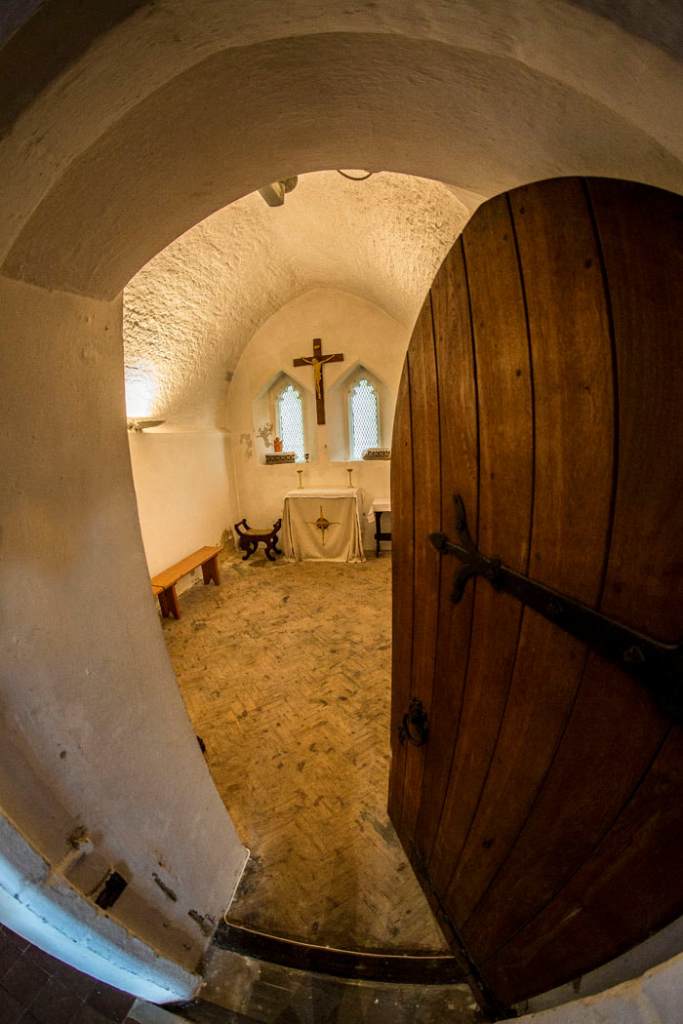
I really like this picture so I thought I would share it. More information (and the source of the above photo) can be found at All Saints in South Lynn and St. Peter in West Lynn.
 a fool and his prayer book