nihilism

What villain actually had a good point?
First thought is either Walter White or Tony Soprano.

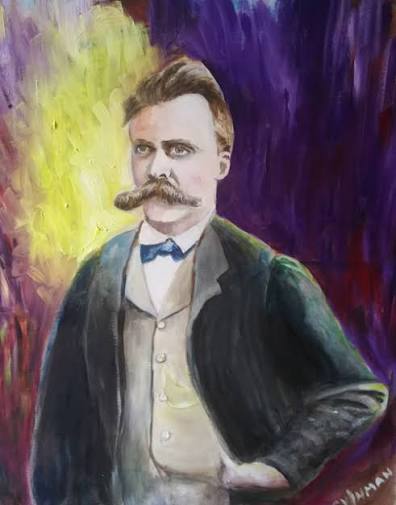
On reflection, I think the author of the “perhaps”, Beyond Good and Evil, and the “death of God”. Yes, he was super weird and he died after an extended mental illness but he needs to be experienced. I think his take on “truth” is well worth a thought or two. And his take on writing, that all is autobiographical, is worthy of much thought. His sister did him no service!

So, maybe not a standard villain, but Fredrick Nietzsche for me.
Russia and the BCP

I. There is nothing in the actual contents of “Daily Morning and Evening Prayer,” together with the collects, which change according to the season, which is open to any particular objection on the positive side from the Orthodox point of view, unless the addition of the Filioque to the Creed is taken into account. But at the same time, while the recourse in prayer to the Most Holy Mother of God, to the Angel Hosts, and to the illustrious saints, the glorification and invocation of them, forms an essential part of Orthodox and Catholic worship, these things are entirely foreign to Anglican worship. It is absolutely necessary that there should be introduced into this worship some such prayers (or hymns) in one or another form and degree.

Russian Observations upon the American Prayer Book

from St Andrew’s Service Book

A Table of Fast and Abstinence

Strict Fast Days
Ash Wednesday Good Friday

Wednesdays and Fridays are days of abstinence throughout the year.

Fast Periods During the Year:

  • Advent
  • The Forty Days of Lent
  • The Ember Days at the four seasons, being the Wednesday, Friday, and Saturday after the First Sunday in Lent, the Feast of Pentecost, September 14, and December 13.

The Wednesdays and Fridays that fall during a fast period are considered days of fast and abstinence.

Note: There is no fast or abstinence of any kind from Christmas Day to the eve of Epiphany, or from Easter to the following Sunday.

Abstinence means to avoid eating certain kinds of food; e.g., flesh meat, dairy products.

Fasting means to reduce the amount of food eaten, generally to one and one-half meals per day.

the holy mountain

If you could live anywhere in the world, where would it be?

I am very happy where I am at the moment. But …

Mount Athos! It would be so inspiring to live in a hermitage there. Maybe an old used one!? And soak up the wisdom of the elders. To simply “be” somewhere so beautify and with such history. Yes, I think I would like to live somewhere on Mount Athos.

If you ask me tomorrow, it will be a different place!

to be humble?

Humility is the quality of being humble and kind. While older definitions, such as the 1998 Oxford Dictionary entry, described humility as having a “low opinion of oneself” or “not being proudful”, more recent psychological and philosophical definitions emphasize having an “accurate opinion of oneself“. This modern view includes expressing modesty appropriately, possessing clear goal orientation, openness, broad-mindedness, and a non-imposing mentality.

The term “humility” comes from the Latin noun humilitas, related to the adjective humilis, which may be translated as “humble”, but also as “grounded” or “from the earth”, since it derives from the word humus (earth).

The word “humble” may be related to feudal England where the least valuable cuts of meat (whatever was left after the members of the upper class had taken their parts), or “umbles”, were provided to the lowest class of citizens.

Humility

money!

What’s a lesson you’ve learned recently that shifted your perspective?

I would like to say something profound and insightful. But I have learned recently that I am really bad with money. When I have it, I spend it. (Hence, my library.) Also I have noticed that I try to reward myself with purchases (that I absolutely do not need).

Having things does not make you happy, neither does it take away the darkness inside. My perspective shift!!!!!

monasticism is a strange event

By avoiding being recognised as an institution, monasticism remains hidden from the eyes of this world, and this allows it to keep its perfect and absolute freedom to exist purely on the spiritual plane, governed exclusively by the power of the Holy Spirit. If monasticism were to become an institution, it would cease to be a life ‘outside the camp of this world;’ it would lose its charismatic power of humility and its prophetic and paradoxical character, whereby it maintains the knowledge of God on earth.

Zacharou, Archimandrite Zacharias. Monasticism: The All-Embracing Gift of the Holy Spirit, 8

Monasticism is prophetic by nature not only because of its truthful character which attracts the Spirit of Truth, but also because the prophet of God has no place in this life, just as ‘the Son of man had nowhere to lay His head’, not even in the Synagogue which had been founded in His Name. However, the word of God loves the heart of the prophet for he has God as his only refuge. It runs through his heart freely and without hindrance as a stream of living water, so that his heart becomes a precious vessel filled with words of eternal life.

ibid, 10