There is, for me, a deep difference between longing and expectation.
In expectation, there is a demand – a standing in line, impatiently wondering, When will the line move?
In longing, there is a request – and a willingness to wait.
The waiting itself becomes a connection. When I truly ask – when my longing is genuine – I am open. Open even to pain, open even to disappointment.
This is living in the full force of life.
But when I am in expectation, I am demanding: The experience must come to pass! Do not disturb me now!
Ragen, Akiva ; רגן, עקיבא. The Secret of the Encounter: An existential interpretation of the book ‘I and Thou’ by Martin Buber, 8-9.
Category: MonasticLife
beards etc
[W]earing a beard in Orthodoxy can and should be interpreted as an outward sign of an inward belief. The Bible makes a strong case that growing a beard is an honor for a man and glory to God. … What is it about a man’s face that would cause him to reflect on who and what he is and what is required of him? In short, if he wore a beard in compliance with the holiness code, he would immediately be reminded of his obedience to God and his ways. Modern times reflect something similar.
Ask An Eastern Orthodox Christian: On Beards
To shave or not to shave, that is the question. I have a beard because I am lazy and really dislike shaving.
Yet the above makes the point that the outward sign is a reminder for the individual. This is a great starting point for everything – clothing, religious symbols, etc. These are a reminder for me and not a religious “look at me”. Or, as Soren Kierkegaard says,
[The individual] is a stranger in the world of the finite, but does not define his difference from worldliness by an alien mode of dress (a contradiction, since it would define him as worldly); he is incognito, but his incognito consists precisely in looking just like everyone else.
Concluding Unscientific Postscript (Cambridge Texts in the History of Philosophy), 345
Ok, not incognito with a long white beard but nothing about me screams heretic!
interesting article
I found this article via Facebook and thought it was interesting. Before anyone says anything, I have no view of the innocence or guilt of the individual but rather like this as a picture of transfiguration:
The Redemption of Frank Atwood
Atwood’s story echoes the lives of the great repentant saints: the Apostle Paul, once a persecutor; St. Moses the Black, a violent brigand; or St. Dismas, the thief on the cross. His prison cell became a desert where he was able to work out his salvation with fear and trembling. His correspondence reveals a soul grappling earnestly with sin, bravely confronting his mortality, and seeking union with God. His sponsors and monastic community, including monks and nuns who witnessed his transfiguration, affirmed the authenticity of this change and swore to his innocence in the murder of poor Vicki Lynne. …
On the eve of his execution, June 7, 2022, Atwood was tonsured a monk, receiving the Great Schema. He was given a new name, Ephraim.
without the church
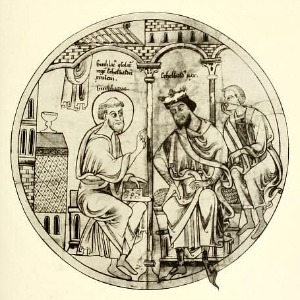
Under the guidance of the Holy Spirit, and counseled and assisted by the knight just mentioned, he moved to another village of his called Haselbury, some thirty miles east of Exeter. There in a cell abutting on the church, which had been empty for some time, and without the usual induction by the bishop and no solemn blessing, but only the inward authority of the Holy Spirit, he buried himself with Christ, shortly to be transformed with him in a sort of resurrection glory: in newness of life, in cheerfulness of spirit, in the power of signs, in the grace of prophecy.
The Life of Wulfric of Haselbury, Anchorite.
Wikipedia: Wulfric of Haselbury
Article: Saint Wulfric of Haselbury
spiritual elders
Even though many of the elders were priests or monks, or both, being an elder was not a church office, but rather an informal ministry. Individual supplicants engaged with spiritual elders sometimes with, or sometimes without, the sanction of the institutional church. The reputation of an elder was established “from below” by ordinary believers and an elder’s disciples. Hence, within the Orthodox Church, eldership may be regarded as a more democratic, nonhierarchical form of religious authority, which, until now, has not received sufficient analysis. ….
Many of them had an uneasy relationship with the institutional church.
Spiritual Elders: Chrisma and Tradition in Russian Orthodoxy, 4-5
tonsure
In essence, the monastic tonsure is a second Baptism. We have all been baptized and have given an oath that we will belong to God. We have said, “I do renounce Satan” and “I do unite myself to Christ,” and we have dedicated ourselves to God through the cutting of our hair, but we have forgotten all of this. In fact, by our Baptism, we have bound ourselves to the obligation of belonging to God. With the words “I do renounce,” which we then pronounced (if we were baptized as infants, then through the mouth of our godparent), we drove satan out of our lives, and we even spat upon him three times, losing all connection with him. With the words, “I do unite” we signed, in the presence of angels and men, a sacred contract that now we fully belong to God. With If anyone desires to come after me (Lk. 9:23) the Lord called to the unbaptized. It behooves us, the baptized, to pronounce: Speak Lord, for Thy servant heareth (1 Kg. [1 Sam.] 3:10). It is a big deal, my brothers, that we were baptized and became Christians. How terrible that we forget our baptismal vows, and from this we now lose the grace of holy Baptism.
Monastic Tonsure: Second Baptism, or the Marriage of the Soul to Christ
Jesus Prayer
St Elisabeth the New Martyr
living the Gospel
That we may be justified by the grace of our Lord Jesus Christ and by the guidance of the Holy Spirit, let us repudiate the customary actions of our own wills and the observance of human traditions. Let us, on the other hand, go forward by means of the Gospel of the Blessed God, Jesus Christ, our Lord. Having lived during this present life in a manner acceptable to Him, by a rigorous avoidance of all that is forbidden and a zealous observance of whatever is commended, may we be able in the future age of immortality to escape the wrath to come upon the sons of contumacy and be found worthy of obtaining eternal life and the heavenly kingdom which has been promised by our Lord Jesus Christ to such as keep his covenant and are mindful of his commandments to do them.’ [ Ps. 103:18 ] Moreover, remembering the words of the Apostle, ‘in Christ Jesus neither circumcision availeth anything nor uncircumcision, but faith that worketh by charity. [ Gal. 5:6 ] I regarded it as at once appropriate and necessary to set forth first the sound faith and sacred doctrine respecting the Father and Son and Holy Ghost, and then add the Morals.
St Basil, Preface on the Judgement of God
“Anglican” Religious Life
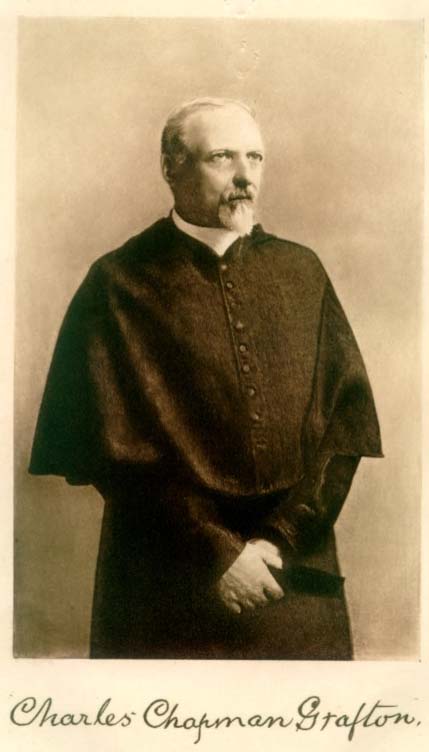
However, the general tone was of praise and support for Religious Life. The contribution which stands out, however, as one reads the debate a century later, came from Charles Grafton, Bishop of Fond du Lac in the USA, the only bishop present who had been a member of a community. He made three important points.
Petà Dunstan, Bishops and Religious 1897-1914
- First, he believed Religious Life was a vocation and should be treated as such.
- Second, it did not belong, as priesthood did, to the corporate life of the Church, but instead belonged ‘to the economy of the Holy Ghost’. Obedience to a Religious superior was a voluntary action of love, not the result of the legislative action of the Church. Unlike ‘the fixity of ministerial orders’ then, he believed the work of the Holy Ghost in the call of Religious Life manifested itself in a variety of different forms. Bishops had to trust this call to have a corrective power in itself.
- Third, he reminded the Conference that in Religious, bishops were dealing with ‘special devotional temperaments’ that could be ‘personally emotional’ about small matters of worship. A high-handed approach would not therefore be advisable. He went on to echo the arguments put forward in Father Puller’s paper, and concluded by suggesting bishops should regulate communities only in relation to property, financial donations and in insisting on communities ‘having sound government.
 a fool and his prayer book