Oh wow!!!
EDIT: there is a great article on Father Maxime Qavtaradze. Read!!!!
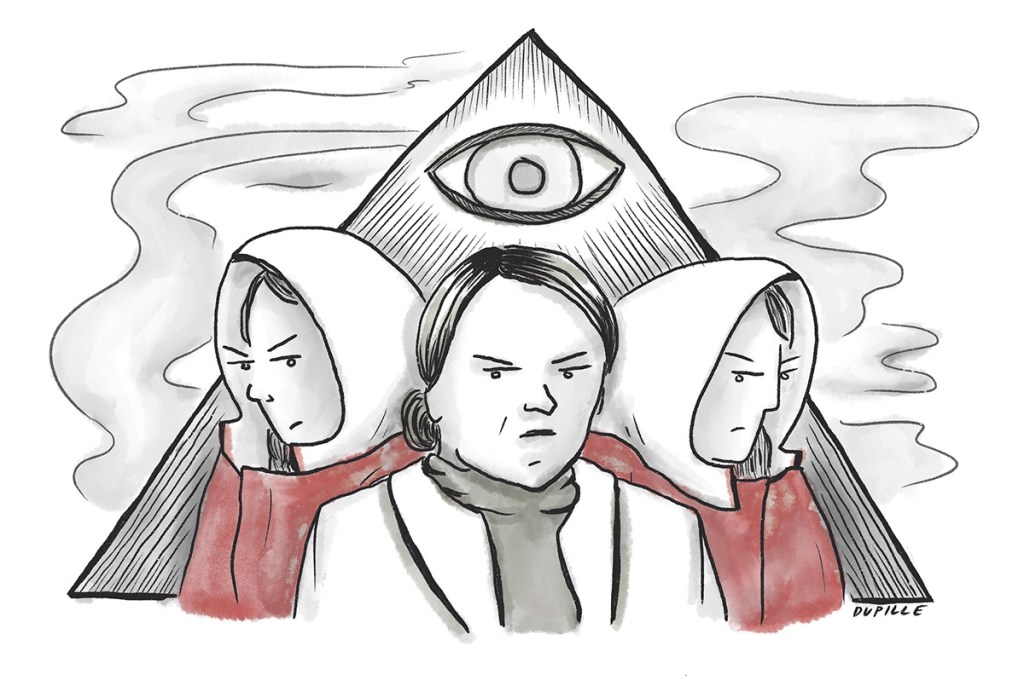
For a time I almost believed what I understood I was supposed to believe. I numbered myself among the faithful for the same reason that many in Gilead did: because it was less dangerous. What good is it to throw yourself in front of a steamroller out of moral principles and then be crushed flat like a sock emptied of its foot? Better to fade into the crowd, the piously praising, unctuous, hate-mongering crowd. Better to hurl rocks than to have them hurled at you. Or better for your chances of staying alive.
Atwood, Margaret. The Testaments
O Lord and heavenly Father, we thy humble servants entirely desire thy fatherly goodness mercifully to accept this our sacrifice of praise and thanksgiving; most humbly beseeching thee to grant, that by the merits and death of thy Son Jesus Christ, and through faith in his blood, we and all thy whole Church may obtain remission of our sins, and all other benefits of his passion.
And here we offer and present unto thee, O Lord, ourselves, our souls and bodies, to be a reasonable, holy, and lively sacrifice unto thee; humbly beseeching thee, that all we, who are partakers of this holy Communion, may be fulfilled with thy grace and heavenly benediction.
And although we be unworthy, through our manifold sins, to offer unto thee any sacrifice, yet we beseech thee to accept this our bounden duty and service; not weighing our merits, but pardoning our offences, through Jesus Christ our Lord; by whom, and with whom, in the unity of the Holy Ghost, all honour and glory be unto thee, O Father Almighty, world without end. Amen.
Holy Communion
I love the traditional (1662) Prayer Book. Much upon which to meditate and reflect!
If I wanted a funeral, which I do not, this would have to be part of it. The words and the music!!!!
I am down the rabbit hole of existentialism. So, I just wanted to share this quote (because someone out there agrees with me):
In his reflection, Søren Kierkegaard deliberately focused on his own life, making it the subject of philosophical contemplation. He believed that the only true philosophy stems from life – a view that Friedrich Nietzsche later shared and expanded upon. Kierkegaard maintained that the only life we truly know is our own experience. … Operating with general concepts and categories, thoughts inevitably simplify and schematize everything. Therefore, no philosophy, reasoning, or language can fully express the truth of human existence, which is something unique and unrepeatable. So, the truth about existence can only be accessible through inner experience.
Exploring Søren Kierkegaard: Pursuing Authenticity and Existential Freedom
And, I would add, everything else is a leap of faith.
We are born biological beings but we must become existential individuals by accepting responsibility for our actions. This is an application of Nietzsche’s advice to ‘become what you are’. Many people never do acknowledge such responsibility but rather flee their existential individuality into the comfort of the faceless crowd.
Flynn, Thomas.
Existentialism: A Very Short Introduction (Very Short Introductions)
O be joyful in the Lord, all ye lands : serve the Lord with gladness, and come before his presence with a song.
2 Be ye sure that the Lord he is God : it is he that hath made us, and not we ourselves; we are his people, and the sheep of his pasture.
3 O go your way into his gates with thanksgiving, and into his courts with praise : be thankful unto him, and speak good of his Name.
4 For the Lord is gracious, his mercy is everlasting : and his truth endureth from generation to generation.
… skepticism is but the result of our anxious desire to secure certainty by being “at home in the world.”
Harvey, Michael G.. Skepticism, Relativism, and Religious Knowledge
I struggle with what “tomorrow will bring.” I try to control things without much success. So, the above quote hits home (sorry!). Perhaps it is part of the anchorite tradition – the enclosed solitary life – to surrender any hope of certainty? I am thinking especially with other people. Do I have to make myself understood? Or is it that terrible if other people do not “get it”?
I am reading Slavoj Žižek. He is super funny. I think he is the perfect “modern” philosophy! Not for what he says but how he says it. Life is chaotic and unpredictable so why am I trying to be organised and predictable? Life is full of paradoxes and contradictions so maybe just take the leap and live?
All of that is super easy to say but living it is hard. Jesus by your holy wounds, have mercy on me.
No post – sorry. I have not spoken with anyone since the beginning of the year. So, maybe that helps?
I am reading. Lots of different books. I am trying for a book a week – non-theological and non-philosophical. I would like to read more literature. The first one is Never Let Me Go. A little slow at the start but gets a lot better. It has been banned in some states in the US.
Yesterday was a Desert Christian day. The following intrigues me:
We live in a society that is at once deeply individualist and deeply conformist; the desert fathers and mothers manage to be neither, and they suggest to us that the church’s calling likewise is to avoid both these pitfalls.
Williams, Rowan. Silence and Honey Cakes: The Wisdom of the Desert
The analysis is good. Yes, conformity is the only virtue. Perhaps it goes a little deeper:
Conformity is the tendency to change our perceptions, opinions, or behaviors in ways that are consistent with group norms. Norms are implicit, specific rules shared by a group of individuals on how they should behave. People may be susceptible to conform to group norms because they want to gain acceptance from their group.
Conformity
The modern tendency is to think, “If we can measure it, we can build it”. Perhaps Kierkegaard’s leveling?
Anyway, back to solitude and silence.
Day 1! Will I get through to the end? Maybe not a great question for the first day.
As this is Day 1, The Circumcision of Christ, the first spilling of blood, I am going to share some insights from Morning Prayer
Stand in awe, and sin not : commune with your own heart, and in your chamber, and be still.
Psalm 4:4, 5
Offer the sacrifice of righteousness : and put your trust in the Lord.
Almighty God, who madest thy blessed Son to be circumcised, and obedient to the law for man; Grant us the true circumcision of the Spirit; that, our hearts, and all our members, being mortified from all worldly and carnal lusts, we may in all things obey thy blessed will; through the same thy Son Jesus Christ our Lord. Amen.
I read a book on the spirituality of the Prayer Book that emphasised its monastic origins. Life is structured in prayer – Morning, Evening, and Mass. But the other side of monasticism – mortification or asceticism – did not get a mention. The 1662 BCP has a system of days of fasting, abstinence, and feasting.
So, Day 1: “mortified from all worldly and carnal lusts” and “offer the sacrifice of righteousness“.
 a fool and his prayer book