enclosed garden

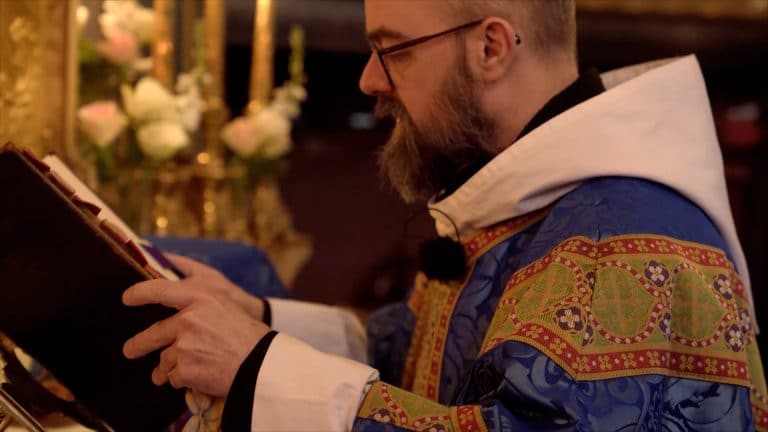
Similar to contemplative monasteries, the Office is kept in Warfhuizen. In Western Christianity, that is often prayed in accordance with the precepts of Saint Benedict, but in 2009, the hermit switched to the Office of Saint John Cassian from the 5th century. John of Cassian based his schedule on the customs of the hermits in the Egyptian desert, the so-called Desert Fathers, making it very suitable for hermits.

Instead of the eight (usually short) Benedictine offices, Cassian prescribes two (longer) vigils, one at the start and one at the end of the night. In Warfhuizen, these vigils are sung softly in Latin. The other hours do not have an office with Psalms, but are prayed in silence using the Jesus Prayer.

As such, the Office currently used in Warfhuizen clearly deviates from that of the ancient Dutch hermits, who usually used an abbreviated Liturgy of the Hours of Benedict. The influence of the Limburgian tradition on the atmosphere in the hermitage remains clearly noticeable through the various additions from popular devotions, such as praying the Rosary and various litanies, which are sung out loud at various moments during the day. The chapel’s decorations are also a continuation of 17th century examples, through Baroque elements. The devotion to Saint Gerlach of Houthem, of whom there is a reliquary in the retable of the right side altar, has a special place in the hermitage. Saint Anthony Abbot is also especially honoured, with a relic of his kept in the Holy Cross altar.

In addition to the old southern tradition, there are also other influences on the liturgy. The fact that some volunteers are Russian Orthodox has led to the Jesus Prayer being sung in Greek after Compline. The Carthusian tradition is also noticeable in the manner of Gregorian chant.

Our Lady of the Enclosed Garden

Russian spirituality has had an enormous influence on my spiritual life for years, if only because of the Startsi. The Startsi – singular starets – are monks who act as the spiritual father of an entire region, including the monastery where they live. They represent, as it were, the father of the prodigal son,* the spiritual home where you are always welcome and where warmth, safety, and good advice are in abundance.

The sleeping fathers of Kiev (Google translate)

spirituality not religion?

Eremitical life is an expression of spirituality, not religion. When a culture is in a period of profound flux, we spontaneously reach for whatever provides us with a sense of stability. If the religious practices to which we have been accustomed fail to meet our needs, we begin to dig more deeply, bypassing inadequate expressions, usually incarnated in communal formulations, to find our individual roots in the Spirit. Since the end of World War II, there has been a gradual revival of hermit life in Western Christianity. This surprising development is too young yet to be thoroughly analyzed or its fruits fully appraised. At this point, all we have is anecdotal information; experiences related by those who are living this lifestyle in a culture that does not understand it.

Consider the Ravens: On Contemporary Hermit Life

hell is other people

Shortly before the end of [No Exit], one of the three strangers puts into words that toward which the whole play is turning from its beginning when he says that: “There’s no need for red-hot pokers. Hell is other people.”

“Hell is other people” means thus that it is hell and unbearable to exist subject to, awaiting, controlled by, and turned toward the Other’s approval, judgements, and opinions.

“Hell is other people” describes an existence existing at the mercy of the Other, the Other’s judgements, and the Other’s accusing gaze. It is hell, tormenting, and unbearable to be unable to escape the Other’s look that objectifies and, in its objectifying, tortures.

Explaining Sartre’s “Hell Is Other People”

… as a punishment for criminals

In antiquity as well as in the Middle Ages there was an awareness of this longing for solitude and a respect for what it means; whereas in the constant sociality of our day we shrink from solitude to the point (what a capital epigram!) that no use for it is known other than as a punishment for criminals. But since it is a crime in our day to have spirit, it is indeed quite in order to classify such people, lovers of solitude, with criminals.

Sickness Unto Death

All for Jesus

Whatever the rhythm of prayer may be, by day and by night, solitaries must never lose sight of the fact of Jesus as Saviour; it is he, and only he, who draws us to the Father and who has promised us the ministry of the Spirit. We must never lose sight of the Incarnation and all that flows from it; that is the uniqueness and completeness of the Christian way.

Solitude and Communion: Papers on the Hermit Life, 108

whole in each

The Church of Christ is united in all her parts by the bond of love, so that she is both one in many members and mystically whole in each member. … If those who believe in Christ are one, then wherever an individual member is present, the whole body is also there through the mystery of the sacrament.

Peter Damian, Letter 28 Dominus Vobiscum.

incognito: the hiddenness of the solitary life

For you died, and your life is hidden with Christ in God. (Col 3:3)

The individual does not stop being a human being, take off finitude’s motley in order to be dressed in the abstract garb of the monastery; but nor does he mediate between the absolute τέλος and finitude. In immediacy the individual is rooted in the finite; when resignation has convinced itself that he has acquired the absolute orientation towards the absolute τέλος, … He is a stranger in the world of the finite, but does not define his difference from worldliness by an alien mode of dress (a contradiction, since it would define him as worldly); he is incognito, but his incognito consists precisely in looking just like everyone else.

Kierkegaard: Concluding Unscientific Postscript