risk?

Life in Religion is the ultimate wager on the existence of God. The church should always be engaged in doing things that make no sense if God does not exist.

Most Revd Justin Welby, Archbishop of Canterbury

The above is from the Foreword to the Anglican Religious Life Year Book, 2016-17. I suspect I have quoted it before.

I have been thinking about risk and paradox. Maybe we live in a world that tries to remove both? But both are required for faith. Unless we make faith simply a way of knowing without evidence, a religious epistemology that places knowledge above faith, faith needs risk and paradox.

solitary?

The terms Hermit and Solitary are often used interchangeably but for the purposes of the Handbook, the term ‘hermit’ refers to a member of a Religious Community and the term ‘solitary’ refers to one who is not a Religious.

A Handbook of the Religious Life, The Advisory Council for Religious Communities

So … the above is from the Church of Englabnd document, and there is an Australian version that is not as clear, indicating that people living a “vow of celibacy” can do so under a religious rule (hermit) or under a personal rule (solitary).

I think the term religious can be confusing. In a sense (but who am I to say this) the solitary is the modern form of an anchorite – a celibate/single layperson living alone under a rule. And that is how I use the term anchorite – a single layperson living under a personal rule inspired by the lived example of anchorites.

I have been thinking about the above a lot recently. Am I called to such a life? Especially with a few things that are going on in my life, am I called by God to embody a religious incognito type of spirituality within the context of a modern parish?

love the truth?

So here is a completely random idea: what if we were to stop talking about knowing the truth and start talking about loving the truth? Or, to put it in Christian terms, what if we were to stop talking about knowing Jesus and start talking about loving Jesus?

While I kinda understand the idea of knowing something, I think it has been drawn into a direction that is not helpful for our relationship with Jesus. It makes the relationship all about our head and then our heart. Let’s turn that around and make it about the heart exclusively. Let’s make it a human relationship rather than an intellectual.

I want to write about this more but I think this is a start!

new monasticism?

I have been reading a book that had moved me. Okay, that is not usual! It has made me glad and sad in equal measure.

The book is Living the Hours: Monastic Spirituality in Everyday Life. The authors are, I think, involved with Monos which is the UK organisation for “new monasticism”.

So here are a couple of takeaway points from my reading so far:

  • New Monasticism – vocation verses vacation?
  • Four Pillars: Prayer, silence, balance, and study
  • Living a rule
  • Monasticism as the context for being human

It is an interesting read.

rule of life?

I have been thinking of reworking my rule of life. I think it needs to be more describtive rather than prescriptive. I think it needs to be less like rules of old and more like something I can live today.

I have also been reading an article by David Law on Kierkegaard’s view on monasticism. It still amazes me that as a Lutheran in Denmark, who would have had little exposure to monasticism, Kierkegaard spends a lot of time writing about it in his Journals and in other writings. I think it shows that monasticism does offer a challenge and, as the Archbishop of Canterbury has said, is the ultimate wager on God.

Anyway, I was reading the ACARLA (Advisory Council for Anglican Religious Life in Australia) website yesterday before our prayer group. And I read this:

Another form of consecrated life is that of living as a consecrated single person. This is essentially a “hidden life” – without any distinct dress or title.

And I thought of this quote from Kierkegaard:

[the individual] is incognito, but [their] incognito consists precisely in looking just like everyone else.

Kierkegaard writes that within the context of his discussion of monasticism in Concluding Unscientific Postscript. (I have written about it before.) Maybe he is onto something?!

Anyway, I might rework my rule of life today.

experience?

To be honest I only know very little about a very small circle. One of the people I have heard about but never read is Karl Barth. The book I have been reading looks at Barth’s thoughts on monasticism. I will admit that reading it makes me glad to be an Anglican! But I was struck by this:

In Barth’s understanding, Tersteegen’s faith grew “not from confession to experience, but from experience to confession,” which is “the way of self-denial”.

Gerhard Terteegen was a pietist who influenced both Barth and Kierkegaard. So the above quote speaks even more to me.

Maybe a more Kierkegaardian way of putting that is to speak about “resolution preceding conclusions”. Theology is a systematic way of looking at the experience of faith – in Scripture and Tradition – and trying to see themes. But it is the experience that establishes the relationship.

All of that made me wonder: can a heretic be saved? Can a Christian who has experienced the love of God in Jesus be a heretic? Or, to put it a completely different way, can “doctrine save”?

So the answer to the question, that was not asked, is I need to read more!

normal?

After my recent changes I had hoped that I would return to feeling normal. I was hoping for some sense of balance.

This morning I had an insight: what is normal for me? Do I actually have any idea what a balanced life looks like for me? This is the first time in my life – all 50 plus years of it – that I have had the space to find answers to the above.

In the past, and this is one insight that has become clear to me, I defined normal by other people. I thought I could trust people. I thought I could rely on love and mercy working through people for my good, for my normal.

So while I feel somewhat stuck, I know why.

vows as sacrifice

I appeal to you therefore, brothers and sisters, by the mercies of God, to present your bodies as a living sacrifice, holy and acceptable to God, which is your spiritual worship. Do not be conformed to this world, but be transformed by the renewing of your minds, so that you may discern what is the will of God—what is good and acceptable and perfect.

Romans 12:1-2

I have been reading a book on the theology of monasticism within post-reformation groups, Reforming the Monastery: Protestant Theologies of the Religious Life. Interesting! The Anglican chapter is especially interesting as it shows how different the English reformation was from its continental counterparts.

The first chapter looks at Luther and Calvin. Both have the same problem with monasticism: vows as works. The context is faith and works versus works in our relationship with God. So, one could say, Luther and Calvin are not anti-monasticism but rather against the taking of vows that are not directly related to our relationship with God.

But I think (and who am I to say anything?) that the above becomes less of a problem when vows are seen in terms of Romans 12: vows as sacrifice. I need to go much deeper than a superficial reading of the above – and I hope I can do that in the near future. I also realise that the very term sacrifice is a disputed idea. Above all, I am glad I am an Anglican (alas, a very poor one) because it allows the freedom to move beyond the above Reformers.

So allow me to put forward a working definition of sacrifice (that does not include death): a sacrifice is a free surrender of a good for a greater good. And the greater good in the above context is always Jesus. So vows as sacrifice would look a little like this: the free intention of the individual to surrender a good (created by God) for the greater good of living for Jesus alone. The intention is never to work towards salvation or away from my sin but rather an act of love for Jesus. And, by extension, an act of love for my neighbour whom I am free to serve in various ways.

Anyway!

reading

I have had more time to read. I am a little of a shatter-brain reader – when something takes me I like to simply sit and think. (Or pretend to think!) So sometimes I read a huge amount and sometimes only a sentence.

I have been reading Emerging Prophet: Kierkegaard and the Postmodern People of God. I have not read much about the emerging church movement so the book has been a nice introduction. I am more of a new monasticism type person.

I am struck, again, how Kierkegaard is way ahead of his day. He is one of a kind, a single individual, far apart from the crowd. Maybe he is the original new monastic religious? I would like to read more about the emerging church movement! And I want to read more about and by Kierkegaard.

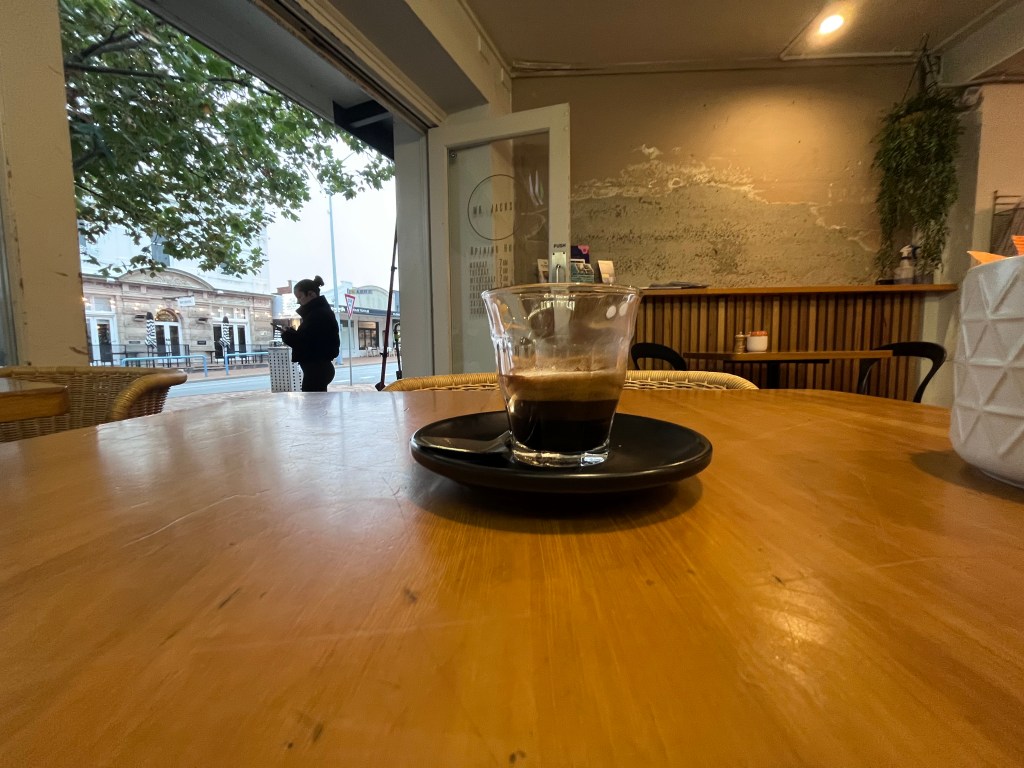
As an aside (completely off-topic): I wonder what Kierkegaard would make of me? (How egotistic!) Would he sit with me in a cafe and drink coffee (and smoke cigars)? Or would he walk past me in the street?

So what are you reading?

anxiety?

So I have made some changes in my life. I think (maybe?!) I am ok with those decisions. But yesterday afternoon I had an anxiety attack. I know the signs and I know how to get through it without too much pain. I have strong physical symptoms (shaking and a sense of confusion) but breathing and being “real” normally restore some sense of balance.

I was reflecting on fear and anxiety. I once heard a sermon that stated (with much authority) that anxiety is just a stronger form of fear. It went on to speak about anxiety as a choice that people make and they can make an equal choice to simply not fear. I really struggle with that thought and the theology that backs it. In one sense, my anxiety is a physical response to chemicals in my head. In another sense, my anxiety is not like my fear.

In my experience anxiety is unfocused. Fear has an object – I am afraid of mice! But my anxiety is a general feeling of foreboding. It is not a fear of something but simply the feeling of being afraid. And, unlike my fear of mice from which I can walk away (that is, the mice), my anxiety is something inside me from which I cannot simply walk away.

So I am stuck with me. And that is the fundamental problem – me. Maybe at the root, my anxiety is all about my fear of people working out who I am? Or maybe it is simply my fear of me working out who I am? No matter what happens in life, one problem remains – me.