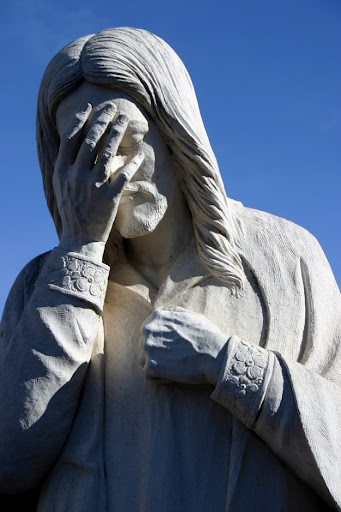
a new self?

This form of despair is: in despair not to will to be oneself.
Or even lower: in despair not to will to be a self.
Or lowest of all: in despair to will to be someone else,
to wish for a new self.

Sickness unto death, 53-54

One of the things I have found is that I like to escape. I often dream of a change of context in the hope that it will fix all my problems. A desire to run away from my problems and look for the solution outside – a new Prayer Book to make my prayer life perfect, a goal to reach to be happy.

But most of all I wish I was someone else. It is sometimes an overwhelming thought – “just will yourself to be not you“. I would like to escape “me”. The “me” that I see is all bad. I often wish I could be someone else – someone who is everything that I am not – comfortable around people, articulate, sociable.

While that thought is often very strong I am also aware that “me” is God’s creation. When I really look at myself I know that I have been blessed with many gifts – I am a good teacher, creative, and can see patterns. And, of course, real “me” is nothing like the imagined “me”.

I need to learn to love me for me because “me” is God given. I am not perfect, and there are many places I can improve, but it is not all bad. The person in the mirror is not a monster like I imagine him to be. The direction I need to move is upwards and inwards. “Me” needs to move towards the God who created me in His image and loves me completely in Jesus.

You are more …

This is completely for me. Depression and faith often battle within me sending my head into a spin. I really like when they speak of knowing all the lines – my head knows but my hearts doesn’t feel it yet! That is what life, for me, with depression is like. Like two people battling inside of me.

God is the middle term

The name Maundy Thursday comes from the Latin, mandatum (to command). There are a number of things that Jesus commands – the washing of feet and the Eucharist among them. But maybe we miss the point? Are we looking at the signs and are not seeing to what they are pointing? Here is the second part of the gospel for today (in APBA):

When he had gone out, Jesus said, “Now the Son of Man has been glorified, and God has been glorified in him. If God has been glorified in him, God will also glorify him in himself and will glorify him at once. Little children, I am with you only a little longer. You will look for me; and as I said to the Jews so now I say to you, ‘Where I am going, you cannot come.’ I give you a new commandment, that you love one another. Just as I have loved you, you also should love one another. By this everyone will know that you are my disciples, if you have love for one another.”

John 13:31-34

The Vulgate used the word, mandatum, in verse 34: “I give you a new commandment, that you love one another“. At the start of these holy three days the readings remind us that it is all about love. And they remind us that I am personally called by God to be a follower of Jesus and enact His love to those around me.

The washing of feet and the Eucharist are signs of God’s love. The washing of the feet is a sign of service and humility. In the Eucharist it is Jesus Himself who says “for you”. I am always drawn to those words, “for you”. These three holy days, the cross and pain of Jesus, are “for me”. This Jesus meets me personally and says “for you” – one on one. The love of the cross is personal and individual – Jesus loves me now.

What does this “love” look like for me? Jesus says “as I have loved you”. Love is the sacrificial giving of the self to the other. It is placing “you” above “me” in my choices and actions. Or, to put it another way, to be open to God working through me. To not close myself off from God. To allow God to be the middle term in all my relationships.

Worldly wisdom thinks that love is a relationship between a person and a person. Christianity teaches that love is a relationship between person-God-person, that is, God is the middle term.

Søren Kierkegaard

Solitude is for criminals

In antiquity as well as in the Middle Ages there was an awareness of this longing for solitude and a respect for what it means; whereas in the constant sociality of our day we shrink from solitude to the point (what a capital epigram!) that no use for it is known other than as a punishment for criminals. But since it is a crime in our day to have spirit, it is indeed quite in order to classify such people, lovers of solitude, with criminals.

Sickness unto death, 64 (Hong)

I “googled” the word “solitary” and the only results I got were related to prisons. People who are being punished are removed from the general population as punishment. The only use our culture has for solitude is for punishment.

What of those who freely seek solitude? What of those who freely seek solitude for God? Are they misanthropists or religious fanatics?

I have become more aware that I need time alone for balance. Not doing yoga or chanting but time without other people to be “me”. Often I read (and drink tea) or simply close my eyes and allow myself to experience the world around me. Even the half an hour to say Morning and Evening Prayer by myself have become essential to my sense of balance.

But solitude is not the same as being alone. I can be with people and feel very alone – I have a general sense of “existential loneliness”. Solitude is something much more than the absence of people.

When I slow down and embrace the solitude, God speaks. And I return to the world with God’s strength to be a better “me”. In the solitude I hear God calling me to friendship with Him and with people He places in my life. Solitude is not an escape from the world but an openness to God. And whether I am with people or by myself I desire to be open to God in the situation. I need alone time for my mental health and I need solitude for my spiritual health.

Missionaries of confusion

“No generation can endure without religion. But then when the front rank, the militia of attackers who want to do away with Christianity (which enemies are by no means the most dangerous), has finished, then comes the second rank of the missionaries of confusion, those who either want to concoct a new religion or even want to be apostles. These are by far the more dangerous, simply because they are religiously influenced and religiously confused but to that extent are also in connection with what is deeper in human beings, whereas those others are irreligiously obsessed.”

Book of Adler

The Book of Adler has been on my list of Kierkegaard books to read. The whole situation is interesting. As with all Kierkegaard books I think it expresses some of the problems within Christendom today.

I am finishing a study on 1 John – a divided congregation struggling with the future. People have left and are now stirring things up. The elder reminds the congregation what (or who) is at the centre of their life together: Jesus and love. I think Kierkegaard’s term “missionaries of confusion” is a good way to describe the situation.

Maybe it’s ok if I am not ok.

I heard this song in the car driving today. And I am struck by the line, “maybe it’s ok if I am not ok”.

I have been trying to work on living for Jesus now. In the midst of depression and anxiety to receive Jesus’ love and mercy. And to accept that sometimes I am not ok – to accept that I need Him all the time.

Anyway, here is the song:

The crowd and the single individual

Now at the festival he used to release a prisoner for them, anyone for whom they asked. Now a man called Barabbas was in prison with the rebels who had committed murder during the insurrection. So the crowd came and began to ask Pilate to do for them according to his custom. Then he answered them, “Do you want me to release for you the King of the Jews?” 10 For he realized that it was out of jealousy that the chief priests had handed him over. 11 But the chief priests stirred up the crowd to have him release Barabbas for them instead. 12 Pilate spoke to them again, “Then what do you wish me to do with the man you call the King of the Jews?” 13 They shouted back, “Crucify him!” 14 Pilate asked them, “Why, what evil has he done?” But they shouted all the more, “Crucify him!” 15 So Pilate, wishing to satisfy the crowd, released Barabbas for them; and after flogging Jesus, he handed him over to be crucified.

Mark 15:6-15

I read the Passion in Mark’s gospel this morning. It is the Palm Sunday reading for Year B.

I was struck by the role the crowd plays in the sentencing of Jesus. And the reason given for Pilate’s handing over Jesus to be crucified, “wishing to satisfy the crowd”. The faceless crowd doing the bidding of the religious leaders against The Single Individual. Jesus stands alone while the crowd shouts for Him to be put to death. The crowd is often an obstacle in the gospels to people meeting Jesus, to being healed, to seeing Him. The crowd is fickle. The Processional Gospel for Palm Sunday reminds us that the crowd acclaimed The Single Individual as King and Messiah.

It is easy to escape into the faceless crowd. And the modern age has made it a virtue to follow the will of the majority. It is easy to do what I am told by those in authority. It is easy to blame and to push the guilt unto someone else – never have to look at myself and my actions. It is easy to escape the single me for the role assigned by the many. The crowd is the opposite of the Single Individual.

During my earthly life that Single Individual calls me to follow Him. As we enter Holy Week, that Individual reminds me that I am called to follow Him to the cross: to be alone with God, alone before God.