Common Worship

This arrived today:

I have been thinking of switching to Common Worship for Morning and Evening Prayer. Also of introducing Prayer During the Day and Prayer at Night (Compline) to my daily cycle of prayer. I have only had a very brief look but I think this book will offer me a fuller office within the modern Anglican tradition. And I can use a weekly, fortnightly, or monthly psalter.

Anyway …

anglican anchorite?!

Sometimes I stumble upon things, without even trying, which makes me think God is at work.

Yesterday I stumbled across Martha Reeves who goes by the “pen-name” of Maggie Ross. Reeves is described as “a vowed Anglican solitary (or anchorite)”. She has written a number of books, not least of which is a two-volume set titled, Silence: A User’s Guide.

But it gets better! She has a blog, Voice in the Wilderness. Yes, an anchorite within the Anglican tradition who is active online. There are a number of YouTube videos of conferences she has given and an article about her life.

And here is a quote to end this post:

The Desert Fathers and Mothers tell us that we are never less alone than when we are in solitude.

anchorites in England

I have been reading Hermits and anchorites in England, 1200-1550 by E.A. Jones. It is a collection of documents with an excellent introduction to each section. I have not read the part on hermits yet but the sections on the anchorite life are filled with amazing insights. I know there are books on continental anchorites, yet there is a part of me that thinks of it as the most English of religious lives.

So I have been thinking about the anchorite rite of enclosure. After some elements inside the church, the anchorite gets to watch their own funeral from their new home. Often their grave was part of their devotional space and they would watch the services inside the church from inside their grave. Death is a reality for the anchorite, as it was, presumably, for everyone in the middle ages.

Not a particularly happy thought for a Sunday afternoon. But the connection between the eucharist, the death of Jesus, and my own death are worth considering. Kierkegaard writes that at the altar (when we receive Communion) we are truly alone. At that moment life and death become one moment. To live for Jesus is to live in that tension between death and life.

Anyway …

vocation?

What I really need is to get clear about what I must do, not what I must know, except insofar as knowledge must precede every act. What matters is to find a purpose, to see what it really is that God wills that I shall do; the crucial thing is to find a truth which is truth for me, to find the idea for which I am willing to live and die.

1 August 1835

I have been thinking a lot about vocation. Do I have one? And if so, what is it? Is it from me or from God? What if I tell people and they laugh?

This morning I thought about one of the earliest pieces that people normally read when they start with Kierkegaard – the journal entry for 1 August 1835. And, in particular, it is the end, “and die”. Is the vocation something I am willing to die for? Or, to put it another way, am I willing to live it for the rest of my life? No matter what the cost. If so, whether the church says it is a vocation, or other people, because less relevant. Yes, God speaks through others! But am I dedicated enough to stick it out to the very end even under opposition.

And then I thought about a quote from a book I have been reading (which I think I have shared before):

And it is in this sense that it has been rightly said that monasticism is a kind of substitute for mar­tyrdom.

I am not sure what a “substitute” means in this context. And I know that various forms of monasticism have sometimes been called “white martyrdom”. So putting it all together I am still as clueless as always!!!

ultimate wager

Life in Religion is the ultimate wager on the existence of God. The Church should always be engaged in doing things that make no sense if God does not exist. This is the reason why I hold the Religious life in the highest esteem. Through the commonality of goods, the life of obedience and above all the commitment to shape life around the Opus Dei (that is, prayer), the monastic life models for all Christians what it means to live fully and abundantly, with and for Christ.”

The Most Rev’d Justin Welby, Archbishop of Canterbury
Foreword to: Anglican Religious Life 2016-17

I have been thinking about the above quote a lot.

So …

I have renewed my blog for another year. In a year, I have no idea where I will be – emotionally, spiritually, or physically – but I am taking a “leap into faith”. I have a very strong sense of what God wants from me but since we are in lockdown I have not had the opportunity to talk to people about it. Life needs to unfold and I simply need to be patient and wait.

Kierkegaard tattoo

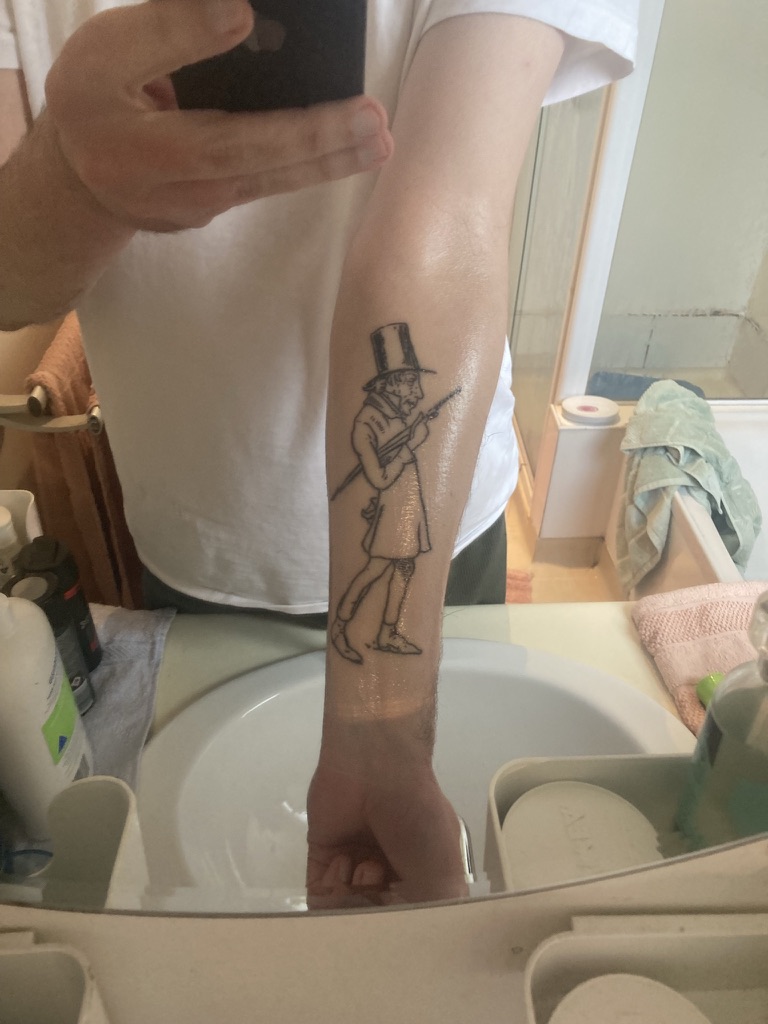
So I wanted to share this picture:

For my birthday I got a tattoo. Something I never thought I would do. But I am so happy with the whole experience that I am thinking about what to get for the other arm. Sorry, a bathroom selfie is not very aesthetic.

Today I am getting my first dose of the Covid vaccine. And, in an ironic twist, I am a little worried that it will hurt. So pray for me!

to be chosen

God is present in the moment of choice, not in order to watch but in order to be chosen. Therefore, each person must choose. Terrible is the battle, in a person’s innermost being, between God and the world. The crowning risk involved lies in the possession of choice.

Søren Kierkegaard

Does anyone have a source for the above quote?