manage people

… because everyone is drawn almost irresistibly back towards this urge to manage.

Rowan Williams. Silence and Honey Cakes, 26.

I have been reading Silence and Honey Cakes – a book by Archbishop of Canterbury Rowan Williams on desert spirituality. It was recommended to me by a lecture in history at a Catholic theological institute.

The above – “this urge to manage” – is a very strong image for me in the first chapter. The withdrawal into the desert is not a withdrawal from a sinful world but an opening of my own sinfulness. And at the core of this is my need to manage people. To set limits on other people’s access to God and to always place myself between God and people. To make myself the spiritual guru, the person with the answers, the person who has it all worked out. To place myself above the other is not an act of love but hubris.

But that is nothing but my sinfulness. And in silence, I hear that most clearly. The desert is not a place but part of my heart that I need to listen to intently. Only when I know what it means to be broken can I really appreciate what it means to be whole – or holy!

John 6:24-35

The lectionary continues the journey through John 6. It skips a couple of verses but the overall flow is still there.

[The next day the crowd that had stayed on the other side of the sea saw that there had been only one boat there. They also saw that Jesus had not got into the boat with his disciples, but that his disciples had gone away alone. Then some boats from Tiberias came near the place where they had eaten the bread after the Lord had given thanks.] So when the crowd saw that neither Jesus nor his disciples were there, they themselves got into the boats and went to Capernaum looking for Jesus.

When they found him on the other side of the sea, they said to him, “Rabbi, when did you come here?” Jesus answered them, “Very truly, I tell you, you are looking for me, not because you saw signs, but because you ate your fill of the loaves. Do not work for the food that perishes, but for the food that endures for eternal life, which the Son of Man will give you. For it is on him that God the Father has set his seal.” Then they said to him, “What must we do to perform the works of God?” Jesus answered them, “This is the work of God, that you believe in him whom he has sent.” So they said to him, “What sign are you going to give us then, so that we may see it and believe you? What work are you performing? Our ancestors ate the manna in the wilderness; as it is written, ‘He gave them bread from heaven to eat.’” Then Jesus said to them, “Very truly, I tell you, it was not Moses who gave you the bread from heaven, but it is my Father who gives you the true bread from heaven. For the bread of God is that which comes down from heaven and gives life to the world.” They said to him, “Sir, give us this bread always.”

Jesus said to them, “I am the bread of life. Whoever comes to me will never be hungry, and whoever believes in me will never be thirsty.

John 6:[22-23]24-35

The introduction – setting the scene – reminds me very much of Fear and Trembling. The double movement of faith – surrender and receive – setting out mind on things above and receive the Bread of Life.

Come, Holy Spirit!

[Verse 1: Gabrielle Jones]
Come, Holy Spirit, come
With energy divine
And on this poor, benighted soul
With beams of mercy shine

[Verse 2: Gabrielle Jones with Wilder Adkins]
Melt, melt this frozen heart
This stubborn will subdue
Each evil passion overcome
And form me all anew

[Verse 3: Gabrielle Jones with Wilder Adkins]
Mine will the profit be
But Thine shall be the praise
And unto Thee will I devote
The remnant of my days
And unto Thee will I devote
The remnant of my days

Three Wives, One Husband

Lockdown means more TV watching. So I have been watching Three Wives, One Husband :

Filmmakers gain access to the community of Rockland Ranch in the middle of the Utah desert where 14 polygamous Mormon families have created unique homes for themselves carved out of a rock-face.

There is a common theme in some “cults” (I am not saying this is a cult): individuality gives way to the community. For the greater good (however, that is defined) individuals stop being individuals and become a cog in the machine. The individual’s task is to be a step for another to reach a “higher level of holiness”.

Anyway, I am enjoying the series!

catastrophizing

I wanted to share that one of the things I really struggle with is catastrophizing. I know it is a learned response for me and it gets worse with the cycle of my depression. But it is incredibly hard to fight (for me) and it can be very overpowering.

As an aside, I think I have drifted to theologies that agree with my catastophizing – “the end is near” type ideas. I have been attracted by the holy elect type of thinking. But, in reality, it only leads to ghetto-type thinking and “us and then” actions.

So today I am struggling with seeing the light in the midst of the darkness I have created. And I am sure that the light at the end of the tunnel is a train!

#lockdown worship

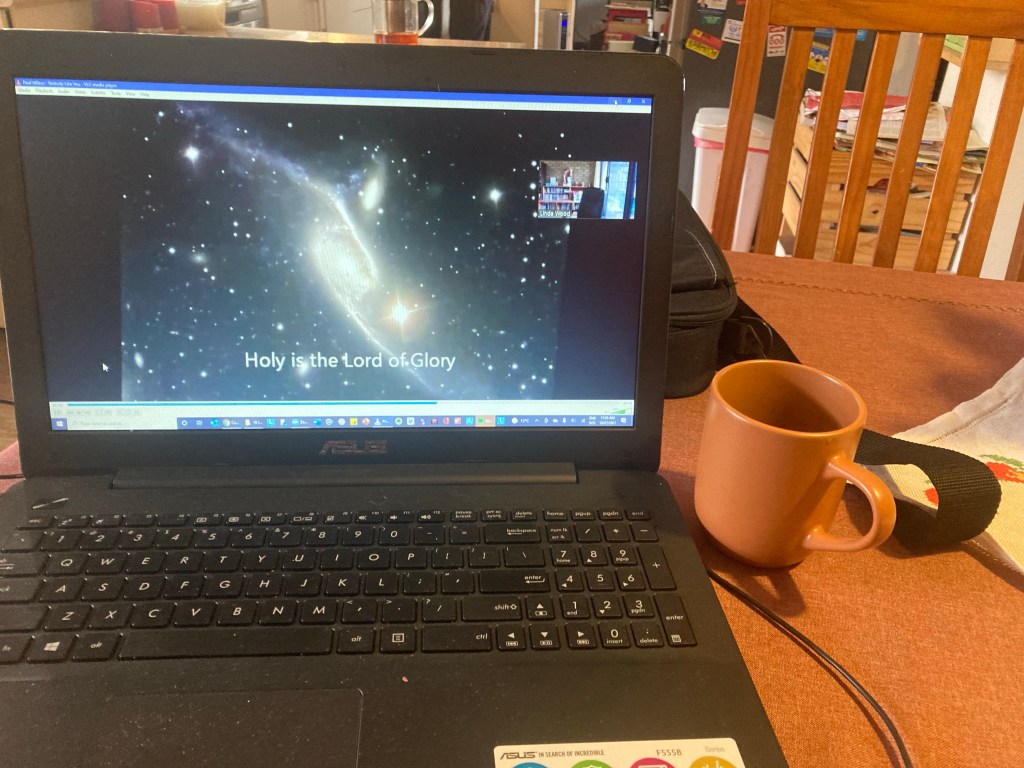
I think Covid-19 has taught me a lot. It has forced me to reflect on my habits and see which I should keep and throw away.

I think Covid-19 has also helped me with my Christianity. It has stripped my relationship with Jesus and has made me look at what is really important. It has helped with focusing on the core. So rather than saying, “Why, God?”, I am saying, “Thank you, Lord!”.

no Christian

No, an illusion can never be destroyed directly, and only by indirect means can it be radically removed. If it is an illusion that all are Christians — and if there is anything to be done about it, it must be done indirectly, not by one who vociferously proclaims himself an extraordinary Christian, but by one who, better instructed, is ready to declare that he is not a Christian at all.

The Point Of View For My Work As An Author (1844)

SK continues to be an inspiration to me.