prayer and self-knowledge

I have a nice day ahead. I am seeing my counsellor and meeting family.

I am a little anxious about the family meet-up but with prayer and self-knowledge I think it will be very nice. The insights I have gained over the last three month make a major difference in my day-to-day life. They give context, background, depth. I have the experience of living through it and coming out the other side.

And I have learned to pray! I have prayed all my life but only recently have I prayed. I have stopped telling God what to do and am simply open to God. I have stopped escaping into form or ritual and have simply used silence and solitude. The moment of silence is worth more than hours of chanted liturgy.

So I face today with prayer and self-knowledge.

streaking

WordPress tells me that I am on a 45 day streak in posting. So I am posting to keep this streak going.

In fact that the streak is the only reason is really good news. My life has balance. I have received three items of very good news this week. And I feel like my waiting in love has been very much worth it – that sounds horrible but I hope you understand what I mean.

The self-awareness I have gained over the last three months has been a great blessing to me. I am so thankful for all the people I have met that have supported me – sometimes without even knowing their support has been so central. The people who have prayed! Life will still be rocky and difficult. But I was very unsure whether I would emotionally survive this week.

So my anxiety says, “just wait”. But I now know who is speaking and why my anxiety says the things it says. And, yes, there will be challenges. I will face these when they come but I do not need to spend energy now planning and worrying. I will simply try to live my life of solitude, simplicity, and service. I will simply try to live now with Jesus and for others.

So … 46 day streak!!! Nothing much to report. Praise Jesus!!!

Ascension Day

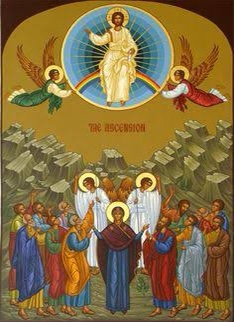
Today is the Festival of the Ascension of Our Lord, Ascension Day, or the Solemnity of the Ascension of the Lord. APBA has the following for the gospel reading for Year B:

And [Jesus] said to them, “Go into all the world and proclaim the good news to the whole creation. The one who believes and is baptized will be saved; but the one who does not believe will be condemned. And these signs will accompany those who believe: by using my name they will cast out demons; they will speak in new tongues; they will pick up snakes in their hands, and if they drink any deadly thing, it will not hurt them; they will lay their hands on the sick, and they will recover.”

So then the Lord Jesus, after he had spoken to them, was taken up into heaven and sat down at the right hand of God. And they went out and proclaimed the good news everywhere, while the Lord worked with them and confirmed the message by the signs that accompanied it.

Mark 16:15-20

Theologically the Ascension is difficult. Does Jesus lay aside His humanity at the Ascension or does He take it to the right hand of the Father with Him? I have no answers. But I, for one, think Jesus is still active and present in some form today. And He still works “for me” today.

The Ascension is the first occasion I remember preaching. I think it was for a small devotional group. I remember telling a story – a story which, alas, overpowered. People remembered the story but not the point I was making. So much so that I cannot recall the point but I remember telling the story.

So Blessed Ascension Day to you!!! May you have a Jesus filled day!!!

transform to transform

I have just purchased this book. While I suspect that it will not be my cup of tea, I am intrigued by the premise. And it follows from the previous post. So the premise is:

Christian mysticism is about the holy transformation of the mystic by God so that the mystic becomes instrumental in the holy transformation of God’s people. This transformation always results in missional action in the world. The idea that mysticism is private and removed from the rugged world of ministry is simply false. All the Old Testament prophets were mystics. Their visions, dreams, and other experiences of God were for the express purpose of calling God’s people back to their missional vocation.

Elaine Heath, The Mystic Way of Evangelism: A Contemplative Vision for Christian Outreach, 5

“Being transformed leads to a desire to transform”. Yes! Experiencing Jesus leads to a desire for others to experience Him. There are movements that emphases the experience of Jesus that are also intensely missional. (Pietism and Pentecostalism are only two.) Yet the missional impulse does not grow out a “requirement” but rather from love.

So mission is about people experiencing and being transformed by Jesus. And that can only happen if I am transformed and reflect Jesus in my life. And the modern prophet is a mystic who calls individuals back to their mission to proclaim Jesus.

encountering Jesus?

I woke up thinking about the Knowledge argument. Yes, I am really weird! Actually I suspect I was thinking about Ex Machina that includes it. It goes by some other names – Mary’s room or Mary the super-scientist – yet fundamentally it is a thought experiment by Frank Jackson. In short:

… Jackson’s Mary is a scientist who knows everything there is to know about the science of color, but has never experienced color. The question that Jackson raises is: once she experiences color, does she learn anything new? Jackson claims that she does.

I find that idea really interesting. I think we sometimes, in a modern scientific world, downplay experience in epistemology. Is something that I know but have never experienced really “knowledge”?

So allow me to move the discussion in a theological direction. Does the experience of Jesus change me? Can I know Jesus without ever experiencing Him? Of course these questions actually influence the way we do “mission” and “evangelism”. Unfortunately sometimes “sharing my faith” is more about personal validation than transformation.

I think that I can tell people about Jesus and then the individual experiences Him. So is the speaking about really transformative or is the experience that may or may not follow? Of course, the issue is further complicated by the very fact that Jesus is a person and not an idea. A person who needs to be encountered. It is the personal meeting with Jesus that transforms – what role does my speaking about Him play?

Anyway, I was wondering what gospel story could be used to illustrate the above philosophical point? The Road to Emmaus? The blind man in John 9? Any suggestions?

Kierkegaard’s gospel?

I have stumbled across this article a couple of times and I feel I may have mentioned it already. So I am linking to it again and just going to quote a paragraph:

There is a scandalous dimension to the intrusion of God upon goodness. Many atheists today claim that Christianity is “offensive” in some way or another. Kierkegaard would say this is quite in order – Christianity is offensive and must be so in order to remain what it is. The offensive aspect of the difference God makes to goodness is one that Kierkegaard thought Socrates missed, as he believed anyone without the benefit of revelation would have done, no matter how wise they were in other respects.

The gospel according to Kierkegaard: Sin, guilt and the offense of forgiveness

Christianity is offensive because there is something offensive about Jesus. When an individual is confronted by the reality of the Word Incarnate, the God-man, offence is one of the responses – the other being a leap into faith, into the uncertainty of a relationship. The same as when the individual is confronted by the reality of sin in their own life. Modern Christianity has turned Jesus into one product amongst many and has made Him acceptable to the market. But do I miss the real depth of the Gospel when I refuse the offence of Jesus?

Another paragraph:

To forgive sins is a radical, wild, gratuitous folly. Really to forgive is to do something grossly offensive: it is to move beyond the categories of moral good and evil, to declare that, yes, an evil has been done against you, but that the evil is dispelled, it is of no account. Forgiving sin however means that the forgiver is still exposed to the possibility that the offender could hurt them again. This is part of what makes forgiveness so reckless: it offers no protection against future injury. For someone really to forgive, they have to reconcile themselves to the offenses of the past and remain vulnerable to injury in the future. Most of us are too self-protective, too shrewd, too timid really to forgive. But without forgiveness we are stuck in a cycle of self-loathing and despair.

I really like that paragraph. There is something very offensive about forgiveness. Because there is a risk of future injury. Forgiveness is a willingness to remain in a relationship even if the future is full of risk. All because of the other person, because of love. Anyway, I like the above article and it is Australian so another bonus.

I am a passenger

God uses people for the good of others. That is love. He uses them not in a negative way but puts people in your life that He uses for your good. God has placed people into my life for my good.

I have an extremely stressful and anxious day ahead. A day in which I am completely powerless – I am a passenger. But yesterday I spoke with a person involved and I am not nearly as stressed as I thought I would be. This person, without being involved previously and with little information, sees the situation the same way that my support people have been telling me. I trust them but my anxiety often talks very loudly. And my support people have been extremely supportive with a rather strange conference call. I know it is the anxiety and depression talking but I cannot shake, at the moment, the feeling that I am a burden and pain to people.

I have things to do today – I have yet to even start the Bible Study and that is tonight. I have been putting it off because my anxiety has been running riot. But I have learned how to manage it and how to live with it rather than against it. I am looking forward to the study and being useful.

This is the beginning of a very painful end. An end that I have yet to face fully – an end in which I am emotionally invested. An end that I do not desire and in which I have had no say. I am a passenger. So I am seeing it in a positive way – today is the start of a new life. A life that will look somewhat different than I had assumed. A life that is yet to be fully realised. A life into which I carry many scares and pains. But Jesus carries my scares, and my pain, on the cross for me. And that is the point I am starting from.