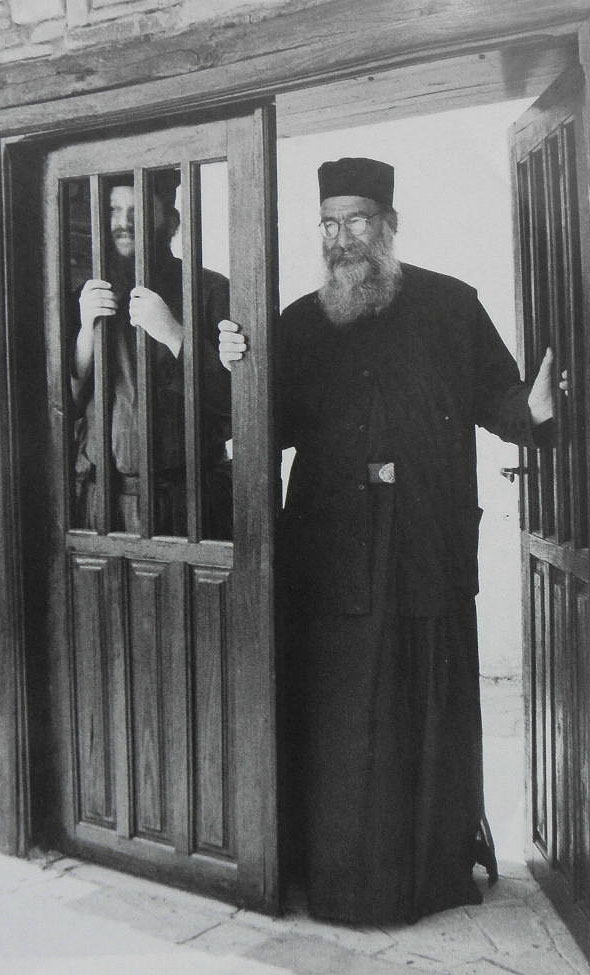
So hear me out: what if the dissolution of the monasteries (under Henry VIII) was not so bad after all? But the real tragedy was the jumping into the same model with rules and canons at the restoration of religious life? What if rather than useful sisterhoods (which only happened because priests needed help) an eastern model was used?
All monks and nuns share the same ascetic call and belong to a single, all-embracing ‘order’ or ‘estate’; yet within that one ‘estate’ there is a wide variety of patterns and a constant flexibility.
So there is one estate – the monastic – which the individual, male or female, enters through tonsure. More freedom! And then the individual has a choice:
The wide variety of patterns is reduced by St John Climacus (d. circa 649) to three main types: “The monastic way of life takes three general forms: to live in ascetic withdrawal and solitude; to be a hesychast with one or two companions; to dwell with patient endurance in a coenobium.” These three forms—the coenobitic, the eremitic, and the middle or semi-eremitic way of the hesychast who dwells with one or two others—are found at the very outset of Christian monasticism in fourth-century Egypt.
Ware, Metropolitan Kallistos; Walls in Solitude and Communion: Papers on the Hermit Life (Fairacres Publications), 48.
So one estate in three forms. With movement between the forms. Some years active, some years solitary, and some years in the middle. Yet there is one more point that is vital and has been complete (methinks) missed in Anglican “religious life”:
… from the start primary importance was attached to the need for personal spiritual direction under an ‘abba’ or ‘elder’—what the Greek sources call a gerôn and what the Russians were later to term a starets. The variety and flexibility of Eastern monasticism must inevitably seem ill-disciplined and untidy to the Western mind, unless it is remembered that underlying this variety there is the direct personal relationship between the spiritual father or mother and his or her child. This relationship, while it ensures inner order within seeming confusion, is not something that can be contained within institutional forms or controlled by rules.
ibid, 51
So one estate in three forms under the guidance of an “elder”. No need to institutionalise. No need for bishops to be involved and worry about vows. The model, methinks, is that of living one’s baptismal life rather than celibate marriage (to Jesus or the Church).
I suspect this was present in the life of anchorites in England before the Reformation:
The ambivalence in this relationship [between monastic rules and ‘rules’ for solitaries] reflects an underlying tension between monastic and anchoritic ideals. The monastic life is based on obedience, the anchoritic life on independence; one requires the renunciation of the will, the other the exercise of free choice.
Innes-Parker, Catherine; Yoshikawa, Naoë Kukita. Anchoritism in the Middle Ages: Texts and Traditions (Religion and Culture in the Middle Ages), 34.
So missed opportunity?
Discover more from a fool and his prayer book
Subscribe to get the latest posts sent to your email.

 a fool and his prayer book