the crowd?

They were trying to bring him in and lay him before Jesus; but finding no way to bring him in because of the crowd, they went up on the roof and let him down with his bed through the tiles into the middle of the crowd in front of Jesus.

Luke 5:19

Today the reading at Morning Prayer was from Luke 5. I may have written about this before but I was struck by the people who cannot come near to Jesus “because of the crowd”. I wonder if the crowd here is not something like “Christendom”? Or, how often have I stopped people from seeing Jesus by being “religious”?

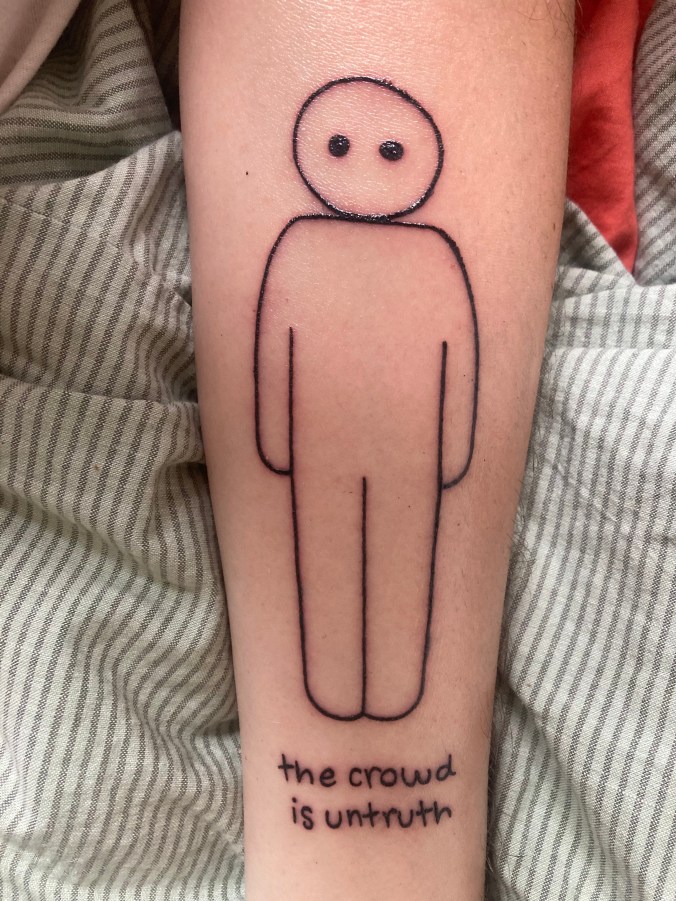
I have a tattoo that says, “the crowd is untruth”. Of course, it is from Kierkegaard’s “This Single Individual”. But I wonder, in the wider sense, if Kierkegaard is not making the same point as Luke? Sometimes the many can stop us from seeing Jesus clearly.

reading?

The second requirement is that in order to see yourself in the mirror when you read God’s Word you must (so that you actually do come to see yourself in the mirror) remember to say to yourself incessantly: It is I to whom it is speaking; it is I about whom it is speaking.

Kierkegaard

I have been following the General Synod of the Anglican Church of Australia. A little more like a spectator than a person who is involved. It is the community I call home but I am also somewhat distanced from it.

One of the things that struck me was the attempt to regulate how Scripture is read. Making statements about what Scripture does or does not say is difficult. But what worries me more is summed up in the quote above: Scripture is a mirror for me. I can take the Bible seriously without taking it literally. But above all else, it is always speaking to me and not to someone else.

And, morality is not a relationship with Jesus – the absolute telos and all that!?

truth?

No human being, with the exception of Christ, is the truth.

Practice in Christianity, 204

I have been struck by how the modern person thinks they can inhabit truth – they can internalise it and make it their own. But the truth – as Jesus is – must always be witnessed as something outside of us. I never have the truth but can only point to it.

An afterthought: that does not mean that I must not be completely committed to that truth. And there is a sense that it must become “my truth” but only in the sense that I am resolved to put it into action.

infinite chasm

Today would have been Soren Kierkegaard’s 209th birthday. I feel very close to him as a person (he was, by all reports, awake, somehow confusing and confused, and intense) and I really enjoy his writings. I am no Kierkegaardian as that would be betraying Kierkegaard. But I find his thought upbuilding and challenging, and always pointing beyond itself to the Absolute Paradox.

So since it is his birthday, I thought I would share a large quote from Practice in Christianity. It is one of his later books and maybe shows a more mature vision of Christianity.

So happy birthday, SK, and thanks for keeping me alive with your writings.

There is, namely, an infinite chasmic difference between God and man, and therefore it became clear in the situation of contemporaneity that to become a Christian (to be transformed into likeness with God) is, humanly speaking, an even greater torment and misery and pain than the greatest human torment, and in addition a crime in the eyes of one’s contemporaries. And so it will always prove to be if becoming a Christian truly comes to mean becoming contemporary with Christ. And if becoming a Christian does not come to mean this, then all this talk about becoming a Christian is futility and fancy and vanity, and in part blasphemy and sin against the Second Commandment of the Law and sin against the Holy Spirit.

In relation to the absolute, there is only one time, the present; for the person who is not contemporary with the absolute, it does not exist at all. And since Christ is the absolute it is easy to see that in relation to him there is only one situation, the situation of contemporaneity; the three, the seven, the fifteen, the seventeen, the eighteen hundred years make no difference at all; they do not change him, but neither do they reveal who he was, for who he is is revealed only to faith.

Christ is no play-actor, if I may say it this soberly; neither is he a merely historical person, since as the paradox he is an extremely unhistorical person. But this is the difference between poetry and actuality: contemporaneity. The difference between poetry and history is surely this, that history is what actually happened, whereas poetry is the possible, the imagined, the poetized. But that which has actually happened (the past) is still not, except in a certain sense (namely, in contrast to poetry), the actual. The qualification that is lacking—which is the qualification of truth (as inwardness) and of all religiousness is—for you. The past is not actuality—for me. Only the contemporary is actuality for me. That with which you are living simultaneously is actuality—for you. Thus every human being is able to become contemporary only with the time in which he is living—and then with one more, with Christ’s life upon earth, for Christ’s life upon earth, the sacred history, stands alone by itself, outside history.

Practice in Christianity, Hong 63-64

for me?

Christ is no play-actor, if I may say it this soberly; neither is he a merely historical person, since as the paradox he is an extremely unhistorical person. But this is the difference between poetry and actuality: contemporaneity. The difference between poetry and history is surely this, that history is what actually happened, whereas poetry is the possible, the imagined, the poetized. But that which has actually happened (the past) is still not, except in a certain sense (namely, in contrast to poetry), the actual. The qualification that is lacking—which is the qualification of truth (as inwardness) and of all religiousness is—for you. The past is not actuality—for me. Only the contemporary is actuality for me. That with which you are living simultaneously is actuality—for you. Thus every human being is able to become contemporary only with the time in which he is living—and then with one more, with Christ’s life upon earth, for Christ’s life upon earth, the sacred history, stands alone by itself, outside history.

Practice in Christianity

resolution?

The conclusion of belief is no conclusion but a resolution, and thus doubt is excluded.

Kierkegaard.

Have I shared that SK quote? I feel I have.

I have been thinking about resolutions. Not the New Year’s resolution that I never keep. Resolutions that motivate life. I think the above is true for relationships in general – with Jesus and with others. A resolution may not always end in action (or appropriate action) but it will always try again. Is resolution an act of the will? So is a resolution related to love?

Anyhow, it is Saturday and I need to do something!

the crowd is untruth

We are born biological beings but we must become existential individuals by accepting responsibility for our actions. This is an application of Nietzsche’s advice to ‘become what you are’. Many people never do acknowledge such responsibility but rather flee their existential individuality into the comfort of the faceless crowd.

Existentialism: A Very Short Introduction

I have a tattoo that says, “the crowd is untruth”. People sometimes see it and think it is an act of rebellion: I can do what I want. (Which is so funny if you know me!) But it is Kierkegaard’s way of summarising the existentialist task we are all called to.

I have been thinking about that distinction: the single individual (Kierkegaard) vs individualism. Individualism is the reason for an action – I can do what I want – while “the single individual” is taking personal responsibility for my actions.

In the context of faith, I am sometimes (often?) intellectually stretched by the idea that what I believe is less important than that I have faith. I have no answer! Apart from saying that the what (or much better the who) is important to me. When the content of faith remains outside of me, do I really have faith? But if the content is only inside of me?

So anyway, feeling cactus so I am escaping into books.

experience

During the week the theme of “experience” has surfaced a couple of times. It reminded me of a thought experiment sometimes called Mary’s Room. I think it highlights the importance of experience. And, by extension, to experience Jesus is better than to know about Jesus.

Also: I think the above is what Kierkegaard writes about in Philosophical Fragments.

Anyway, read the thought experiment and think about it:

Mary is a brilliant scientist who is, for whatever reason, forced to investigate the world from a black and white room via a black and white television monitor. She specializes in the neurophysiology of vision and acquires, let us suppose, all the physical information there is to obtain about what goes on when we see ripe tomatoes, or the sky, and use terms like “red”, “blue”, and so on. She discovers, for example, just which wavelength combinations from the sky stimulate the retina, and exactly how this produces via the central nervous system the contraction of the vocal cords and expulsion of air from the lungs that results in the uttering of the sentence “The sky is blue”. … What will happen when Mary is released from her black and white room or is given a color television monitor? Will she learn anything or not?

chasmic difference

There is, namely, an infinite chasmic difference between God and man, and therefore it became clear in the situation of contemporaneity that to become a Christian (to be transformed into likeness with God) is, humanly speaking, an even greater torment and misery and pain than the greatest human torment, and in addition a crime in the eyes of one’s contemporaries. And so it will always prove to be if becoming a Christian truly comes to mean becoming contemporary with Christ. And if becoming a Christian does not come to mean this, then all this talk about becoming a Christian is futility and fancy and vanity…

Practice in Christianity

I have always liked the above quote from Practice in Christianity. Yes, SK is very Lutheran/Augustinian in it but I think it says something about God: God’s transcendence in being and his imminence in action (in Jesus). It is about the King and the Servant, and love, and surrender.