resolutions?

I have been reading Devotio Moderna: Basic Writings by John Van Engen. I have been waiting for it to arrive for over a month. There is a collection of “Resolutions and Intentions” by the founder of the Brethren of the Common life, Geert Groote, in the book. There is a decisive fell that this is not a set of vows or a rule of life but rather a way to live. I like the idea of religious life without vows beyond those of all the baptised. We are all called to “love God and love our neighbour as ourselves”. The religious life is not for the “spiritual elite” so why ask any more of the religious than of all the baptised?

So I thought I would follow that through a little. What does the noun “resolution” mean?

noun: resolution; plural noun: resolutions
1. a firm decision to do or not to do something.
Similar: intention, resolve, decision, intent, aim, aspiration, design, purpose, object, plan, commitment, pledge, promise, undertaking

A resolution is connected to an intention. Both are a decision to set a path and walk it. There is no certainty in the resolution – no end result. But rather it is for the moment. A resolution needs renewing every new moment – it is a way of life rather than a point in time. And there is no room for doubt – I am either going to do it or not.

So vow to love, be resolved to live for Jesus only?
sharing?

“Contemplata aliis tradere” is a Latin phrase which translates into English as “to hand down to others the fruits of contemplation.”

Contemplata aliis tradere

I am not a great advocate for St Thomas. In fact, the scholastic thing is very foreign to me. But the above has always torn at my heart. In the books about anchorite spirituality and life I have been reading, there is agreement that it is about contemplation. But what then? Just sit in the warm glow of a job well done?

Last night, while driving home, I had a long think about the above. And I came to the conclusion (or should that be resolution) that it is less important what it meant to people of the past than what it means for me today. Yes, I think I have a moral duty to share those fruits of future possible contemplation. And whether that is through a blog like this, a podcast, or some other way, there is a duty to make that available to people.

So a life set apart to pray and read, to think and contemplate, and to share. Not to have the answers but to be present with people and witness to the transforming power of Jesus. Maybe the word “witness” puts it better than share? It is not a treasure I have within me but rather a Person.

Anyway …

the eternal now

During this morning’s meditation (doesn’t that sound grandiose) I was thinking about the reason for my love. And how I can love people I cannot be in the same room with! Sometimes I love people because we have a past together. We have shared experiences. Sometimes I love people because I can see a future with that person. We are walking in the same direction. Rarely it is both, and even more rare is loving people for the here and now.

Yet God loves us in the eternal now. It is not about what we bring or what we can do, he simply loves us. No matter who I was yesterday, God loves me. And no matter who I will be tomorrow, God loves me. It is eternal because it is beyond time – it is always “now”. And that eternal now is the person of Jesus. My role is simple to get into this Now – to find it in my rush and the pressure of the past and future.

Anyway, that is what I was thinking about.

love and rules

I am a Prayer Book nerd. I like the older versions but I also like the modern versions. The Prayer Book has formed me in a particular way. But (an important distinction) my relationship with Jesus is so much more than liturgy.

I was thinking about the traditional structure of the Communion Service in the Prayer Book. It starts with the Collect for Purity (my favourite prayer) and then has this (from Common Worship):

Our Lord Jesus Christ said:
The first commandment is this:
‘Hear, O Israel, the Lord our God is the only Lord.
You shall love the Lord your God with all your heart,
with all your soul, with all your mind,
and with all your strength.’

The second is this: ‘Love your neighbour as yourself.’
There is no other commandment greater than these.
On these two commandments hang all the law and the prophets.
Amen. Lord, have mercy.

The original compilers of the Prayer Book must have felt it was important to rehearse this central message of Jesus. Maybe because it is the Rule of Life for all Christians? Is there really any need to go beyond?

Anyway, I have updated my Rule of Life page to reflect the above.

king?

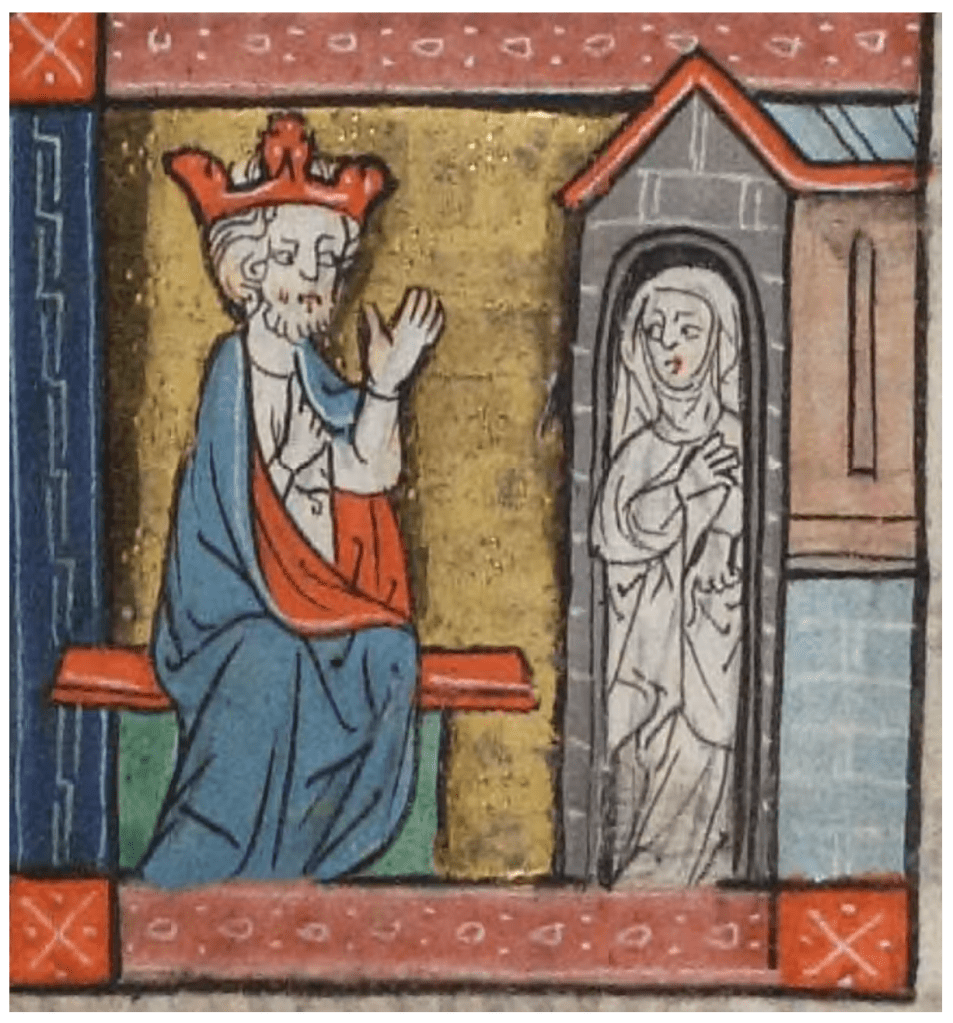
A king consults an anchorite. Beinecke MS 404 (Rothschild Canticles), Yale Library

The picture above is often associated with the visit of a king to an anchorite, hence illustrating the importance of anchorite spiritual counsel. But …

What if the picture is not a king but King Jesus? What is the picture is about the everyday encounter that the anchorite has with Jesus – the Jesus who is present to the anchorite as King?

I like both but King Jesus is very heart-warming to me.

choice

… I believe most sincerely that the consolation of Jesus Christ, and the sweetness of his love, with the fire of the Holy Spirit who cleanses all sin, shall be in you and with you, leading you and instructing you how you are to meditate, how you are to pray, and what you are to do, so that after a few years you
shall certainly have more delight in being yourself and speaking with your beloved and your spouse, Jesus Christ, who is high in Heaven …

Richard Rolle

The above is written by the English hermit Richard Rolle to an anchorite. The anchorite has asked for a rule but Richard replies rather with a reflection on the spiritual life in general. The text illustrates that, unlike vowed monasticism, there is a certain amount of freedom and choice. Yes, the choice is inspired by the Holy Spirit. Yet the life of an anchorite within the English tradition is less about obedience and more about the freedom to explore the self in the presence of God.

It has been a real insight for me to see that there is a life that is not about rules but about being present with Jesus.

choice

The monastic life is based on obedience, the anchoritic life on independence; one requires the renunciation of the will, the other the exercise of free choice.

Anchoritism in the Middle Ages: Texts and Traditions

I just wanted to share the above quote. Interesting!!! Yes, ordered life based on choice. Even without a rule, or vows, or a habit.

cf: The Moment