… today, yesterday, right, and wrong

What we do today is ruled not by the past but by the adaptation of tradition to the needs of the present. History can only help us decide what the essentials of that tradition are, and the parameters of its adaption.

The Liturgy of the Hours in East and West, xv

I am reading Taft’s chapter on Egyptian monasticism and noticed that I marked this passage in the Introduction. The mindset that asks, “Why is what was right now wrong?”, is a temptation for me. Maybe even for others?

So two ways: the past is always right; the present is always right. Either way the word “Tradition” becomes a battle cry. Both miss that Tradition, like experience, can be used both as a verb and as a noun. It is a living Tradition, for me, that is important. (And, please, do not get me started on the Scripture vs Tradition debate!!!!)

Jesus speaks of the good scribe (Matthew 13). Words to think about.

Anyway …

… emotional roller coaster

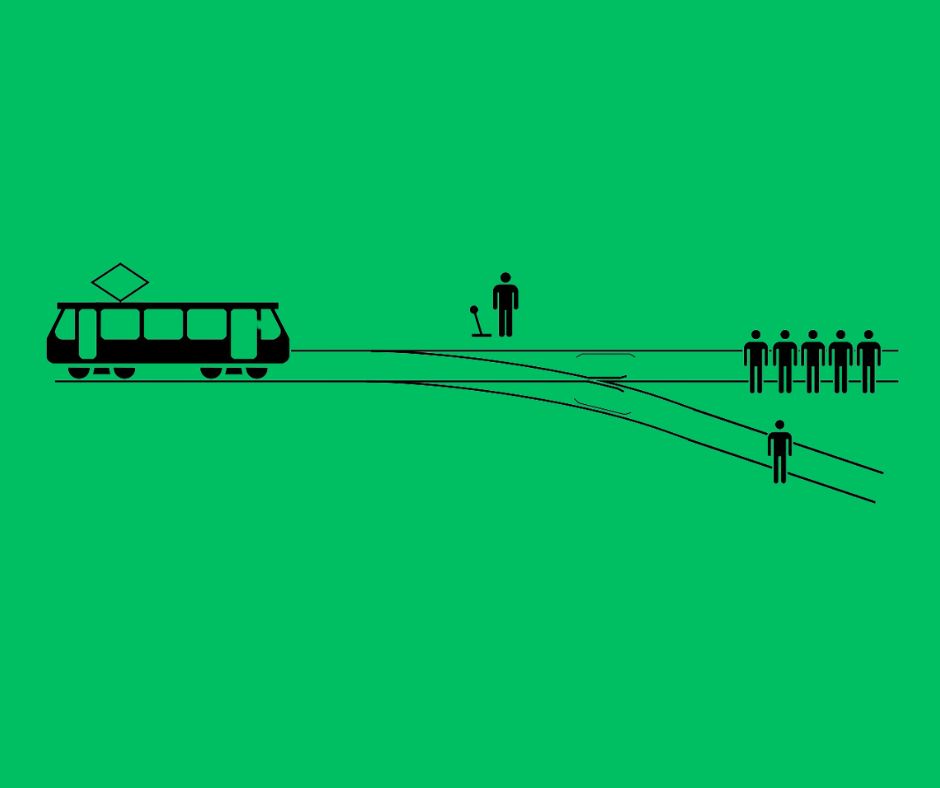
I have been thinking about the trolley problem. It was the first thought experiment I read about when I became interested in philosophy. So, in brief, your only option is to pull the lever or not. Utilitarian ethics would place the greater good at the forefront of mind – one vs five. So the active choice of pulling the lever to kill one is a “better choice” than the passive non-action. For me, the first question is what type of person can make that choice?. Who am I to pull the lever to kill one person over five?

So how would the choice change when the “one person” is more defined? Let’s say the one person can heal more than five? Would that change the choice? Yet my real question is, how would my choice change if I have an emotional relationship with the one? Either positive or negative. Would my relationship change my actions?

To return to the original utilitarian point: is the good defined by my relationship? Is there any objective (external to me) way of defining the good?

Sorry, that was way too heavy!!!!

hermits and solitaries

The Advisor Council publishes “A Handbook of the Religious Life” which is extremely helpful. In recent editions, there is an Appendix on hermits and solitaries.

The terms Hermit and Solitary are often used interchangeably but for the purposes of the Handbook, the term ‘hermit’ refers to a member of a Religious Community and the term ‘solitary’ refers to one who is not a Religious.

Appendix V

There is a long tradition that anchorites (modern solitaries) are semi-religious. The above gives a technical starting point. There are many consequences from the above short working definition. Maybe I will post about them?!

… without a clue

Sometimes people ask if I follow a “rule of life”. The short answer is no: not in any formal written sense. But, of course, the answer is much more involved. And part of the problem is people misunderstand, through no fault of their own, the terminology involved. So maybe a very short definition of terms, how I use them, is necessary.

A very helpful place to start is the following:

The monastic life is based on obedience, the anchoritic life on independence; one requires the renunciation of the will, the other the exercise of free choice.

Can there be such a thing as an ‘anchoritic rule’? by Bella Millett in Catherine; Yoshikawa, Naoë Kukita. Anchoritism in the Middle Ages: Texts and Traditions (Religion and Culture in the Middle Ages), 34.

Hermits are “monastic” and anchorites live in the grey-area of church life. So for me:

Hermits are individuals who live alone following a rule within the context of a religious community (monastic). Hermits wear habits (of their order) and have a religious name. These individuals have taken vows and, therefore, their physical needs are provided by the community. Hermits are accountable to their religious superior via a confessor.

Anchorites (or the modern term solitaries) are individuals who live alone within the context of a parish. These individuals do not follow one of the rules but rather use guides for asceticism. Normally there is no habit or religious name. The important difference is these individuals do not make vows, especially the vow of poverty. Hence these individuals are responsible for their own physical needs. Anchorites live in the grey area of religious life, being neither laypeople nor religious, and often outside of ecclesial control. In modern terms, these individuals often have a spiritual director.

In the English tradition, hermits were itinerant while anchorites were enclosed. The enclosure was more intense for females, often including being walled in but also including a garden or outside area. Male anchorites had more freedom to meet people and priest anchorites had access to the church. Anchorites were also often questioned on their theology by church authorities and were considered heterodox.

Somewhat mudding the water is the use of the term “Diocesan Hermit” within the 1982 Roman Code of Canon Law (Can 601 and 602). This term, as I understand it, includes both of the above. It should also be noted that neither of the above takes a vow (or the like) of celibacy – it is simply a natural part of the life.
… walls of salvation

I use Common Worship: Daily Prayer for my Office. It is simply more me and offers options that are not in other Anglican Prayer Books. During the Epiphany season, the following is part of the canticle at Morning Prayer:

You will call your walls, Salvation,  ♦ and your gates, Praise.

Common Worship: Daily Prayer.

It is from Isaiah 60. I am not sure what the original meaning is (and I do not think I can) but to me, it speaks of my vocation. I am called by God to wait. And I wait within the context of solitude, which for me means a place.

When I step outside my four walls, I step outside of my calling from God.

For me, solitude is not an escape from the world. It is not a time of recharging for something else. The more I live here, the more I feel a sense of deep longing for this place of waiting. I live an enclosed life, which means the calling is lived within the context of my four walls. And here I wait. So I do call my walls “salvation” and maybe I should name my gate “praise”.

Collect for Richard Rolle

O God, who by the example of the most holy hermit Richard taught us to despise the earthly and to seek with a sincere heart the heavenly: grant to us, [through his merits and prayers,] that we may imitate him faithfully and drink with him in the eternal bliss. Through Jesus Christ our Lord.

The above is a translation from The Officium and Miracula of Richard Rolle of Hampole.

… on entering

O Jesus, I pray that in entering into this house
I can enter into the immensity of Your love.
Bless this place of my earthly life.
Enrich it with Your presence.
And grant that Your divine life
may free me from the world.
May this house be a sacred place:
the place where Bridegroom meets the bride.
The place where through my body,
I enter into Your Passion.
Do not allow me to profane it
by a lack of silence or of solitude.
Grant that it may be the place
where you have led me to speak to my heart.
And, at the moment of my death,
may it be the door to paradise.

Based on A Carthusian Nun’s prayer on entering her cell

Carthusians have, in their cell, an entrance area. This area has an altar and a kneeler. I like that idea. So the above is a prayer upon entering the Anchorage upon return from a journey (ie when I leave the enclosure).