surrender?

After Communion yesterday I had this very strong sense that Jesus is saying to me:

I surrender justice and “being right” for love of you.

I had a sense of being called to share in the cross in a special way. Psychologically I can see where that sense originated – I have decided on a new life. But Jesus gives up everything, including any concept of justice, on the cross for love of me.

Or, of course, it could simply be the leftover wine that I drank!?

new life?

I have so many things happening in my head that I often find it very hard to put them in order. So I was somewhat confused (and happily amazed) when I read this:

All coming into existence occurs in freedom, not by way of necessity.

Kierkegaard

A “new life” will not come without my choice made in freedom. No one is forcing me, circumstances do not set the agenda. And I think the moment has come for a choice. Without knowing the future and without allowing the past to slow me down. I know all of that but feeling it is a completely different thing.

BTW: the liturgical rites we have (baptism, communion, especially monastic vows) are a free choice for a new life.

reading?

The second requirement is that in order to see yourself in the mirror when you read God’s Word you must (so that you actually do come to see yourself in the mirror) remember to say to yourself incessantly: It is I to whom it is speaking; it is I about whom it is speaking.

Kierkegaard

I have been following the General Synod of the Anglican Church of Australia. A little more like a spectator than a person who is involved. It is the community I call home but I am also somewhat distanced from it.

One of the things that struck me was the attempt to regulate how Scripture is read. Making statements about what Scripture does or does not say is difficult. But what worries me more is summed up in the quote above: Scripture is a mirror for me. I can take the Bible seriously without taking it literally. But above all else, it is always speaking to me and not to someone else.

And, morality is not a relationship with Jesus – the absolute telos and all that!?

neither do I

Jesus straightened up and said to her, “Woman, where are they? Has no one condemned you?” She said, “No one, sir.” And Jesus said, “Neither do I condemn you. Go your way, and from now on do not sin again.”

John 8:10-11

I was thinking about the story of the woman caught in adultery. I was thinking about how the story ends with Jesus not condemning the woman. Compassion over law!

Common Worship: Daily Prayer

I have been using the Church of England’s Common Worship: Daily Prayer for nearly a year. I like the wording and the way everything is organised. I like that there are antiphons and Psalm Prayers.

AND today I found that there is an online site with Morning, Evening, Prayer During the Day, and Night Prayer for the current day. It makes it so easy!

Psalm 139:7

Refrain:    Search me out, O God, and know my heart.

1    O Lord, you have searched me out and known me;  ♦
you know my sitting down and my rising up;
you discern my thoughts from afar.
2    You mark out my journeys and my resting place  ♦
and are acquainted with all my ways.
3    For there is not a word on my tongue,  ♦
but you, O Lord, know it altogether.
4    You encompass me behind and before  ♦
and lay your hand upon me.
5    Such knowledge is too wonderful for me,  ♦
so high that I cannot attain it. [R]
6    Where can I go then from your spirit?  ♦
Or where can I flee from your presence?
7    If I climb up to heaven, you are there;  ♦
if I make the grave my bed, you are there also.
8    If I take the wings of the morning  ♦
and dwell in the uttermost parts of the sea,
9    Even there your hand shall lead me,  ♦
your right hand hold me fast.
10  If I say, ‘Surely the darkness will cover me  ♦
and the light around me turn to night,’
11  Even darkness is no darkness with you;
the night is as clear as the day;  ♦
darkness and light to you are both alike. [R]
12  For you yourself created my inmost parts;  ♦
you knit me together in my mother’s womb.
13  I thank you, for I am fearfully and wonderfully made;  ♦
marvellous are your works, my soul knows well.
14  My frame was not hidden from you,  ♦
when I was made in secret
and woven in the depths of the earth.
15  Your eyes beheld my form, as yet unfinished;  ♦
already in your book were all my members written,
16  As day by day they were fashioned  ♦
when as yet there was none of them.
17  How deep are your counsels to me, O God!  ♦
How great is the sum of them!
18  If I count them, they are more in number than the sand,  ♦
and at the end, I am still in your presence. [R]
19  O that you would slay the wicked, O God,  ♦
that the bloodthirsty might depart from me!
20  They speak against you with wicked intent;  ♦
your enemies take up your name for evil.
21  Do I not oppose those, O Lord, who oppose you?  ♦
Do I not abhor those who rise up against you?
22  I hate them with a perfect hatred;  ♦
they have become my own enemies also.
23  Search me out, O God, and know my heart;  ♦
try me and examine my thoughts.
24  See if there is any way of wickedness in me  ♦
and lead me in the way everlasting.
Refrain:    Search me out, O God, and know my heart.

Creator God,
may every breath we take be for your glory,
may every footstep show you as our way,
that, trusting in your presence in this world,
we may, beyond this life, still be with you
where you are alive and reign
for ever and ever.

Common Worship: Daily Prayer

Psalm 139:7b is the verse about anchorites!

singleness?

I very rarely discuss “church politics”. In fact, I have very little interest in it and find it somewhat confusing. It also makes me anxious and angry.

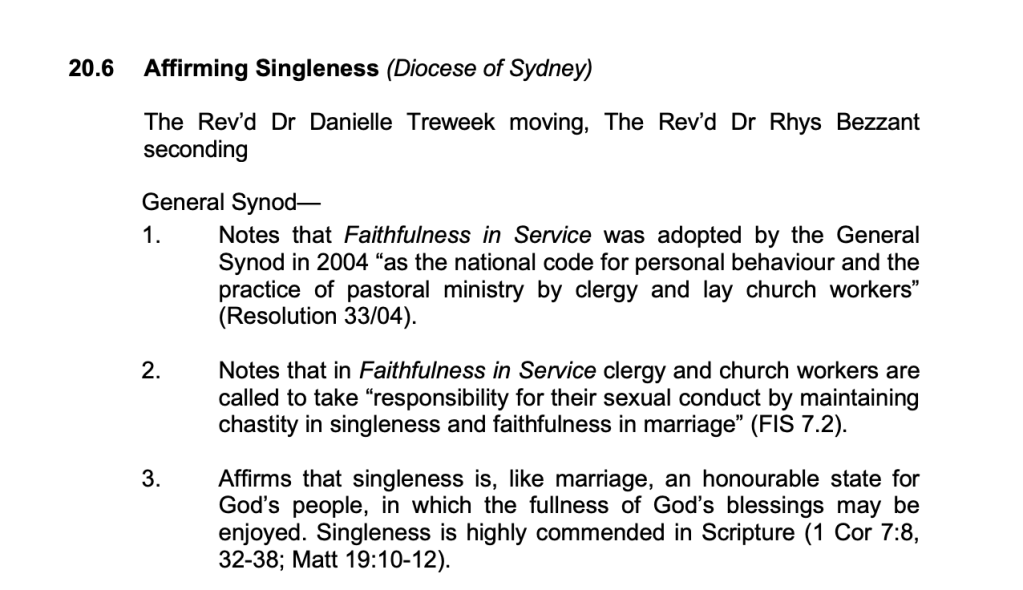
That being said, here is a motion to be discussed at the Anglican Church in Australia General Synod:

Of course, it is in a much wider context and really needs to be understood in that context. But I am somewhat pleased that singleness gets a mention. It is also interesting that it is seen as a state in the church rather than a negation.

Anyway, it is to be discussed today along with some other issues.

truth?

No human being, with the exception of Christ, is the truth.

Practice in Christianity, 204

I have been struck by how the modern person thinks they can inhabit truth – they can internalise it and make it their own. But the truth – as Jesus is – must always be witnessed as something outside of us. I never have the truth but can only point to it.

An afterthought: that does not mean that I must not be completely committed to that truth. And there is a sense that it must become “my truth” but only in the sense that I am resolved to put it into action.