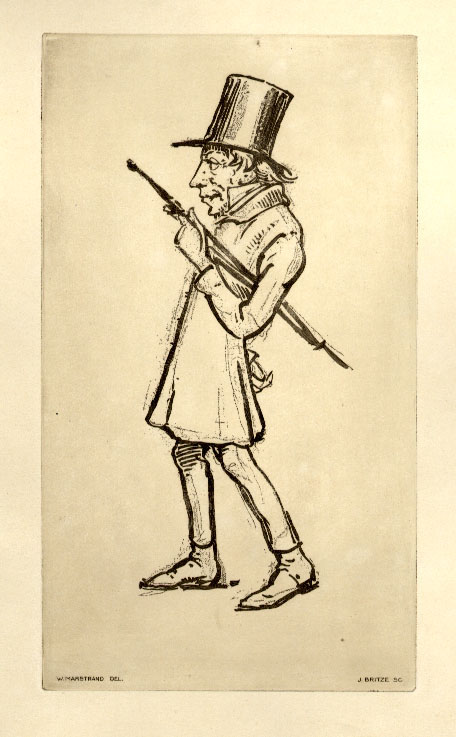
Today would have been Soren Kierkegaard’s 209th birthday. I feel very close to him as a person (he was, by all reports, awake, somehow confusing and confused, and intense) and I really enjoy his writings. I am no Kierkegaardian as that would be betraying Kierkegaard. But I find his thought upbuilding and challenging, and always pointing beyond itself to the Absolute Paradox.
So since it is his birthday, I thought I would share a large quote from Practice in Christianity. It is one of his later books and maybe shows a more mature vision of Christianity.
So happy birthday, SK, and thanks for keeping me alive with your writings.
There is, namely, an infinite chasmic difference between God and man, and therefore it became clear in the situation of contemporaneity that to become a Christian (to be transformed into likeness with God) is, humanly speaking, an even greater torment and misery and pain than the greatest human torment, and in addition a crime in the eyes of one’s contemporaries. And so it will always prove to be if becoming a Christian truly comes to mean becoming contemporary with Christ. And if becoming a Christian does not come to mean this, then all this talk about becoming a Christian is futility and fancy and vanity, and in part blasphemy and sin against the Second Commandment of the Law and sin against the Holy Spirit.
In relation to the absolute, there is only one time, the present; for the person who is not contemporary with the absolute, it does not exist at all. And since Christ is the absolute it is easy to see that in relation to him there is only one situation, the situation of contemporaneity; the three, the seven, the fifteen, the seventeen, the eighteen hundred years make no difference at all; they do not change him, but neither do they reveal who he was, for who he is is revealed only to faith.
Christ is no play-actor, if I may say it this soberly; neither is he a merely historical person, since as the paradox he is an extremely unhistorical person. But this is the difference between poetry and actuality: contemporaneity. The difference between poetry and history is surely this, that history is what actually happened, whereas poetry is the possible, the imagined, the poetized. But that which has actually happened (the past) is still not, except in a certain sense (namely, in contrast to poetry), the actual. The qualification that is lacking—which is the qualification of truth (as inwardness) and of all religiousness is—for you. The past is not actuality—for me. Only the contemporary is actuality for me. That with which you are living simultaneously is actuality—for you. Thus every human being is able to become contemporary only with the time in which he is living—and then with one more, with Christ’s life upon earth, for Christ’s life upon earth, the sacred history, stands alone by itself, outside history.
Practice in Christianity, Hong 63-64

 a fool and his prayer book