Experiencing Jesus

To be grateful is to recognize the Love of God in everything He has given us—and He has given us everything. Every breath we draw is a gift of His love, every moment of existence is a grace, for it brings with it immense graces from Him. Gratitude therefore takes nothing for granted, is never unresponsive, is constantly awakening to new wonder and to praise of the goodness of God. For the grateful [person] knows that God is good, not by hearsay but by experience. And that is what makes all the difference.

Thomas Merton, Thoughts in Solitude (20 in my edition)

“Not by hearsay but by experience”. Yes, that does make all the difference. I feel that is something I would like to be able to say. To experience Jesus is the aim of it all. To really know Him above all.

All of that reminds me of a Kierkegaard quote which I think I have already used:

I do not dare to call myself a Christian; but I want honesty, and to that end I will venture.

“What do I want?”, The Moment

To be honest, like Kierkegaard, I dare not call myself a Christian – my life does not reflect Him nor does my thinking. My life does not conform to the Pattern – my life does not follow Jesus. I try! I try by doing Christian things and choosing Him when I have the choice. I try by allowing myself to be swept along by His Love. I try by living with hope that in God all things are possible.
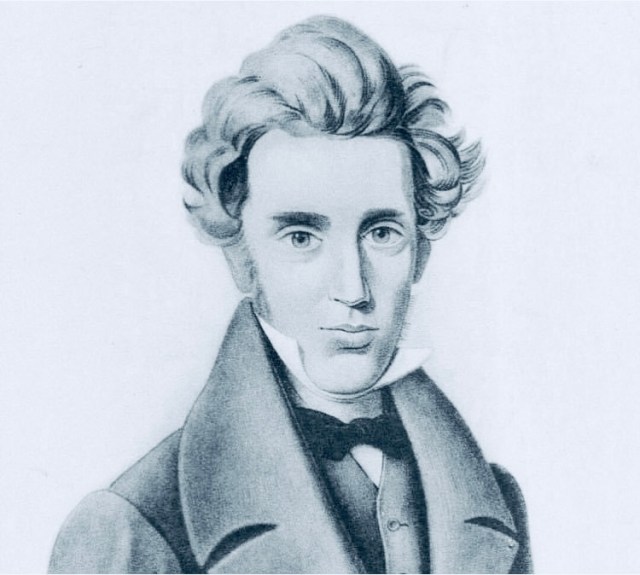
just a picture of Søren

I am helping with our youth group tonight. As with all things, I feel rather under-qualified for the task and more than a little out of my depth. I am hoping to be a wall-flower and just stand in the corner.

I was thinking about what God asks me to do when I feel I am rather useless. God has more confidence in me than I do. And often, I think, it is more about leaping into the river and just allowing God to carry me along.

There is always an element of risk in ever relationship. I like certainty but I know that is an escape from the risk. There is risk in relationship with people, revealing myself, and there is risk in my relationship with Jesus, Him revealing who I am.

There is risk because tomorrow is a mystery. So in that mystery I am called to live my relationships. I am called to be “me”.

So maybe a Kierkegaard quote:

God is present in the moment of choice, not in order to watch but in order to be chosen. Therefore, each person must choose. Terrible is the battle, in a person’s innermost being, between God and the world. The crowning risk involved lies in the possession of choice.

I pray you have a Jesus filled day!

… and …

I wanted to add something to the previous post – life is not always as bad as my anxiety makes me think!!!! Sometimes my anxiety and depression lie to me about life.

Thank you to the people who prayed – I do very much appreciate it.

Today has ended up not as bad as I had imagined. Things are moving in the right direction and I am going to get the help I need. Sometimes the system does work! More than ever I am thankful for the people in my life who support me and who have journey with me through it all. The people who write little messages of support, pray for me, and those who give me advice and provide wisdom. I am really not alone in this all. And God is always good, loving, merciful, and compassionate.

fragile

I have a number of important things to do today. I am very anxious about it all and it has been on my mind for many days. If you are so inclined, would you please pray for me?!

This morning I was trying to think of a word that describes me at the moment. I came up with fragile. I feel like I am about to break with any small bump. Everything is finely balanced and I am ok with going on but a small thing could make everything come crashing down.

So today I am praying that I can get to the end of the day without too much pain. I am ok at the moment but know today will be stressful.

I pray you have a Jesus filled day!

anglican monasticism

One of the topics I am interested in is the Anglican expression of the monastic tradition. Part of this is trying to keep up to date, and support in prayer, various religious communties throughout the world. So I follow Vocational Stories into Anglican Religious Life.

Today there is a post, Pictures of Alnmouth friary, that has some spectacular pictures. I will share only one:

I like the simplicity and the focus on the Pascal Candle. I love the icon in the corner! And the monastic stalls are a great way for a community to prayer.

the psalter

I like the tradition of prayer the Prayer Book gives to me. The rhyme of prayer – morning and evening – is central to the Anglican expression of the “catholic faith”. I have always appreciated that the psalms are part of this daily cycle of prayer. The psalms, more than any other part of Scripture, embody how the individual feels before God. Maybe because the psalms, unlike the rest of the Bible, do not have a particular context. Yes, they were used in the temple but often my life sets the context for the psalm, sets the context for my prayer using the psalms.

So this morning Psalm 143 was one of the psalms. I was struck by these verses, especially in the light of my previous post:

For the enemy has pursued me,
crushing my life to the ground,
making me sit in darkness like those long dead.
Therefore my spirit faints within me;
my heart within me is appalled.
I remember the days of old,
I think about all your deeds,
I meditate on the works of your hands.
I stretch out my hands to you;
my soul thirsts for you like a parched land.

Psalm 143:3-6

I identify with the darkness about which the psalmist speaks. I know that feeling of my heart dropping. And my spirit faints within me – I am overwhelmed and have no more energy to go on.

This psalm is my prayer today. Like the psalmist I am sitting in darkness crushed to the ground. And, like the psalmist, I look for the Lord to come to me and refresh me like the rain does to a parched land. I remember the mighty acts of God in Jesus and how He is my Helper now.

Alone?

I feel very overwhelmed. I am facing a hurdle that is not of my making but for which I feel responsible. The very thought of it brings me to tears. I am trying to not engage with the overthinking, trying to let it pass through me, but it is harder than normal this morning. My counsellor helped me yesterday but I feel like I have regressed in regard to my anxiety and depression. I know what I should be doing (in my head) but my heart just does not agree and is actually holding me back.

I have tried this journey on my own for almost 50 years. I have “toughed out” the darkness and just kept going. I have lived with the anxiety and have just hidden the screaming voice inside of me. I have worn a mask that has been handed to me by other people. A mask I convinced myself was the right thing to do, the Godly thing to wear.

So someone sent me the above song this morning. I am extremely thankful for the people God has placed in my life: some by blood, and some by a common faith and Lord. I still feel the disappointment of past failures and I really like to overthink those and what they say about me. But God speaks through people! People that draw me back to Jesus and to His community. People that literally hold my hand when it gets difficult and dark.

Today I am hoping to go for a walk, maybe record a podcast, and finish The Young Pope. And have a nice cup of tea. I am hoping to get some time to pray and just sit silently in God’s presence. And in the silence to hear God speak to me rather than listening to the voices that hold me back.

I hope you have a Jesus filled day!

Knight of faith

I have been watching The Young Pope. I am watching it in the hope of getting to The New Pope.

I admit it makes me laugh – the grandioseness of Pope Pius XIII and his view of religion. There is a sense of absurdity about Pope Pius XIII. And also a very deep sadness and confusion. This scene, I think, represents best what I mean:

The whole is a little like Kierkegaard’s Abraham in Fear and Trembling. The question of the nature of faith, and the nature of a calling from God, is very much at the front of many conversations in the show.

And I found someone who agrees with me, Kierkegaard’s Pope! This quote puts it well:

The Knight of Faith transcends the universal for the prison of the particular.

All of this has made me look at Fear and Trembling again. As with all Kierkegaard’s books, it is not easy or straight forward. There is always a sense that one needs a decoder ring along with any Kierkegaard book. I am far from the person to guide another through Kierkegaard. The simple act of reading a book can change a person and I think that is the aim that I read Kierkegaard – the very act makes me someone different.

So I thought I would share some quotes from Fear and Trembling. I like the Cambridge Texts in History of Philosophy edition so all the quotes are from that edition:

Faith is exactly this paradox, that the single individual is higher than the universal, but in such a way, mind you, that the movement is repeated, so that after having been in the universal he now as the particular keeps to himself as higher than the universal.

Kierkegaard: Fear and Trembling (Cambridge Texts in the History of Philosophy), 47.

For the movement of faith must constantly be made by virtue of the absurd, yet in such a way, mind you, that one does not lose the finite but gains it entire.

Kierkegaard: Fear and Trembling (Cambridge Texts in the History of Philosophy), 31.

I think myself into the hero; I cannot think myself into Abraham.

Kierkegaard: Fear and Trembling (Cambridge Texts in the History of Philosophy), 27

The tragic hero resigns [themlseves] in order to express the universal; the knight of faith resigns the universal in order to become the single individual.

Kierkegaard: Fear and Trembling (Cambridge Texts in the History of Philosophy), 66

via negationis

I wanted to share this series of post as I think they are really interesting: Existentialism and Christianity (Part 1, Part 2, Part 3). One little quote from The Totalitarianism of “Reason” (Part 3):

Danish philosopher Søren Kierkegaard was a dissenter from the new totalitarianism of “reason” and the gnosticism of Enlightenment philosophy. For him, as for the ancient Christian mystics, God was grasped intuitively, by a love that is beyond mere reason, since caritas is greater than even the greatest human knowledge. Such a view is redolent of the “cloud of unknowing” or the via negationis – the doctrine of divine simplicity espoused by the medieval theologian, Thomas Aquinas. According to this “eliminative method” one can define God by what he is not, since it is so difficult for us to truly appreciate what he is.

One of the things I have learned from existentialism (read: Kierkegaard) is that every person carries their story into everything they do and say. We each have an individual view of everything but it is always nice when one story meets another. The author is maybe a Roman Catholic and hence the return to Aquinas.

I like the opening: Kierkegaard stands solidly within the mystical tradition of Christianity. Maybe even the neo-Platonism of Augustine and Anselm! But, as with all modern philosophers of note, he takes it one step further – he speaks to a modern context. And to make the point: Kierkegaard is not an existentialist as he both predates it and is solidly a writer within the Christian tradition. Kierkegaard is not part of any school of thought and that is why he is so interesting – he is the “single individual” of philosophy.

But I have gotten off-topic. David R. Law has written a number of books on Kierkegaard as a negative theologian and kenotic Christology. Law’s article on the Chirstology of Practice in Christianity is a very interesting read. I think Kierkegaard’s Christology, “who is Jesus for Søren?”, would be a very interesting topic to explore especially in light of his later writings, that is, the Communion Discourses. Also how pietism played a role in Kierkegaard’s thought.

Anyway, just wanted to share the quote.