
Yesterday was the best day this blog has ever had! So congratulations (and thanks) to those who visited. I am celebrating by having a cup of tea. BTW: my new favourite pen!
Yesterday was the best day this blog has ever had! So congratulations (and thanks) to those who visited. I am celebrating by having a cup of tea. BTW: my new favourite pen!
I have been meaning to write on this topic for some time. I have written previously on Kierkegaard’s insights on sermons. Today I stumbled across this blog post, Soren Kierkegaard and Preaching…, and it reminded me that I wanted to write on the topic. But, as I reflected on preaching, it struck me that topic is much larger. Rather than preaching, it is about how to communicate the faith since it is faith in a Person.
Pursue love and strive for the spiritual gifts, and especially that you may prophesy. For those who speak in a tongue do not speak to other people but to God; for nobody understands them, since they are speaking mysteries in the Spirit. On the other hand, those who prophesy speak to other people for their upbuilding and encouragement and consolation. Those who speak in a tongue build up themselves, but those who prophesy build up the church. Now I would like all of you to speak in tongues, but even more to prophesy. One who prophesies is greater than one who speaks in tongues, unless someone interprets, so that the church may be built up.
1 Corinthians 14:1-5
Paul writes that those who “prophesy speak to other people for their upbuilding and encouragement and consolation“. The older Prayer Books used to call it “edification”. Kierkegaard would maybe call it indirect communication.
The aim of prophesying or preaching is not supplying of information but rather the upbuilding (towards God) of those who are listening. It is done to encourage the listener to do what they believe. And to find consolation when things do not work out in Jesus. Modern sermons are too often academic discourses that speak little to individuals. And all too often do not require a response from the individual in their daily life.
Preaching is an impossible task because it is a Person who is experienced that is the aim and end. This Person is not an absent past reality but a present person in the community. And this Person calls me to communion with Him. He calls me to intimacy now. And He speaks a very simple command, “Follow Me”.
I want to keep this topic open as I think it is very important for me to thinking aloud.
Is there anyone who could and would send me an invite to Clubhouse? I think it sounds amazing and would be something for me. (But I am not going to purchase an invite!) I have set up an account (@singleind) but have to wait for an invite. Contact me, please!!!!
I just wanted to share an article I read online: Inhuman communication: Søren Kierkegaard versus the internet by Patrick Stokes.
Just the last paragraph:
Equally, the fact that we are human beings dealing with other human beings is essential for maintaining the integrity of communication if we’re going to use this disproportionate talking tube. Indeed, a great deal of the abuse we encounter online ― though by no means all or even a majority of it ― seems to be a function of just this sort of abstraction from interpersonal communication, losing sight of the face behind the avatar, so to speak. Kierkegaard knew what it was to be attacked from all sides. But he also knew how to take responsibility, and how to engage with his neighbour even amidst the tumult.
All of this is another example of levelling. And the internet is very much the abstraction that kills the individual. But Stokes points out that the internet can become very impersonal – forgetting that there are people behind the keyboard. Impersonal communication is not only reserved for the internet. I think we live in a world of impersonal communication and religious communities are not immune. A “personal relationship” cannot be separate from personal interaction – some large communities can become extremely impersonal.
I think the article has many things to ponder. I do not think we need to abandon the internet (and technology) and live in the woods like Ted Kaczynski. (Yes, I have watched the Unabomber series on Netflix’s.) I think the internet can be redeemed by me being me and by me allowing people to be people and not seeing them as another product. The internet can be extremely impersonal, yes, and it can make individuals just another object. But in the end, Kierkegaard challenges me in my behaviour – to not allow abstractions to rule people, not to make individuals into objects, into hits or downloads. Kierkegaard encourages me to see people as people: people with stories, with experiences, with feelings. And for me to be a person online and reflect on the way I interact with others.
Towards the end of his life, Kierkegaard had a shaky relationship with Christendom – for him that meant the official Lutheran Church of Denmark. He did not receive Communion on his deathbed and refused visits from clergy, even his own brother. He turned his back on the institution, stayed away from public worship, and wrote at length about the dangers of Christendom. But did he have a shaky relationship with God?
I have always found Kierkegaard’s gravestone very inspiring. The inscription finishes with “And unceasingly / Speak with my Jesus.” For me, it separates the institution from the Person – the church from Jesus. Yes, Jesus speaks through His Church – in His Word and through the Sacraments – but the institution is not Jesus. I do not have faith in the church but only in the Absolute Paradox that brings life and embodies love. I like community and I am not anti-people but the community of faithful needs to lead me to communion with Jesus – He is the end of the journey!
So today I thought about a quote from the end of Kierkegaard’s life in the midst of his struggle with the official church:
I do not dare to call myself a Christian; but I want honesty, and to that end I will venture.
“XII. What do I want?”, The Moment, Hong 46
I guess, in modern speak, we would call that authenticity. For Kierkegaard, this honesty is connected to risk and faith. And the honesty he is speaking about is honesty about my relationship with God – honest before God. Being on a parish roll is not the same as being in the book of life.
It is human nature to try to find security in this world – finding certainty. For a lot of people, science offers that certainty – a truth that is imminent. Sometimes we use the terminology objective or absolute truth – a truth outside of me that is indepentant of me. Unfortunately, some people use that terminology about God. Kierkegaard’s point is that people finding that absolute truth in the institution is not the same as a personal relationship with Jesus. The fundamental movement of faith is to leap into uncertainty and that leap changes me.
So honesty has to do with risk before God. Risk that God will change me. Honesty is also about uncertainty – I do not have all the answers within myself. I am not complete without transcendence. I am not complete without the God who has reached out to me in love in the Absolute Paradox. And I can not surrender that honesty to another person – no one leaps for me into uncertainty.
My mental health struggles have taught me that I must live each day on its own merits. I must live now. Without any certainty about tomorrow. And that requires of me a certain amount of honesty about me and about my relationship with others and ultimately with God. I try (with God’s grace) to live for Him today.
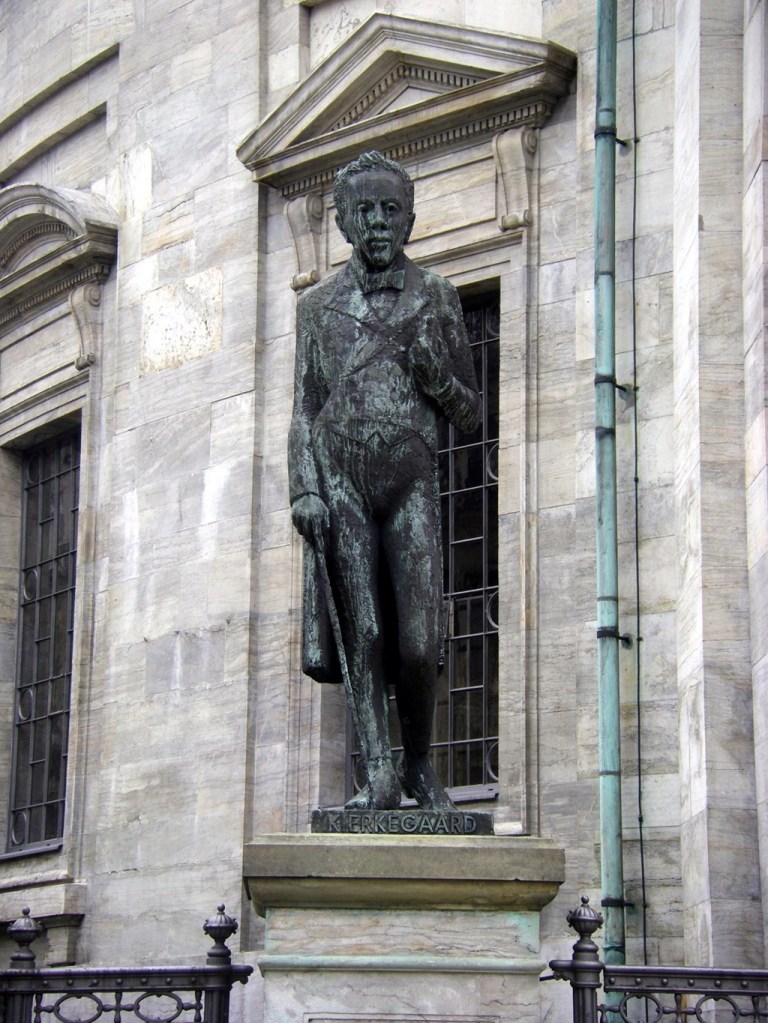
… this statue of Kierkegaard! It is one of 14 that surrounds the Marble Church. I like that he looks small and childlike – not a physical presence like some of the other statues. It shows that his impact is more subversive, that he stood against “the System” and for the Single Individual.
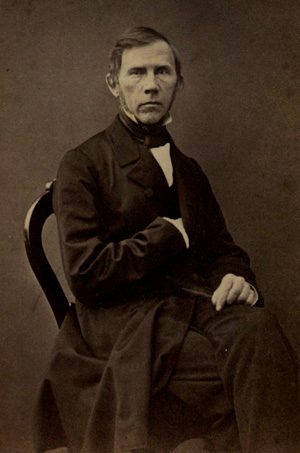
Emil Boesen (1812-81), life long friend of Kierkegaard. The person who spoke last with him.

I said Morning Prayer outside today. It was extremely windy so I had to stop my Prayer Book from being blown away. I used to be very fanatic about saying Mattins and Evensong – same time, same place, with full ceremonial – making my prayer life ever more and more complicated and involved. I wonder if I was trying to impress God or convince myself.
The simple form for every day in APBA is great – simple and not too involved. I use a very simple calendar and only keep a few festivals apart from the major ones. I read only the New Testament reading. The liturgical purest that was me would be horrified.
I like that the rhyme of prayer shapes my life. Morning and Evening Prayer are part of my Rule of Life. I try to say Prayer at the End of the Day (Compline) but often I forget or I am too tired. I have used Evening Prayer as a time to pray for people – people who have asked for my prayers and the people in my life. I also use the time to sit in silence and just “be”.
Life has taught me that it is not about the “how” of prayer (Prayer Books etc) but rather the “why” – my desire for intimacy with Jesus. My daily routine of praying sets the foundation for my life and also reminds me of Who is important. Using APBA is an act of obedience – I use what our parish uses – and also frees me up. It gives me the freedom for time with Jesus rather than maintaining some arbitrary tradition.
What do you use for your daily time with Jesus?
If he were alive today I am pretty sure that Kierkegaard would have a blog and a podcast. And he would create different profiles to talk to each other – to comment on posts – and create a whole “blogoverse” of his own.
I am going to take this writing thing a little more seriously. The blog and the podcast have been great while I have worked with my depression and anxiety (and continues to be great for me). Yet I think I have more to offer than personal reflections. So I am going to write a little more seriously and in the process challenge myself to move beyond.
I am open to suggestions on topics! I will try to add to the mix with honesty. Not to give an answer (always without authority) but rather to add another voice from the experience of a particular person at a particular time in a particular place.
So, if you have not already, “Like” the Facebook page. Ask anything in the comments (which are moderated so say if you do not want them public) or contact me via the blog.
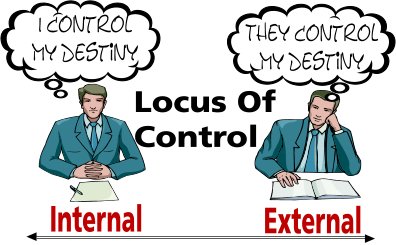
I have been reading about the idea of the locus of control. In brief, it is “the degree to which people believe that they, as opposed to external forces (beyond their influence), have control over the outcome of events in their lives“. I find that a challenging idea as it appears to not include any room for the Divine – that there is a Person outside of me that is in control of everything.
I think in his Journals Kierkegaard says that an all-powerful being is not all-powerful if that being cannot choose to not use all of their powers. And we Christians call that choice “love”. For me to love God, to choose Him, I must be free and God allows that freedom so that I can love Him. I know people theologically disagree – and I was raised in a tradition that does not agree with that idea of freedom. But I find that a comforting and challenging idea – I am free to love people and to love God without limit.
So back to the locus of control. Rather than not allowing for the Divine, it calls on me to “own” my choices. As I have worked with my counselor I have been encouraged to move beyond a “victim mentality”. And that movement has really helped me face my depression and my anxiety. These are not choices but how I react to them and how I live with them are my choices. In the past, I have made the wrong choices and those choices have hurt people.
So this morning I stumbled across this quote from Thomas Merton:
Today I seemed to be very much assured that solitude is in deed His will for me and that it is truly God Who is calling me into the desert. But this desert is not necessarily a geographical one. It is a solitude of heart in which created joys are consumed and reborn in God.
Sign of Jonas, 52
I think as Christians we can find our locus of control outside of ourselves. Christians have swallowed the scientific world view and elevated the “objective” to the role of the Divine. Simply to surrender to an idea, to a community, to a tradition, and to simply conform. Faith becomes an intellectual movement of non-questioning and just “doing”. Faith becomes an impersonal act. Of course, it is human nature to create that outside according to my experience and expectations. And, maybe even worse, it is human nature to expect that my “conforming” pleases God.
Maybe the Christian way of speaking about the locus of control is to speak about the “solitude of heart”? There is a place inside of me into which I can withdraw that I truly meet Jesus. And in this place, I surrender to Jesus. In this solitude, I listen to Jesus and have intimacy with Him. This place is not external to me but is the very nature of my being. My relationship is not only intellectual but personal and instinctive. Faith is personal and subjective. I experience Jesus in my “solitude of heart”.
 a fool and his prayer book