I wanted to share this link:
‘Seven Minutes on Being a Contemplative’ with Sr. Cara
Go and listen!
Yesterday’s sermon was about the Inbetween Times. It made me think of the monastic/religious life – a choice/vocation to inhabit the in-between times with purpose. And that made me think of this quote by the “the charismatic evangelical” Archbishop of Canterbury:
Life in Religion is the ultimate wager on the existence of God. The church should always be engaged in doing things that make no sense if God does not exist.
Most Revd Justin Welby, Archbishop of Canterbury
The above is written for the Anglican Religious Life Year Book so when it speaks of “life in religion” it is about monastic life. And the reason most forms of contemplative life are so unknowable to modern society is because it is the “ultimate wager” and “makes no sense” without God.
I have also been thinking that the absolute relationship to the absolute telos should be lived openly in secret. “Enclosed in plain sight”, for a modern anchorite. A complete commitment to Jesus who lives in my heart and I in his. But without the outward trappings of the monastic life – habit and a change of name.
I have been reading The Cloud of Unknowing. And I wanted to share the prayer it starts with, which is also the Collect for Purity that starts the Anglican Eucharist:
Almighty God,
to whom all hearts are open,
all desires known,
and from whom no secrets are hidden:
cleanse the thoughts of our hearts
by the inspiration of your Holy Spirit,
that we may perfectly love you,
and worthily magnify your holy name;
through Christ our Lord.
All Amen.
The second requirement is that in order to see yourself in the mirror when you read God’s Word you must (so that you actually do come to see yourself in the mirror) remember to say to yourself incessantly: It is I to whom it is speaking; it is I about whom it is speaking.
Kierkegaard
I have been following the General Synod of the Anglican Church of Australia. A little more like a spectator than a person who is involved. It is the community I call home but I am also somewhat distanced from it.
One of the things that struck me was the attempt to regulate how Scripture is read. Making statements about what Scripture does or does not say is difficult. But what worries me more is summed up in the quote above: Scripture is a mirror for me. I can take the Bible seriously without taking it literally. But above all else, it is always speaking to me and not to someone else.
And, morality is not a relationship with Jesus – the absolute telos and all that!?
Jesus straightened up and said to her, “Woman, where are they? Has no one condemned you?” She said, “No one, sir.” And Jesus said, “Neither do I condemn you. Go your way, and from now on do not sin again.”
John 8:10-11
I was thinking about the story of the woman caught in adultery. I was thinking about how the story ends with Jesus not condemning the woman. Compassion over law!

I have been using the Church of England’s Common Worship: Daily Prayer for nearly a year. I like the wording and the way everything is organised. I like that there are antiphons and Psalm Prayers.
AND today I found that there is an online site with Morning, Evening, Prayer During the Day, and Night Prayer for the current day. It makes it so easy!
I very rarely discuss “church politics”. In fact, I have very little interest in it and find it somewhat confusing. It also makes me anxious and angry.
That being said, here is a motion to be discussed at the Anglican Church in Australia General Synod:
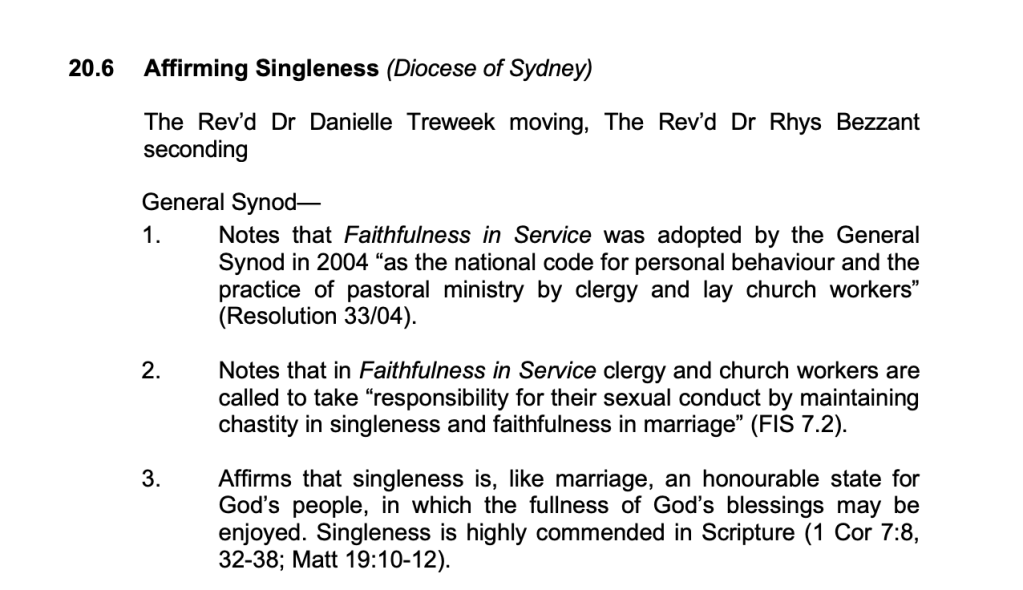
Of course, it is in a much wider context and really needs to be understood in that context. But I am somewhat pleased that singleness gets a mention. It is also interesting that it is seen as a state in the church rather than a negation.
Anyway, it is to be discussed today along with some other issues.
The past is like the internet: there is always someone who agrees with you.
I escape into books. I prefer people of old (in books) to most modern people. But books can also frustrate and annoy me.
So I have been reading: Anglicanism: A Reformed Catholic Tradition. The book may have many merits. Yet it has illustrated for me that the way we see today influences the way we see the past.
The book tries to trace some of the theological seeds to Anglicanism in the pre-Reformation period. Not an uncommon way to see Anglicanism. Yet, the book does not mention any of the people who not only formed English spirituality but also the English language. The book does not mention Julian of Norwich, Richard Rolle, Walter Hilton, or Margery Kempe. It does not mention The Cloud of Unknowning or the monastic tradition. It certainly does not mention the involvement of the Carthusian in English spirituality and theology. It mentions Anselm of Canterbury who, while he did work in England as Archbishop of Canterbury, knew no English and was an Italian by birth.
So there is one random observation!
I just wanted to share Psalm 62 again. It was set for Morning Prayer and it always speaks to me. So here is the whole Psalm with Refrain as found in Common Worship:
1 On God alone my soul in stillness waits; ♦
from him comes my salvation.
2 He alone is my rock and my salvation, ♦
my stronghold, so that I shall never be shaken.
3 How long will all of you assail me to destroy me, ♦
as you would a tottering wall or a leaning fence?
4 They plot only to thrust me down from my place of honour;
lies are their chief delight; ♦
they bless with their mouth, but in their heart they curse.
5 Wait on God alone in stillness, O my soul; ♦
for in him is my hope.
6 He alone is my rock and my salvation, ♦
my stronghold, so that I shall not be shaken. [R]
7 In God is my strength and my glory; ♦
God is my strong rock; in him is my refuge.
8 Put your trust in him always, my people; ♦
pour out your hearts before him, for God is our refuge.
9 The peoples are but a breath,
the whole human race a deceit; ♦
on the scales they are altogether lighter than air.
10 Put no trust in oppression; in robbery take no empty pride; ♦
though wealth increase, set not your heart upon it.
11 God spoke once, and twice have I heard the same, ♦
that power belongs to God.
12 Steadfast love belongs to you, O Lord, ♦
for you repay everyone according to their deeds.
O God, teach us to seek security,
not in money or theft,
not in human ambition or malice,
not in our own ability or power,
but in you, the only God,
our rock and our salvation.
… I have not mentioned it: I have started using Common Prayer: Daily Prayer as my office book. And I must admit I absolutely love it. It is physically a very nice book. And the offices are within the Anglican tradition and solidly traditional in their shape. It provides Morning Prayer, Prayer During the Day, Evening Prayer, and Prayer at the end of the day. I like the four-fold office as it is doable for me in my current context. And, to be honest, I do not want more at the moment!
I will admit that sometimes I feel some anxiety about not using the Australian prayer book that my parish uses. But that is for another day to consider!
 a fool and his prayer book