religious life?

I have been returning to an older theme: religious life. And I have been thinking about two quotes in particular that, I think, say the same thing.

Life in Religion is the ultimate wager on the existence of God. The Church should always be engaged in doing things that make no sense if God does not exist. This is the reason why I hold the Religious life in the highest esteem … the monastic life models for all Christians what it means to live fully and abundantly, with and for Christ.

The Most Rev’d Justin Welby, Archbishop of Canterbury
Foreword to: Anglican Religious Life 2016-17

Of this there is no doubt, our age and Protestantism in general may need the monastery again, or wish it were there. The “monastery” is an essential dialectical element in Christianity. We therefore need it out there like a navigation buoy at sea in order to see where we are, even though I myself would not enter it. But if there really is true Christianity in every generation, there must also be individuals who have this need.

Kierkegaard, Nov 1847

I am always amazed that Kierkegaard, living in 1800s Lutheran Denmark, writes at length about “the monastery” in his journals. What experience would he have had of religious life? What books would he have read? And, in some ways, his very life is an example of what he said above – even if he does not want to enter a monastery.

To put it another way: people need to take the “single individual” to the extreme to show other people what it means to be the “single individual” – “dare to desire Jesus alone”. I am seeing that reality more and more. Like yeast in the dough, individuals need to place all their eggs in the one basket (sorry!) and say, “what if all of this stuff about God is true?”. And much more: let’s take Jesus seriously and actually follow Him alone, pick up our cross and live a life of love.

I think both of these quotes call us to “new monasticism” (to introduce yet another person’s quote). Not looking to the past alone but using the past to live today for Jesus alone. Yes, the church as a community and especially individuals within the Church need to do things that make no sense if God does not exist. Individuals need to take Jesus seriously.

today?

So today I move from “wannabe Anglican” to a member of the Anglican Church of Australia. I guess I am really only becoming a member of the parish which is part of the Archdiocese of Melbourne. With the numerous lockdowns, this has been some time in coming. I am anxious about the physical side of things – getting there, setting up, meeting people. I am meeting a person, a bishop of the diocese, whom I have not met before. I have worn masks for so long I sometimes forget the real me.

This is the first religious decision I have made on my own. The previous ones have been made with a community (family) around me to support me. This one is me alone before God. So I am extremely anxious about it all. I guess I feel quite silly for doing this again. And I worry that this is yet another temporary fix for the problem that is “me”. I guess (lots of guessing) that, in the end, I belong nowhere. People will wake up to me and that will be the end of another chapter,

It is bringing up the same monologue that I struggled with earlier in the year. My counsellor calls it the “monster within”. To be honest, the “monster” has simply become not as loud but it is always there. The last two weeks have been full of instances where I feel like an “alien in this world”. I simply do not connect and, to be honest, do not have the energy to connect. Conversations have become exhausting and people are wearisome. I have become more aware of my own emotions and how I basically run on them. I love the people in my life but my darkside wonders if that is enough. (And whether loving Jesus is enough.)

Sorry, that is a very depressing post! I rejoice in the small glimpses of love I feel from others and from Jesus. But the monster simply double guesses everything and everybody. I am just going to try to not overthink today. Go with the flow. But I know that will be hard! Life is such a balancing act.

I am going to try to say the various offices in the car at their normal time. I am hoping that some rhythm to the day will help, And, of course, that the prayer itself will change me – bring light to the darkness.

Common Worship

This arrived today:

I have been thinking of switching to Common Worship for Morning and Evening Prayer. Also of introducing Prayer During the Day and Prayer at Night (Compline) to my daily cycle of prayer. I have only had a very brief look but I think this book will offer me a fuller office within the modern Anglican tradition. And I can use a weekly, fortnightly, or monthly psalter.

Anyway …

anglican anchorite?!

Sometimes I stumble upon things, without even trying, which makes me think God is at work.

Yesterday I stumbled across Martha Reeves who goes by the “pen-name” of Maggie Ross. Reeves is described as “a vowed Anglican solitary (or anchorite)”. She has written a number of books, not least of which is a two-volume set titled, Silence: A User’s Guide.

But it gets better! She has a blog, Voice in the Wilderness. Yes, an anchorite within the Anglican tradition who is active online. There are a number of YouTube videos of conferences she has given and an article about her life.

And here is a quote to end this post:

The Desert Fathers and Mothers tell us that we are never less alone than when we are in solitude.

anchorites in England

I have been reading Hermits and anchorites in England, 1200-1550 by E.A. Jones. It is a collection of documents with an excellent introduction to each section. I have not read the part on hermits yet but the sections on the anchorite life are filled with amazing insights. I know there are books on continental anchorites, yet there is a part of me that thinks of it as the most English of religious lives.

So I have been thinking about the anchorite rite of enclosure. After some elements inside the church, the anchorite gets to watch their own funeral from their new home. Often their grave was part of their devotional space and they would watch the services inside the church from inside their grave. Death is a reality for the anchorite, as it was, presumably, for everyone in the middle ages.

Not a particularly happy thought for a Sunday afternoon. But the connection between the eucharist, the death of Jesus, and my own death are worth considering. Kierkegaard writes that at the altar (when we receive Communion) we are truly alone. At that moment life and death become one moment. To live for Jesus is to live in that tension between death and life.

Anyway …

witnesses

I am always struck by other people’s faith. I feel my own is so small and limited – often more intellectualised than real – that I often envy how other people experience Jesus. I guess it is always easier looking in from the outside. And people tell you what they want you to hear. But I have seen real faith in my life – people living sacrificial love for Jesus and their neighbour.

But this morning it struck me: all these people are sent to me as a witness. A witness of what it means to follow Jesus. A witness of faithfulness. Not that they are better than me – which, of course, they are. But rather that I am not alone in this journey. I am not walking by myself. Yes, in the end, I give account for my life alone before the throne of grace. But at this very moment in time, I am given the strength of witnesses to Jesus.

layperson?

Yesterday, during “leadership prayers” before church, I had this strange inside: I like being part of a community of Christians within the Anglican tradition. I had this very strong sense that this was a new beginning for us as a community and for me as an individual. I have been struggling with a couple of issues and, as always, it has affected my sense of balance.

I have been thinking about what it means to be a layperson. And, in my case, a layperson with a theological degree. So a person who has the same academic qualification as a priest but has no desire to become clergy. I will add, a very happy Anglican! Experience has taught me that I do not have the gifts to run a parish or to be involved in the larger denominational context. I am somewhat of a free spirit and like my own agenda.

I have no desire to lead a parish (what a disaster that would be) and I do not want to celebrate the divine mysteries. Other people do that much better than I could ever do. I am happy to use my gifts within the liturgy as a layperson – serving or being Master of Ceremonies, and sacristan. In my current context, it means helping with the technology on a Sunday and setting up the altar before our service.

For my own mental health, I need to be in “the moment”. That means being what I am right now and not looking forward to a possible self that depends on others. And right now I am a “happy layperson” who sometimes teaches and sometimes helps in the parish. I like the freedom of being “without authority” (like SK!). I like that I am answerable to my vicar for what I teach and what I do.

I like the freedom of being an Anglican – the unity within diversity that means I can be “somewhat Catholic” within an emerging parish. A context where doctrine is a witness but not as important as Jesus. I want to be part of a context where the sign of the cross is as familiar as hands raised in praise. Individuals gathering around Jesus!

So a somewhat weird start to the week!!!

birth of John the Baptist

Today is the festival of the Birth (Nativity) of St John the Baptist. Even APBA has a festival office for the occasion. It is, as a personal note, the liturgical date that I started by journey within the Roman Catholic Church which came to an end almost 12 years later. There is something about that but that is for another post.

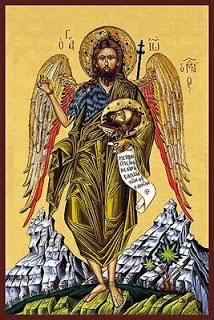
John is a hermit-like figure. In iconography, he often has the wings of a messenger and he carries his own decapitated head, a sign of his martyrdom at the hands of Herod. John’s task is to proclaim Jesus knowing that, like Jesus, that will cost his life.

The New Testament illustrates this connection. Mark’s gospel starts with John but quickly moves to Jesus. But there is bridge between the two ministries.

Now after John was arrested, Jesus came to Galilee, proclaiming the good news of God, and saying, “The time is fulfilled, and the kingdom of God has come near; repent, and believe in the good news.”

Mark 1:14-15

The verb which is used for John’s arrest is the same verb that is used during Jesus’ passion. I think Mark wants us to draw the connection: John shares in Jesus’ cross with his own life. From the outset, he is a martyr – a witness of Jesus in his life. For John that becomes a truth – he is killed for Jesus. But there is a vital connection to my life:

As Jesus passed along the Sea of Galilee, he saw Simon and his brother Andrew casting a net into the sea—for they were fishermen. And Jesus said to them, “Follow me and I will make you fish for people.” And immediately they left their nets and followed him. As he went a little farther, he saw James son of Zebedee and his brother John, who were in their boat mending the nets. Immediately he called them; and they left their father Zebedee in the boat with the hired men, and followed him.

Mark 1:16-20

The previous passage is followed by the calling of the first disciples in Mark’s gospel. It is interesting that John’s call to martyrdom – call to be a witness in his life – is followed by Jesus saying, “Follow me”. The call of faith is to face Jesus’ cross and my own cross. The call is one to sacrificial living as a witness of Jesus.

So blessed feast to all!!!