enclosed garden

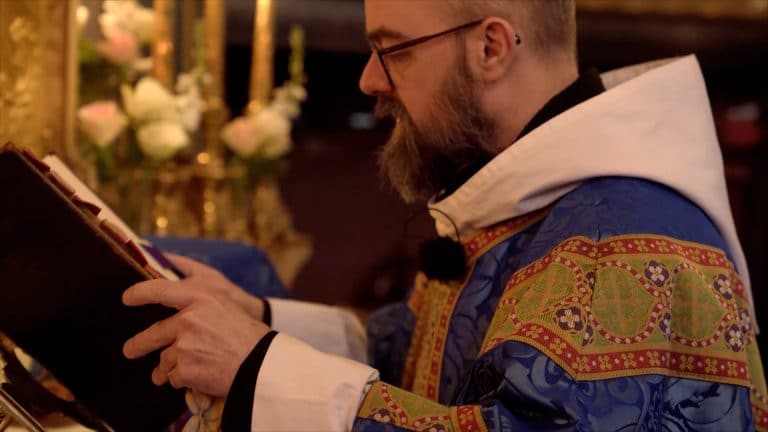
Similar to contemplative monasteries, the Office is kept in Warfhuizen. In Western Christianity, that is often prayed in accordance with the precepts of Saint Benedict, but in 2009, the hermit switched to the Office of Saint John Cassian from the 5th century. John of Cassian based his schedule on the customs of the hermits in the Egyptian desert, the so-called Desert Fathers, making it very suitable for hermits.

Instead of the eight (usually short) Benedictine offices, Cassian prescribes two (longer) vigils, one at the start and one at the end of the night. In Warfhuizen, these vigils are sung softly in Latin. The other hours do not have an office with Psalms, but are prayed in silence using the Jesus Prayer.

As such, the Office currently used in Warfhuizen clearly deviates from that of the ancient Dutch hermits, who usually used an abbreviated Liturgy of the Hours of Benedict. The influence of the Limburgian tradition on the atmosphere in the hermitage remains clearly noticeable through the various additions from popular devotions, such as praying the Rosary and various litanies, which are sung out loud at various moments during the day. The chapel’s decorations are also a continuation of 17th century examples, through Baroque elements. The devotion to Saint Gerlach of Houthem, of whom there is a reliquary in the retable of the right side altar, has a special place in the hermitage. Saint Anthony Abbot is also especially honoured, with a relic of his kept in the Holy Cross altar.

In addition to the old southern tradition, there are also other influences on the liturgy. The fact that some volunteers are Russian Orthodox has led to the Jesus Prayer being sung in Greek after Compline. The Carthusian tradition is also noticeable in the manner of Gregorian chant.

Our Lady of the Enclosed Garden

Russian spirituality has had an enormous influence on my spiritual life for years, if only because of the Startsi. The Startsi – singular starets – are monks who act as the spiritual father of an entire region, including the monastery where they live. They represent, as it were, the father of the prodigal son,* the spiritual home where you are always welcome and where warmth, safety, and good advice are in abundance.

The sleeping fathers of Kiev (Google translate)

… be humble?

To be humble means to consider ourselves deserving, for our sins, of every humiliation, injury, persecution, and even blows; and to be meek means patiently to endure injustice, abuse, et cetera, and to pray for our enemies.

If you wish to be truly humble, then consider yourself lower than all, worthy of being trampled on by all; for you yourself daily, hourly trample upon the law of the Lord, and therefore upon the Lord Himself.

When any one, out of kindness, praises you to others, and they transmit these praises to you, do not consider them as a just tribute of esteem really due to you, but ascribe them solely to the kindness of heart of the person who thus spoke of you, and pray to God for him, that God may strengthen him in his kindness of heart and in every virtue; but acknowledge yourself to be the greatest of sinners, not out of humility, but truthfully, actually, knowing as you do your evil deeds.

A deep feeling of spiritual poverty, a lamentation at the existence of evil, a thirst after salvation, are to be found in every straightforward and humble soul.

Receive every one who comes to you, especially with a spiritual purpose, with a kind and cheerful aspect, although he or she may be a beggar, and humble yourself inwardly before everybody, counting yourself lower than he or she, for you are placed by Christ Himself to be the servant of all, and all are His members, although like you they bear the wounds of sin.

There is absolutely nothing for a Christian to be proud of in accomplishing works of righteousness, for he is saved, and is being constantly saved, from every evil through faith alone, in the same manner as he accomplishes works of righteousness also by the same faith. “For by grace you are saved through faith, and that (faith itself) not of yourselves, for it is the gift of God; not of works, that no man may glory.” So that no one can be proud of anything.

Spiritual poverty consists in esteeming oneself as though not existing, and God alone as existing; in honouring His words above everything in the world, and in not sparing anything to fulfil them, even one’s own life; in considering God’s Will in everything, both for ourselves and others, entirely renouncing our own will. The man who is poor in spirit desires and says with his whole heart: “Hallowed be Thy name, Thy kingdom come, Thy will be done in earth as it is in heaven.” It is as though he himself disappears; everywhere and in everything he wishes to see God – in himself and in others. “Let every thing be Thine, not mine.” He wishes to contemplate God’s holiness in himself and in all His kingdom, also His will; also to see Him alone entirely filling the human heart, as it should be, because He alone is all-merciful and all-perfect, all-creating; whilst the enemy -the Devil and his instruments, and those who oppose God – are thieves in the kingdom of God, and adversaries of God. To him who is poor in spirit the whole world is as nothing. Everywhere he sees God alone giving life to everything, and ruling everything; for him there is no place without God, no moment without God; everywhere and at every minute he is with God, and as though with Him alone. He who is poor in spirit does not dare and does not think of trying to comprehend the incomprehensible, to discover God’s mysteries, to philosophise on the highest; he believes in the single word of the Lord, the Life-giver, knowing that every word of His is truth, spirit, and eternal life; and in the words of His Church, ever instructed in all truth by the Holy Ghost, he believes as a child believes his father or mother, not requiring proofs, but perfectly relying upon them. He who is poor in spirit considers himself the very last and the most sinful of all, reckons himself worthy of being trampled under foot by every one.

St John of Kronstadt

Saint Peter’s Day

The Collect

O Almighty God, who by thy Son Jesus Christ didst give to thy Apostle Saint Peter many excellent gifts, and commandedst him earnestly to feed thy flock: Make, we beseech thee, all Bishops and Pastors diligently to preach thy holy Word, and the people obediently to follow the same, that they may receive the crown of everlasting glory; through Jesus Christ our Lord. Amen

For the Epistle: Acts 12.1-11

About that time Herod the king stretched forth his hands to vex certain of the Church. And he killed James the brother of John with the sword. And because he saw it pleased the Jews, he proceeded further to take Peter also. (Then were the days of unleavened bread.) And when he had apprehended him, he put him in prison, and delivered him to four quaternions of soldiers to keep him, intending after Easter to bring him forth to the people. Peter therefore was kept in prison; but prayer was made without ceasing of the Church unto God for him. And when Herod would have brought him forth, the same night Peter was sleeping between two soldiers, bound with two chains; and the keepers before the door kept the prison. And behold, the angel of the Lord came upon him, and a light shined in the prison; and he smote Peter on the side, and raised him up, saying, Arise up quickly. And his chains fell off from his hands. And the angel said unto him, Gird thyself, and bind on thy sandals: and so he did. And he saith unto him, Cast thy garment about thee, and follow me. And he went out and followed him; and wist not that it was true which was done by the angel; but thought he saw a vision. When they were past the first and the second ward, they came unto the iron gate that leadeth unto the city, which opened to them of his own accord; and they went out, and passed on through one street, and forthwith the angel departed from him. And when Peter was come to himself, he said, Now I know of a surety, that the Lord hath sent his angel, and hath delivered me out of the hand of Herod, and from all the expectation of the people of the Jews.

The Gospel: St. Matthew 16.13-19

When Jesus came into the coasts of Caesarea Philippi, he asked his disciples, saying, Whom do men say that I, the Son of man, am? And they said, Some say that thou art John the Baptist, some Elias, and others Jeremias, or one of the prophets. He saith unto them, But whom say ye that I am? And Simon Peter answered and said, Thou art Christ, the Son of the living God. And Jesus answered and said unto him, Blessed art thou, Simon Bar-jona: for flesh and blood hath not revealed it unto thee, but my Father which is in heaven. And I say also unto thee, that thou art Peter, and upon this rock I will build my Church; and the gates of hell shall not prevail against it. And I will give unto thee the keys of the kingdom of heaven: and whatsoever thou shalt bind on earth shall be bound in heaven; and whatsoever thou shalt loose on earth shall be loosed in heaven.

1 John 2

Love not the world, neither the things that are in the world. If any man love the world, the love of the Father is not in him. For all that is in the world, the lust of the flesh, and the lust of the eyes, and the pride of life, is not of the Father, but is of the world. And the world passeth away, and the lust thereof: but he that doeth the will of God abideth for ever.

Little children, it is the last time: and as ye have heard that antichrist shall come, even now are there many antichrists; whereby we know that it is the last time. They went out from us, but they were not of us; for if they had been of us, they would no doubt have continued with us: but they went out, that they might be made manifest that they were not all of us. But ye have an unction from the Holy One, and ye know all things.

I have not written unto you because ye know not the truth, but because ye know it, and that no lie is of the truth. Who is a liar but he that denieth that Jesus is the Christ? He is antichrist, that denieth the Father and the Son. Whosoever denieth the Son, the same hath not the Father: he that acknowledgeth the Son hath the Father also.

Let that therefore abide in you, which ye have heard from the beginning. If that which ye have heard from the beginning shall remain in you, ye also shall continue in the Son, and in the Father. And this is the promise that he hath promised us, even eternal life.

These things have I written unto you concerning them that seduce you. But the anointing which ye have received of him abideth in you, and ye need not that any man teach you: but as the same anointing teacheth you of all things, and is truth, and is no lie, and even as it hath taught you, ye shall abide in him.

And now, little children, abide in him; that, when he shall appear, we may have confidence, and not be ashamed before him at his coming. If ye know that he is righteous, ye know that every one that doeth righteousness is born of him.

15-29

… to go beyond Jesus

Further to the pervious post …

I was told, by a professional theologian, that I was a Jesus-only Christian. The person went on to say that we (meaning the church in general) have gone “beyond Jesus” and are now Trinitarian Christians.

I was thinking about going “beyond Jesus”. Is there a “going beyond”?

further …

… to yesterday’s post, what if, here is a section from Kierkegaard:

But as in Christendom everything has been brought to confusion, so also this; and thereby the point has been reached where Christianity has become paganism. In Christendom they preach perpetually about what happened then after Christ’s death, how He triumphed, and how His disciples made a triumphal conquest of the whole world-in short, one hears only sermons which might properly end with Hurrah I rather than with Amen. No, Christ’s life here upon earth is the paradigm; it is in likeness to it that I along with every Christian must strive to construct my life; and this is the essential object of the sermon, this is the end it should serve, to keep me alert when I would become slack, and to strengthen me when I would become disheartened. In such a sense He is the paradigm in the situation of contemporaneousness; in that situation there was no stuff and nonsense about what happened afterwards. But Christendom has abolished Christianity – on the other hand, it would like to inherit Him and His great name, to gain advantage from the immense consequences of his life, coming pretty close to appropriating these consequences as its own meritorious achievement and making us believe that Christendom is Christ. Every generation has to begin all over again with Christ and thus to present His life as the paradigm; but instead of this, Christendom has taken the liberty of interpreting the whole relationship simply historically, beginning by letting Him be dead-and then it triumphs! Since that time Christendom has been increasing in numbers year by year-and what wonder; for people are only too eager to take part when there is nothing whatever to do but to triumph and to join the parade. And therefore to be a Christian in Christendom is as different from being a Christian in the situation of contemporaneousness as paganism is from Christianity.

Training in Christianity, 109

desert ascetics

These are the reading for Mattins (alternative First Lesson), the Gospel for Mass from the Book of Common Prayer, and the Collect for the First Sunday in Lent.

My son, if thou come to serve the Lord, prepare thy soul for temptation. Set thy heart aright, and constantly endure, and make not haste in time of trouble. Cleave unto him, and depart not away, that thou mayest be increased at thy last end. Whatsoever is brought upon thee take cheerfully, and be patient when thou art changed to a low estate. For gold is tried in the fire, and acceptable men in the furnace of adversity. Believe in him, and he will help thee; order thy way aright, and trust in him. Ye that fear the Lord, wait for his mercy; and go not aside, lest ye fall. Ye that fear the Lord, believe him; and your reward shall not fail. Ye that fear the Lord, hope for good, and for everlasting joy and mercy. Look at the generations of old, and see; did ever any trust in the Lord, and was confounded? or did any abide in his fear, and was forsaken? or whom did he ever despise, that called upon him? For the Lord is full of compassion and mercy, longsuffering, and very pitiful, and forgiveth sins, and saveth in time of affliction. Woe be to fearful hearts, and faint hands, and the sinner that goeth two ways! Woe unto him that is fainthearted! for he believeth not; therefore shall he not be defended. Woe unto you that have lost patience! and what will ye do when the Lord shall visit you? They that fear the Lord will not disobey his Word; and they that love him will keep his ways. They that fear the Lord will seek that which is well, pleasing unto him; and they that love him shall be filled with the law. They that fear the Lord will prepare their hearts, and humble their souls in his sight, Saying, We will fall into the hands of the Lord, and not into the hands of men: for as his majesty is, so is his mercy.

Ecclesiasticus 2

Then was Jesus led up of the Spirit into the wilderness, to be tempted of the devil. And when he had fasted forty days and forty nights, he was afterward an-hungred. And when the tempter came to him, he said, If thou be the Son of God, command that these stones be made bread. But he answered and said, It is written, Man shall not live by bread alone, but by every word that proceedeth out of the mouth of God. Then the devil taketh him up into the holy city, and setteth him on a pinnacle of the temple, and saith unto him, If thou be the Son of God, cast thyself down; for it is written, He shall give his angels charge concerning thee, and in their hands they shall bear thee up, lest at any time thou dash thy foot against a stone. Jesus said unto him, It is written again, Thou shalt not tempt the Lord thy God. Again, the devil taketh him up into an exceeding high mountain, and sheweth him all the kingdoms of the world, and the glory of them; and saith unto him, All these things will I give thee, if thou wilt fall down and worship me. Then saith Jesus unto him, Get thee hence, Satan; for it is written, Thou shalt worship the Lord thy God, and him only shalt thou serve. Then the devil leaveth him, and behold, angels came and ministered unto him

The Gospel St. Matthew 4.1-11

O Lord, who for our sake didst fast forty days and forty nights: Give us grace to use such abstinence, that, our flesh being subdued to the Spirit, we may ever obey thy godly motions in righteousness and true holiness, to thy honour and glory, who livest and reignest with the Father and the Holy Ghost, one God, world without end. Amen.

The Collect

Psalm 38

This is the first Psalm from Morning Prayer.

Psalm 38. Domine, ne in furore

Put me not to rebuke, O Lord, in thine anger : neither chasten me in thy heavy displeasure.
2 For thine arrows stick fast in me : and thy hand presseth me sore.
3 There is no health in my flesh, because of thy displeasure : neither is there any rest in my bones, by reason of my sin.
4 For my wickednesses are gone over my head : and are like a sore burden, too heavy for me to bear.
5 My wounds stink, and are corrupt : through my foolishness.
6 I am brought into so great trouble and misery : that I go mourning all the day long.
7 For my loins are filled with a sore disease : and there is no whole part in my body.
8 I am feeble, and sore smitten : I have roared for the very disquietness of my heart.
9 Lord, thou knowest all my desire : and my groaning is not hid from thee.
10 My heart panteth, my strength hath failed me : and the sight of mine eyes is gone from me.
11 My lovers and my neighbours did stand looking upon my trouble : and my kinsmen stood afar off.
12 They also that sought after my life laid snares for me : and they that went about to do me evil talked of wickedness, and imagined deceit all the day long.
13 As for me, I was like a deaf man, and heard not: and as one that is dumb, who doth not open his mouth.
14 I became even as a man that heareth not : and in whose mouth are no reproofs.
15 For in thee, O Lord, have I put my trust : thou shalt answer for me, O Lord my God.
16 I have required that they, even mine enemies, should not triumph over me : for when my foot slipped, they rejoiced greatly against me.
17 And I, truly, am set in the plague : and my heaviness is ever in my sight.
18 For I will confess my wickedness : and be sorry for my sin.
19 But mine enemies live, and are mighty : and they that hate me wrongfully are many in number.
20 They also that reward evil for good are against me : because I follow the thing that good is.
21 Forsake me not, O Lord my God : be not thou far from me.
22 Haste thee to help me : O Lord God of my salvation.

sacrifice

I beseech you therefore, brethren, by the mercies of God, that ye present your bodies a living sacrifice, holy, acceptable unto God, which is your reasonable service. And be not conformed to this world: but be ye transformed by the renewing of your mind, that ye may prove what is that good, and acceptable, and perfect, will of God.

Romans 12:1-2 (KJV)

The above is from Second Evensong for Candlemas. It reminded me of one of the post-communion prayers In the Second Order in APBA:

Father,
we offer ourselves to you
as a living sacrifice
through Jesus Christ our Lord.
Send us out in the power of your Spirit
to live and work to your praise and glory.

What does “sacrifice” mean in these two texts? Not death. Perhaps we could define it as the surrender of a good (body in Romans) for a greater good (life in Jesus).

BTW: Augustine makes the opposite his definition of sin:

On account of all these, and such as these, is sin committed; while through an inordinate preference for these goods of a lower kind, the better and higher are neglected — even You, our Lord God, Your truth, and Your law.

Confessions 2:5:10

So, the choice between higher and lower goods is the root of sin and sacrifice.

Anyway …

what is “all”?

I have been sick – not much sleep for the last two days. I am not sure how well my medication is working – I guess I will know when I get withdrawals. Anyway, I dreamt last night that I was walking into a church – a nondescript building which I somehow knew was a church. King of strange as I have not been to church for six weeks. There was no person in the church but a hymn was playing:

All to Jesus I surrender,
All to him I freely give;
I will ever love and trust him,
In his presence daily live.

Chorus:
I surrender all,I surrender all,
All to thee, my blessed Savior,
I surrender all.

All to Jesus I surrender;
Make me, Savior, wholly thine;
Let me feel the Holy Spirit,
Truly know that thou art mine.

All to Jesus I surrender,
Lord, I give myself to thee,
Fill me with thy love and power,
Let thy blessing fall on me.

Sometimes I remember my dreams. (I cannot know if I ever forget a dream!) The first thing that came to mind this morning was: What does “all” mean in this hymn? “All to Jesus I surrender – Lord, I give myself to thee”.

Maybe let me put it another way!? Does “all” include:

  • the institution of the church? or any institution?
  • the desire for certainty in this world? To find absolutes in either the community or the book?
  • morality?
  • duty?
  • family?
  • other people?

Anyway …