
Skepticism arises from our desire to know without the self being transformed. … Ironically skepticism is but the result of our anxious desire to secure certainty by being “at home in the world.”
Harvey, Michael G.. Skepticism, Relativism, and Religious Knowledge: A Kierkegaardian Perspective Informed by Wittgenstein’s Philosophy.
nobody goes further
Faith is the highest passion in a human being. There are perhaps many in every generation who do not even come to it, but nobody goes further.
Evans, C. Stephen; Walsh, Sylvia. Kierkegaard: Fear and Trembling (Cambridge Texts in the History of Philosophy), 108.
nihilism
nihilism is the view that certain things people often assume are “real” or “given”—like objective meaning, objective values, or a purpose built into the universe—may not exist. …
The key practical point is this: a claim about what exists in the universe is not the same as a recommendation about how to live. “There is no objective meaning” is descriptive. “Therefore I should act cruelly” is prescriptive.
J. Colle, Ardenne. Nihilism Explained: A Short Philosophy Book for Beginners on Existential and Moral Nihilism and the Meaning of Life, 13 & 21
bcp
What are your favorite brands and why?
Is Jesus a brand?
The closest brand that I am associated with is Anglicanism. I cannot technically be an Anglican – that is, I cannot be on an electoral roll (very long story for another day).
My association with the brand is via the Book of Common Prayer. Not the newer versions. The 1662 version that is still the benchmark. I use it for my daily prayer and sometimes for the occasional offices.
Why? It has been part of my life for so long. And I am too old to change.
I am also an iSheep!
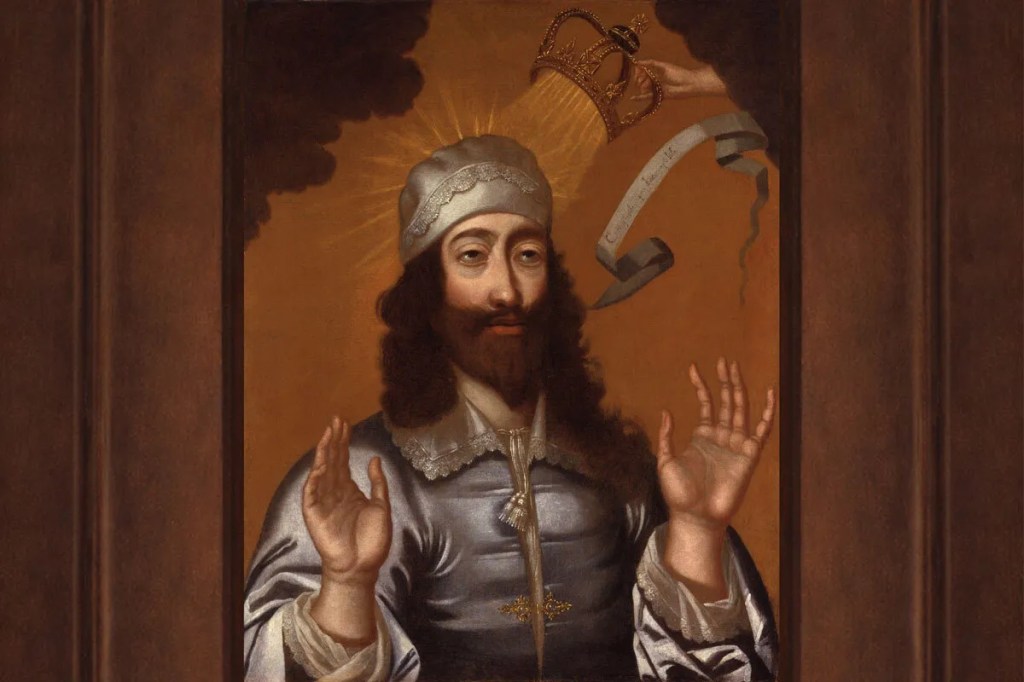
King Charles I, passion-bearer
living in silence
The whole monastic state consists of three specific kinds of establishment: either the retirement and solitude of a spiritual athlete, or living in silence with one or two others, or settling patiently in a community. Turn not to the right hand nor to the left, but follow the King’s highway. Of the three ways of life stated above, the second is suitable for many people, for it is said: ‘Woe unto him who is
alone when he falleth’ into despondency or lethargy or laziness or despair, ‘and hath not another among men to lift him up’. ‘For where two or three are gathered in My name, there am I in the midst of them,’ said the Lord.Ladder of Divine Ascent, 1:26
not in essence but in intensity
Monasticism is the most authentic form of Christian discipleship. As Basil sees it, if we would let the Lord’s grace have its way with us, if we would follow our baptism to its end and keep all the commandments, we would end up in the monastic life. Indeed, Basil’s word (eisagomenoi) for candidates seeking to enter the monastic community is also the word for catechumens, indicating a “link between the ascetic life and baptism.” Basil’s “monks”—as they would later be called and as we call them—“were simply,” Robert Taft writes, “Christians taking the whole business seriously.” The monastic life, then, differs from the life of ordinary discipleship not in essence but in intensity. But what does this most intense Christian life look like in Basil’s thought and practice?
One of the most fascinating features of the fourth-century church is that we get to observe monasticism in its various stages of development, from devoted and pious family to highly organized monastery, from informal household virginity to ritually consecrated virginity.
Stephen Hildebrand, Basil of Caesarea, 125
in no particular order
List the people you admire and look to for advice…
So I am hoping not to repeat myself. Yes, Jesus. But also (in no particular order):
- My oldest son
- My mother
- My last vicar and her husband (sorry that is two people but they make a team)
- Kierkegaard
- Nietzsche
further …
… to yesterday’s post, what if, here is a section from Kierkegaard:
But as in Christendom everything has been brought to confusion, so also this; and thereby the point has been reached where Christianity has become paganism. In Christendom they preach perpetually about what happened then after Christ’s death, how He triumphed, and how His disciples made a triumphal conquest of the whole world-in short, one hears only sermons which might properly end with Hurrah I rather than with Amen. No, Christ’s life here upon earth is the paradigm; it is in likeness to it that I along with every Christian must strive to construct my life; and this is the essential object of the sermon, this is the end it should serve, to keep me alert when I would become slack, and to strengthen me when I would become disheartened. In such a sense He is the paradigm in the situation of contemporaneousness; in that situation there was no stuff and nonsense about what happened afterwards. But Christendom has abolished Christianity – on the other hand, it would like to inherit Him and His great name, to gain advantage from the immense consequences of his life, coming pretty close to appropriating these consequences as its own meritorious achievement and making us believe that Christendom is Christ. Every generation has to begin all over again with Christ and thus to present His life as the paradigm; but instead of this, Christendom has taken the liberty of interpreting the whole relationship simply historically, beginning by letting Him be dead-and then it triumphs! Since that time Christendom has been increasing in numbers year by year-and what wonder; for people are only too eager to take part when there is nothing whatever to do but to triumph and to join the parade. And therefore to be a Christian in Christendom is as different from being a Christian in the situation of contemporaneousness as paganism is from Christianity.
Training in Christianity, 109
… hmm
Do you vote in political elections?
In Australia, where I happen to live, everyone over 18 must vote. Either you vote (and, yes, they check your name off from a list) or you get a fine.
So I vote without any passion for the political system.
 a fool and his prayer book