objectivity?

Thus Christianity protests against all objectivity; it wants the subject to be infinitely concerned with itself.

Kierkegaard: Concluding Unscientific Postscript (Cambridge Texts in the History of Philosophy).

So I have tried to read a little Kierkegaard every day. I admit that Fear and Trembling always gets me thinking (and desiring).

Yet I have also been reading Concluding Unscientific Postscript. And the above quote has struck me as something very relevant. In a world that elevates objectivity (and denigrates passion), what is the role of Christianity? Kierkegaard would say that it is this very paradoxical role that defines Christianity. Some within Christendom have adopted the objective approach and have created a dispassionate version of Christianity where reason is elevated over faith. In the process, humanity is reduced to being a “reasonable animal” and “me” is reduced to the sum of my parts.

I do not think we need to surrender objective truth. I am simply thinking that we cannot ignore the subject individual who related to the objective truth. But, I am no philosopher!

risking it all

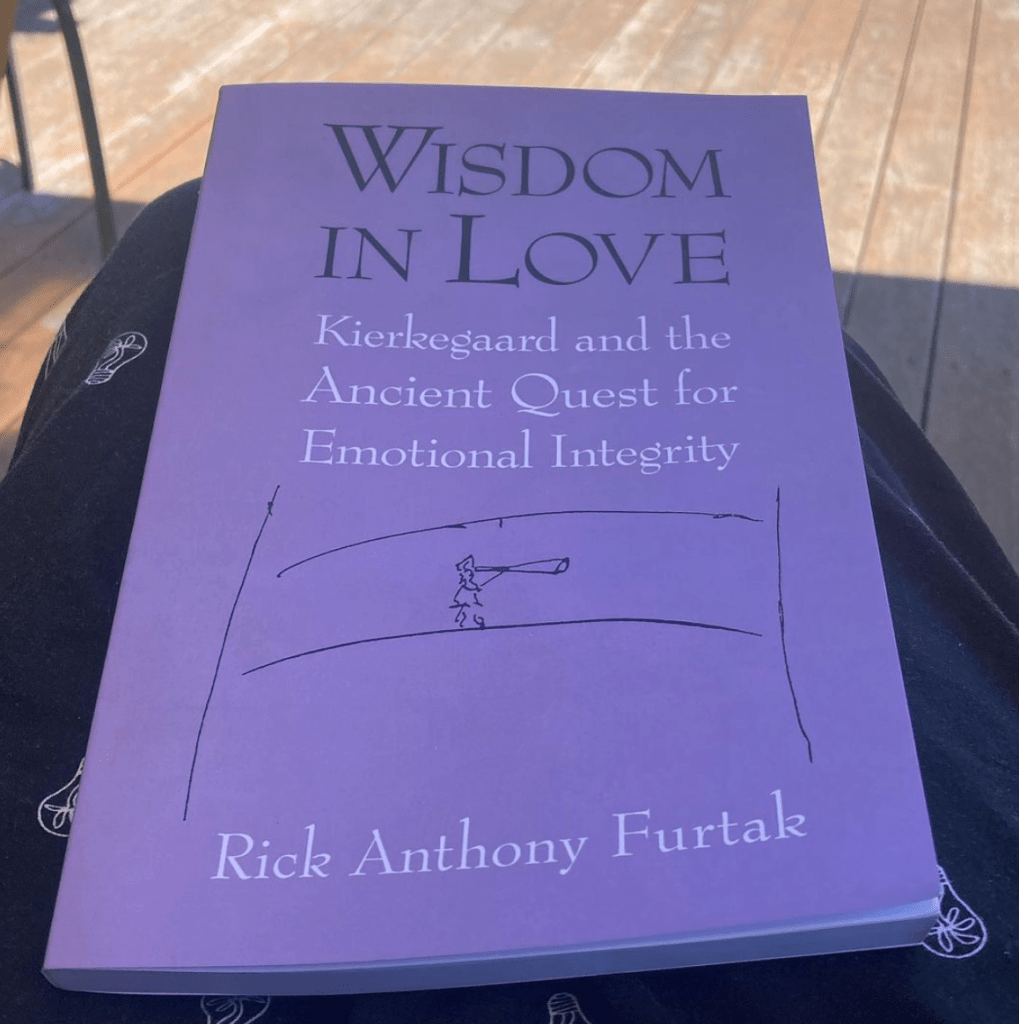
I have been reading Wisdom in Love: Kierkegaard and the Ancient Quest for Emotional Integrity by Rick Anthony Furtak. It has been on my list for a while and it was on special so I thought I might as well. I have been thinking about emotions a lot and this book really hits the spot on that topic.

So here is a quote from the Introduction:

One uncomfortable truth which emerges from this inquiry is that we cannot sustain the emotions that hold us together without accepting the risk of suffering the emotions that tear us apart.

All life involves risk! Maybe that is the fundamental problem with people today?! (Sorry, that is really judgemental and generalised.) Maybe that is the fundamental problem with me!? Life always involves risk because it always involves faith.

I did a quick google (as you do!) and found this article: Kierkegaard on the Psychology of a Risk Averse Society. It is worth a read.

So my point? I think we have become a society that likes to watch because we like to play it safe. It is much more fun watching someone else do the risky thing. More fun watching the “love story” or the “adventure movie” than loving or acting ourselves. But can we really grow (spiritually or emotionally) if we never risk? With the risk of being wrong can we ever really be right? Without the risk of hate can there ever really be love?

religious life?

I have been returning to an older theme: religious life. And I have been thinking about two quotes in particular that, I think, say the same thing.

Life in Religion is the ultimate wager on the existence of God. The Church should always be engaged in doing things that make no sense if God does not exist. This is the reason why I hold the Religious life in the highest esteem … the monastic life models for all Christians what it means to live fully and abundantly, with and for Christ.

The Most Rev’d Justin Welby, Archbishop of Canterbury
Foreword to: Anglican Religious Life 2016-17

Of this there is no doubt, our age and Protestantism in general may need the monastery again, or wish it were there. The “monastery” is an essential dialectical element in Christianity. We therefore need it out there like a navigation buoy at sea in order to see where we are, even though I myself would not enter it. But if there really is true Christianity in every generation, there must also be individuals who have this need.

Kierkegaard, Nov 1847

I am always amazed that Kierkegaard, living in 1800s Lutheran Denmark, writes at length about “the monastery” in his journals. What experience would he have had of religious life? What books would he have read? And, in some ways, his very life is an example of what he said above – even if he does not want to enter a monastery.

To put it another way: people need to take the “single individual” to the extreme to show other people what it means to be the “single individual” – “dare to desire Jesus alone”. I am seeing that reality more and more. Like yeast in the dough, individuals need to place all their eggs in the one basket (sorry!) and say, “what if all of this stuff about God is true?”. And much more: let’s take Jesus seriously and actually follow Him alone, pick up our cross and live a life of love.

I think both of these quotes call us to “new monasticism” (to introduce yet another person’s quote). Not looking to the past alone but using the past to live today for Jesus alone. Yes, the church as a community and especially individuals within the Church need to do things that make no sense if God does not exist. Individuals need to take Jesus seriously.

relationship and affections

I think this is the principal reason why the invisible God willed to be seen in the flesh and to converse with people as a person. He wanted to recapture the affections of carnal humanity who were unable to love in any other way, by first drawing them to the salutary love of his own humanity, and then gradually to raise them to a spiritual love.

St Bernard of Clairvaux

In Michael Casey’s book on Lectio Divina, Sacred Reading, he makes the point that relationships and bonds between persons are emotional in nature. I have never really thought about that but I suspect it is very true. (Yes, very true!) In a modern context, maybe we are tempted to intellectualize relationships into common aims and common beliefs. But what bonds me to you is my feelings for you.

The above from St Bernard reminds me of Kierkegaard’s story of the king who falls in love with his servant. Love should be freely given and not forced. The Incarnation is an invitation to love on “my level”. Jesus does not force love but offers it.

SK and Oz

While this article, Kierkegaard and Australia’s sense of historical despair, is a little on the old side, it is an interesting read. Maybe one observation:

Kierkegaard’s idea of what it means to be an Australian would surely have matched his idea of what it meant to be a Christian—an idea that was far removed from what he saw around him, especially within the institution of the Danish State church.

Being a Christian is about a relationship with God in Jesus. That is hardly comparable to being an Australian? I think this illustrates one of the points about Kierkegaard that frustrates me most: he is above all a Christian, writing about being a Christian, alone before God. Some of his more philosophical work prepares the way for his Christian work which prepares the way for his “upbuilding work”.

Anyway, read the above.

knowing

The only way of coming to know and understand the divine, therefore, is by the god annulling the absolute difference in absolute equality in the absolute paradox of the incarnation.

Sylvia Walsh. Kierkegaard: Thinking Christianly in an Existential Mode (Christian Theology in Context)

I want to collect quotes that help me work towards a definition of a disciple and the discipleship pathway. I am deeply indebted to Kierkegaard for my major understandings in this area so I am looking for quotes from him. I guess I should start with Scripture, the New Testament, and Jesus.

So the above shows how God takes the first step in the Jesus-event, especially the incarnation. And there is an absolute difference between God and me that can only be bridged in Jesus.

More to think about!

sin – part 2

No, the test in which this woman is tried is: to love her Saviour more than her sin.

Kierkegaard, Søren. Discourses at the Communion on Fridays, 114

I like SK’s Communion Discourses. They are good spiritual reading. He mixes his various geners into these “talks”.

I have been thinking about the above quote from a discourse on Luke 7:47, “Therefore, I tell you, her sins, which were many, have been forgiven; hence she has shown great love. But the one to whom little is forgiven, loves little”. I will leave the quote for you to meditate on.

sin?

… when [the Advocate] comes, he will prove the world wrong about sin and righteousness and judgment: about sin, because they do not believe in me; about righteousness, because I am going to the Father and you will see me no longer; about judgment, because the ruler of this world has been condemned.

John 16:8-11

The Holy Spirit will “prove the world wrong about sin, because they do not believe in me”. Kierkegaard would point out that sin here is the opposite of faith. I would dare to say that sin and faith are two sides of one coin we call “relationship”. One side is a relationship with Jesus we call faith, the other is a broken relationship with Jesus we call sin. Both express themselves in action but that is only a symptom: the relationship is the real issue. So sin is more about being outside of Jesus than having something missing within.

In the mission of the church, in the proclamation of Jesus, the way the individual sees “sin” is central – only thing more important is what the individual says about Jesus. I think we sometimes fall into an idea of sin that is too much like a law-court and too focused on actions. The reality is that the actions follow the relationship and everything done apart from Jesus is sin – even a great good.

I have to acknowledge that I live with both in my life. I try to have a relationship with Jesus but often my brokenness and distance from Jesus shows itself in my actions. And when I am honest about that tension in my life I am always driven back to Jesus as my Saviour.