enclosed garden

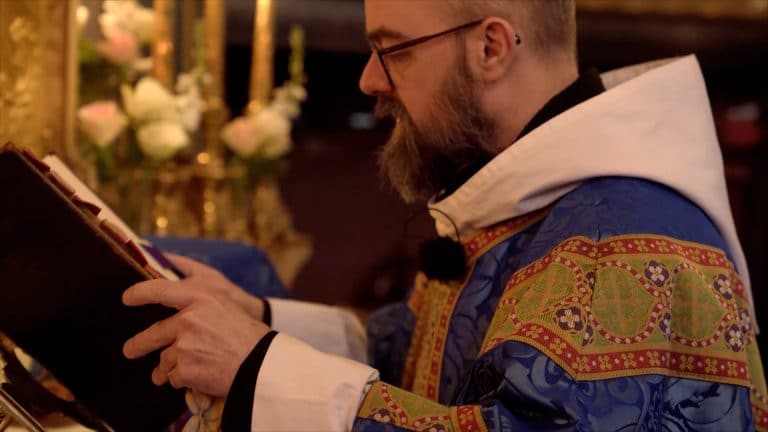
Similar to contemplative monasteries, the Office is kept in Warfhuizen. In Western Christianity, that is often prayed in accordance with the precepts of Saint Benedict, but in 2009, the hermit switched to the Office of Saint John Cassian from the 5th century. John of Cassian based his schedule on the customs of the hermits in the Egyptian desert, the so-called Desert Fathers, making it very suitable for hermits.

Instead of the eight (usually short) Benedictine offices, Cassian prescribes two (longer) vigils, one at the start and one at the end of the night. In Warfhuizen, these vigils are sung softly in Latin. The other hours do not have an office with Psalms, but are prayed in silence using the Jesus Prayer.

As such, the Office currently used in Warfhuizen clearly deviates from that of the ancient Dutch hermits, who usually used an abbreviated Liturgy of the Hours of Benedict. The influence of the Limburgian tradition on the atmosphere in the hermitage remains clearly noticeable through the various additions from popular devotions, such as praying the Rosary and various litanies, which are sung out loud at various moments during the day. The chapel’s decorations are also a continuation of 17th century examples, through Baroque elements. The devotion to Saint Gerlach of Houthem, of whom there is a reliquary in the retable of the right side altar, has a special place in the hermitage. Saint Anthony Abbot is also especially honoured, with a relic of his kept in the Holy Cross altar.

In addition to the old southern tradition, there are also other influences on the liturgy. The fact that some volunteers are Russian Orthodox has led to the Jesus Prayer being sung in Greek after Compline. The Carthusian tradition is also noticeable in the manner of Gregorian chant.

Our Lady of the Enclosed Garden

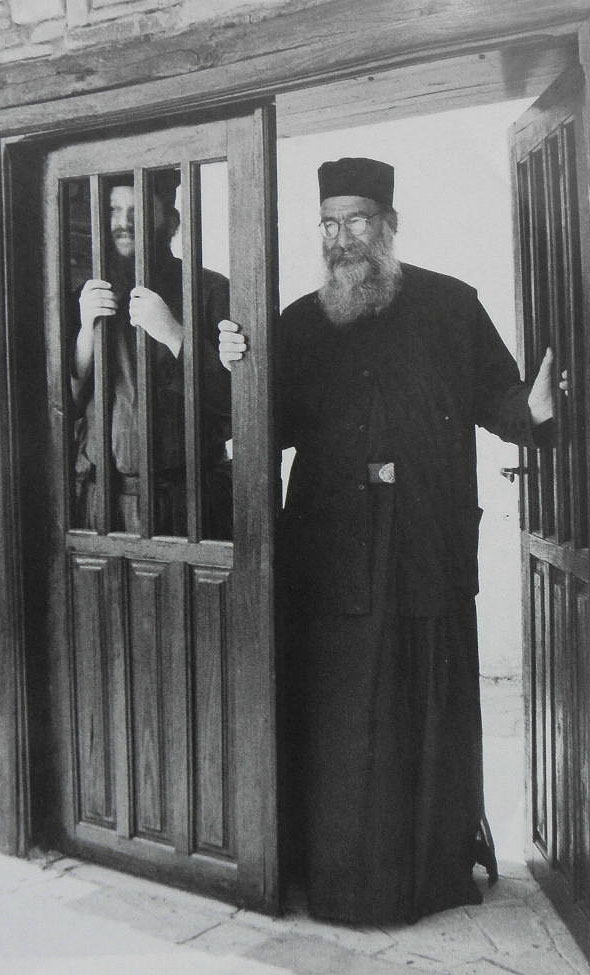
Russian spirituality has had an enormous influence on my spiritual life for years, if only because of the Startsi. The Startsi – singular starets – are monks who act as the spiritual father of an entire region, including the monastery where they live. They represent, as it were, the father of the prodigal son,* the spiritual home where you are always welcome and where warmth, safety, and good advice are in abundance.

The sleeping fathers of Kiev (Google translate)

ebook reader!?

What is the best purchase you have ever made?

Maybe some physical books? Or an icon?

Yet the best purchase is my ebook reader. Yes I am tied to some universal overlord! But instant access to a book is priceless. I can carry a whole library in my pocket. And I can search that library. In fact, when my reader broke (or, I thought it was broken) I had to get another. Now I have two!

And, tbh, I would give my right arm for a colour version!

spirituality not religion?

Eremitical life is an expression of spirituality, not religion. When a culture is in a period of profound flux, we spontaneously reach for whatever provides us with a sense of stability. If the religious practices to which we have been accustomed fail to meet our needs, we begin to dig more deeply, bypassing inadequate expressions, usually incarnated in communal formulations, to find our individual roots in the Spirit. Since the end of World War II, there has been a gradual revival of hermit life in Western Christianity. This surprising development is too young yet to be thoroughly analyzed or its fruits fully appraised. At this point, all we have is anecdotal information; experiences related by those who are living this lifestyle in a culture that does not understand it.

Consider the Ravens: On Contemporary Hermit Life

seek counsel

from Fr. Martin Thornton’s Top Ten on Direction:

1. One has absolute freedom of choice when choosing director.

Remember that Directors do not have to be clergy. There is no compulsion whatsoever when choosing a director. Though a local would make Direction easier, one does not need to choose their own priest or someone nearby.

With the internet, so very true. But where does one find such a person?

2. Give priority, when choosing, to competence.

While this might be hard to find out quickly, Thornton’s point is that your choice of Director should be not be influenced by convenience (place/age/etc.) but by the Director’s skill. Directors should be under direction themselves and should have experience before giving Direction to others.

So someone who themselves has lived the life?! Again, where to find?

4. Make the move yourself.

Like so many things in life, one must make the first move to contact and ask for Direction. The Director should never ask to direct (a sure sign of an incompetent Director).

Ok, I got the message!

idiorrhythmic monasticism

idiorrhythmic monasticism, the original form of monastic life in Christianity, as exemplified by St. Anthony of Egypt (c. 250–355). It consisted of a total withdrawal from society, normally in the desert, and the constant practice of mental prayer. The contemplative and mystical trend of eremitic monasticism is also known as Hesychasm. In the Christian East, the “idiorrhythmic” system (from Greek idios, “particular”; rhythmos, “rule,” or “discipline”) always coexisted with cenobitic monasticism. It is still practiced on modern Mount Athos, Greece. See also cenobitic monasticism.

Britannica

bcp ascetics?

So, here is my reworking of John Cosins’ Precepts:

  • To use a liturgical calender
  • To fast
  • To use an approved BCP (ie: no extras!)
  • To say Morning and Evening Prayer
  • To receive Holy Communion (at least once a year)
  • To seek the advice (counsel) of a spiritual elder

Or: Renunication, Prayer, and Accountability

1 estate in 3 forms

So hear me out: what if the dissolution of the monasteries (under Henry VIII) was not so bad after all? But the real tragedy was the jumping into the same model with rules and canons at the restoration of religious life? What if rather than useful sisterhoods (which only happened because priests needed help) an eastern model was used?

All monks and nuns share the same ascetic call and belong to a single, all-embracing ‘order’ or ‘estate’; yet within that one ‘estate’ there is a wide variety of patterns and a constant flexibility.

So there is one estate – the monastic – which the individual, male or female, enters through tonsure. More freedom! And then the individual has a choice:

The wide variety of patterns is reduced by St John Climacus (d. circa 649) to three main types: “The monastic way of life takes three general forms: to live in ascetic withdrawal and solitude; to be a hesychast with one or two companions; to dwell with patient endurance in a coenobium.” These three forms—the coenobitic, the eremitic, and the middle or semi-eremitic way of the hesychast who dwells with one or two others—are found at the very outset of Christian monasticism in fourth-century Egypt.

Ware, Metropolitan Kallistos; Walls in Solitude and Communion: Papers on the Hermit Life (Fairacres Publications), 48.

So one estate in three forms. With movement between the forms. Some years active, some years solitary, and some years in the middle. Yet there is one more point that is vital and has been complete (methinks) missed in Anglican “religious life”:

… from the start primary importance was attached to the need for personal spiritual direction under an ‘abba’ or ‘elder’—what the Greek sources call a gerôn and what the Russians were later to term a starets. The variety and flexibility of Eastern monasticism must inevitably seem ill-disciplined and untidy to the Western mind, unless it is remembered that underlying this variety there is the direct personal relationship between the spiritual father or mother and his or her child. This relationship, while it ensures inner order within seeming confusion, is not something that can be contained within institutional forms or controlled by rules.

ibid, 51

So one estate in three forms under the guidance of an “elder”. No need to institutionalise. No need for bishops to be involved and worry about vows. The model, methinks, is that of living one’s baptismal life rather than celibate marriage (to Jesus or the Church).

I suspect this was present in the life of anchorites in England before the Reformation:

The ambivalence in this relationship [between monastic rules and ‘rules’ for solitaries] reflects an underlying tension between monastic and anchoritic ideals. The monastic life is based on obedience, the anchoritic life on independence; one requires the renunciation of the will, the other the exercise of free choice.

Innes-Parker, Catherine; Yoshikawa, Naoë Kukita. Anchoritism in the Middle Ages: Texts and Traditions (Religion and Culture in the Middle Ages), 34.

So missed opportunity?

tiktok

What app eats up most of your screen time — and do you even feel bad about it?

Time for honesty: TikTok. (Go and follow me: afoolandhisprayerbook.)

Do I feel bad? Maybe!? There is lots of rubbish on the app. But I have curated my feed over time and now have lots of interesting people and topics. I try to be encouraging with comments. And even post occasionally.

And my time is my time – something that interests me is never bad.