elders

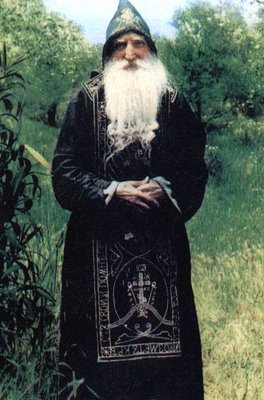
A starets … is an elder of an Eastern Orthodox or Eastern Catholic monastery or convent who functions as venerated adviser and teacher. Elders or spiritual fathers are charismatic spiritual leaders whose wisdom stems from God as obtained from ascetic experience. … Elders are not appointed by any authority; they are simply recognized by the faithful as being people “of the Spirit”. An elder, when not in prayer or in voluntary seclusion, receives visitors (some who travel very far) and spends time conversing with them, offering a blessing (if the elder is an ordained cleric) and confession, and praying. People often petition the elder for intercessionary prayers, believing that the prayer of an elder is particularly effective.

Starets

To this there is a simple answer. The spiritual father or starets is essentially a ‘charismatic’ and prophetic figure, accredited for his task by the direct action of the Holy Spirit. He is ordained, not by the hand of man, but by the hand of God. He is an expression of the Church as “event” or “happening”, rather than of the Church as institution.

The Spiritual Father in Orthodox Christianity

institutions

But Christendom has abolished Christ; yet, on the other hand, it wants—to inherit him, his great name, to make use of the enormous consequences of his life. Indeed, Christendom is not far from wanting to appropriate them as its own merits and to delude us into thinking that Christendom is Christ.

Soren Kierkegaard

No institution can substitute for a living relationship with Jesus – as much as they may try, Sometimes you just have to stand alone before God!!!

Even so, come Lord Jesus.

sacrifice

I beseech you therefore, brethren, by the mercies of God, that ye present your bodies a living sacrifice, holy, acceptable unto God, which is your reasonable service. And be not conformed to this world: but be ye transformed by the renewing of your mind, that ye may prove what is that good, and acceptable, and perfect, will of God.

Romans 12:1-2 (KJV)

The above is from Second Evensong for Candlemas. It reminded me of one of the post-communion prayers In the Second Order in APBA:

Father,
we offer ourselves to you
as a living sacrifice
through Jesus Christ our Lord.
Send us out in the power of your Spirit
to live and work to your praise and glory.

What does “sacrifice” mean in these two texts? Not death. Perhaps we could define it as the surrender of a good (body in Romans) for a greater good (life in Jesus).

BTW: Augustine makes the opposite his definition of sin:

On account of all these, and such as these, is sin committed; while through an inordinate preference for these goods of a lower kind, the better and higher are neglected — even You, our Lord God, Your truth, and Your law.

Confessions 2:5:10

So, the choice between higher and lower goods is the root of sin and sacrifice.

Anyway …

what is “all”?

I have been sick – not much sleep for the last two days. I am not sure how well my medication is working – I guess I will know when I get withdrawals. Anyway, I dreamt last night that I was walking into a church – a nondescript building which I somehow knew was a church. King of strange as I have not been to church for six weeks. There was no person in the church but a hymn was playing:

All to Jesus I surrender,
All to him I freely give;
I will ever love and trust him,
In his presence daily live.

Chorus:
I surrender all,I surrender all,
All to thee, my blessed Savior,
I surrender all.

All to Jesus I surrender;
Make me, Savior, wholly thine;
Let me feel the Holy Spirit,
Truly know that thou art mine.

All to Jesus I surrender,
Lord, I give myself to thee,
Fill me with thy love and power,
Let thy blessing fall on me.

Sometimes I remember my dreams. (I cannot know if I ever forget a dream!) The first thing that came to mind this morning was: What does “all” mean in this hymn? “All to Jesus I surrender – Lord, I give myself to thee”.

Maybe let me put it another way!? Does “all” include:

  • the institution of the church? or any institution?
  • the desire for certainty in this world? To find absolutes in either the community or the book?
  • morality?
  • duty?
  • family?
  • other people?

Anyway …

silent rebellion

AM Allchin’s The Silent Rebellion is a book on religious life in the Church of England. I do not have a copy but I am looking for one.

It is often pointed out that the title, The Silent Rebellion, highlights the need for solitude for religious life. Yet, why “rebellion”? In what sense is it “a violent uprising“?

While I do not have an answer, this quote may help:

Their name itself, anchorite, means rule-breaker, the one who does not fulfil his public duties.

And maybe this one by Kierkegaard:

…Of this there is no doubt, our age and Protestantism in general may need the monastery again, or wish it were there. The “monastery” is an essential dialectical element in Christianity. We therefore need it out there like a navigation buoy at sea in order to see where we are, even though I myself would not enter it. But if there really is true Christianity in every generation there must also be individuals who have this need

And from Fear and Trembling:

Faith is exactly this paradox, that the single individual is higher than the universal, but in such a way, mind you, that the movement is repeated, so that after having been in the universal he now as the particular keeps to himself as higher than the universal.

The tragic hero resigns himself in order to express the universal; the knight of faith resigns the universal in order to become the single individual.

The knight of faith, the rebel, stands with Jesus alone even against institutions. There is nothing higher than the individual’s relationship with Jesus – not even religion!

Anyway …

being certain

… skepticism is but the result of our anxious desire to secure certainty by being “at home in the world.”

Harvey, Michael G.. Skepticism, Relativism, and Religious Knowledge

I struggle with what “tomorrow will bring.” I try to control things without much success. So, the above quote hits home (sorry!). Perhaps it is part of the anchorite tradition – the enclosed solitary life – to surrender any hope of certainty? I am thinking especially with other people. Do I have to make myself understood? Or is it that terrible if other people do not “get it”?

I am reading Slavoj Žižek. He is super funny. I think he is the perfect “modern” philosophy! Not for what he says but how he says it. Life is chaotic and unpredictable so why am I trying to be organised and predictable? Life is full of paradoxes and contradictions so maybe just take the leap and live?

All of that is super easy to say but living it is hard. Jesus by your holy wounds, have mercy on me.

Day 0 – questions

With God’s help, I plan to spend January alone. I am praying for a retreat at home.

Sometimes, writing down the question you bring to a retreat is a good idea. So: do I have a vocation to the solitary life? At the moment, I feel like I am using it as an excuse and escape from me. The end of the year was extremely difficult. And I have simply stepped back into old habits and thought patterns. So, to expand the question, do I have a vocation, or am I just running away from me?

I have become more aware of the differences between my view of Christianity and the community/parish. And that has really hurt. I would like to offer the hurt to Jesus as a form of mortification – hand it over to him. But, apart from the spiritual impact, there are impacts on my life-arrangement. In that context, do I have the resolution to start again?

And, to be honest, I feel like it is all me. I am again in a position where I feel I am the problem. In the end, there is no escaping me. Am I, as a person, suited to this life?

So, 31 days of January to work it all out!